
Last updated: October 2026
Modern vlogging lenses are almost too good. They resolve every pore, stray hair and hard edge on an LED panel, and footage comes out sharp in a way real faces never are. A diffusion filter is the small piece of glass that takes that edge off at capture: highlights bloom, contrast settles, skin renders kindly, and the look is in the file before editing begins. This guide explains what the glass is doing, how the Black Pro-Mist, Glimmerglass and CineBloom families differ, what their strength numbers really mean, and when to reach for one or leave it in the bag.
The short version
- Diffusion scatters a little light inside the glass. Highlights bloom into a soft halo, contrast drops a touch, fine detail and skin smooth over, and focus stays where the lens put it.
- The three famous families render differently. Black Pro-Mist keeps its glow near bright lights and holds deep blacks. Glimmerglass is the quiet one, softening fine detail with barely any haze. CineBloom spreads a dreamier glow frame wide.
- Start weaker than you think. A 1/8 grade, or Moment’s 10 percent, is a leave it on look. A 1/4 grade is where the glow turns plainly visible, especially at night.
- The effect is baked in. It cannot be removed in the edit, so test any filter under the lights you actually film with.
On this page
- What a diffusion filter actually does to the light
- Why vloggers put one on and leave it on
- The families in plain terms: Black Pro-Mist, Glimmerglass, CineBloom
- Strength grades, translated
- Picking your strength, scene by scene
- Onto the lens: threads, rings, magnets and matte boxes
- Diffusion versus ND: two filters, two different jobs
- When diffusion is the wrong tool
- Looking after diffusion glass
- Frequently asked questions
- Keep exploring
What a diffusion filter actually does to the light
A diffusion filter is optical glass with microscopic particles suspended inside it. Most light passes straight through, but a small share is scattered, landing as a soft halo around the bright parts of the scene. Focus and detail stay intact at normal viewing distance; what changes is the rendering, with gentler highlights, slightly lower contrast and fine texture smoothed over.
The glow has a name: halation. It is the halo around a practical lamp, a neon sign or a sunlit window when a diffusion filter is on the lens. The particles create it, and each family uses a different recipe: fine black particles in black mist designs, reflective specks that sparkle silver in Tiffen’s Glimmerglass, a fused fine black layer in Moment’s CineBloom glass. Same physics, three flavors of scatter.

Contrast changes for a simple reason: scattered light lands everywhere, including the shadows, lifting them and squeezing the gap between the brightest and darkest tones. How much depends on the recipe. Tiffen is explicit that Black Pro-Mist lowers contrast less than its original Pro-Mist and keeps blacks black, while the older white style lifts shadows further and reads milkier. Black particle designs hold shadow depth; white particle designs trade some of it for a hazier wash.
Skin is where most vloggers notice it first. Pores, small blemishes and makeup edges are fine, high-frequency detail, and fine detail is exactly what scattered light smooths. Larger shapes, the outline of a face and the shape of the eyes, are barely touched at mild strengths, so a lightly diffused talking head still looks sharp while reading kinder. This is not old-fashioned soft focus. Focus itself does not shift; what softens is micro contrast, the crispness between neighboring tones.
Why vloggers put one on and leave it on
Because a vlogger’s two hardest subjects are their own face at close range and the practical lights of a small room. Diffusion flatters both at once: skin reads smoother with no retouching step, and lamps, LED panels and window highlights stop clipping into hard white blobs.
A talking head filmed at arm’s length with a wide aperture shows everything the sensor can resolve, and modern mirrorless cameras resolve a lot. On a still photograph you might retouch; across hours of vlog footage a week, nobody does. A gentle grade does that softening optically, on every frame, with no per-frame work, and gives a channel a consistent look viewers start to recognize as yours.
The filter is not a substitute for decent light. A small, hard source will still carve hard shadows across a face whatever glass sits on the lens; light softness is set by the size and distance of the source, which our guide to how to light your face for videos covers in full. Think of two separate dials: lighting decides where shadows fall, diffusion decides how gently tones roll into each other once they do.
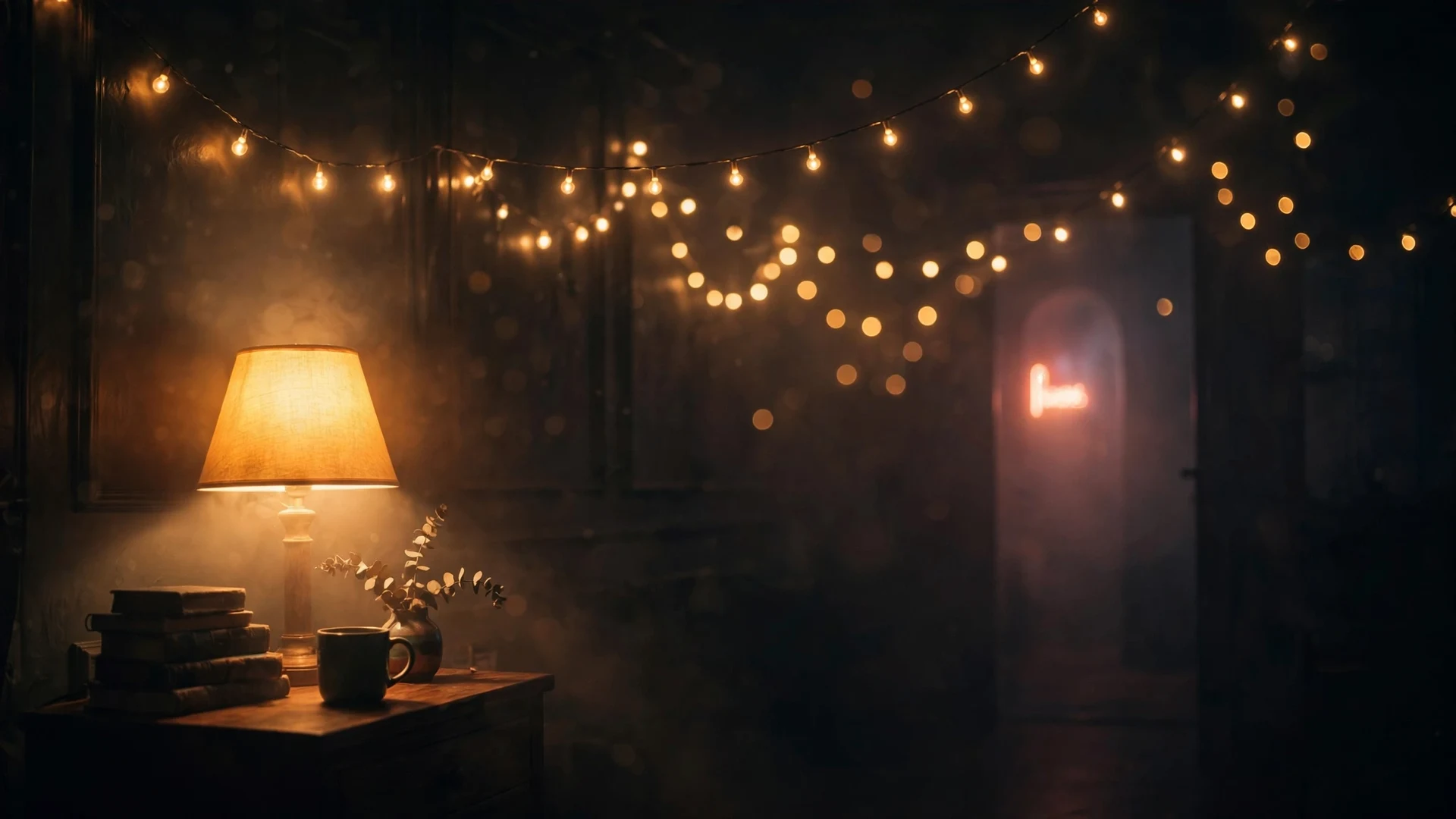
Night shooting is where the case gets strongest. Practical lights fill most home studios and hotel room vlogs, and bare bulbs, candles, fairy lights and screens all bloom through diffusion. A mild grade at night delivers the glow viewers call cinematic, though the camera and settings did nothing unusual.
The families in plain terms: Black Pro-Mist, Glimmerglass, CineBloom
Three names cover most of what vloggers buy. Tiffen’s Black Pro-Mist is the cinema standard, built on black particles that bloom highlights while keeping blacks deep. Tiffen’s Glimmerglass uses reflective silver specks for a subtler softening of fine detail with a mild glow. Moment’s CineBloom fuses a fine black particle layer into its glass and sells the effect in two percent strengths.
Black Pro-Mist (Tiffen). Tiffen describes the look as halation with a gauzy quality, highlights reduced and contrast lowered, with the black layering holding shadow depth better than the original Pro-Mist. After more than 30 years across film and television, it remains the default answer when a cinematographer says diffusion. For vloggers the useful grades are 1/8, 1/4, 1/2, 1 and 2, running from subtle to unmistakable.
Glimmerglass (Tiffen). Tiffen says Glimmerglass softens fine details in a unique manner while adding a mild glow to highlights, and that the glass has a distinct silver sparkle viewed from the front, which Tiffen says instills confidence in the model. In observable terms it is the gentlest of the three at everyday grades: skin texture smooths, highlights pick up a restrained halo, and the frame keeps most of its contrast. Its grades run from 1/8 up to 5, a wider ladder than Black Pro-Mist.
CineBloom (Moment). Moment builds CineBloom from Japanese glass with a fused layer of fine black particulates, in 10 and 20 percent strengths for camera lenses from 37mm to 82mm, and itself likens the 10 percent to a traditional half strength and the 20 percent to a full strength. That half and full wording is Moment’s own comparison, not a position on Tiffen’s fraction ladder. Its glow spreads more evenly across the frame than Black Pro-Mist, which hugs its halation closer to the light source, so CineBloom reads dreamier at night and a little heavier in flat daylight.
The wider shelf. Plenty of other makers sell black mist glass on the same principle, and brand differences at the same grade are smaller than the difference between grades. PolarPro’s ShortStache Everyday fuses a 1/4 black mist with a polarizer, and PolarPro’s own notes draw the same line: black particles retain depth in the shadows, while its plain white Mist leans on white halation and lifts shadows more. Decide the family character first and the strength second.
Strength grades, translated
Think in three bands: barely there, clearly visible, and a look in itself. Tiffen’s fractions run from 1/8 through 1/4 and 1/2 to 1 and 2. Glimmerglass stretches the same idea from 1/8 up to 5. Moment skips fractions for percents, where 10 percent is the gentler grade and 20 percent is its strongest everyday grade.
There is no shared standard behind these numbers. Each maker grades its own glass, so Glimmerglass at 1/4 is visibly milder than Black Pro-Mist at 1/4 despite the matching fraction. Treat the numbers as positions on each family’s own ladder.
| Family | Barely there | Clearly visible | A look in itself |
|---|---|---|---|
| Black Pro-Mist (Tiffen) | 1/8 | 1/4 to 1/2 | 1 and 2 |
| Glimmerglass (Tiffen) | 1/8 to 1/4 | 1/2 to 1 | 2 to 5 |
| CineBloom (Moment) | 10% on a bright day | 10% at night, 20% indoors | 20% at night |
The scene moves the grade as much as the number does. Halation feeds on contrast: a candle against a dark room blooms hard through a 1/8, while the same filter in flat, even daylight can be nearly invisible. Read every grade as roughly one step stronger at night, and expect a bright window behind a talking head to wear a halo at any useful grade.
Picking your strength, scene by scene
For a desk-based talking head channel, start at the gentle end: Black Pro-Mist 1/8, Glimmerglass 1/4 or CineBloom 10 percent. At night those grades read a full step stronger, so the lightest is often plenty. Reach for 1/2 and above only when the glow is the point of the video.
Desk talking head. Your face fills the frame and the background is controlled, so the filter’s job is skin and the practical lamp behind you. The gentle band is right; anything stronger fogs the whole room and softens the set behind you.
Walk and talk in daylight. Outdoors in even light, diffusion mostly takes the digital edge off skin and tames harsh sun highlights. A gentle to middle grade works; the effect will look weaker than in your indoor test, which is normal.
Night city vlogs. Street lights, signs and headlights all bloom at once. This is the scene where beginners overdo it: a middle grade that looked tasteful at the desk turns a night market into soup. Start at 1/8 or 10 percent and step up only if the footage still looks too clean.
Interviews and beauty close ups. The classic use case, and the one the higher middle grades were made for. A 1/4 Black Pro-Mist or a 1/2 Glimmerglass smooths skin convincingly while eyes stay crisp, and forgives the shiny foreheads video lights produce.
Whatever the scene, test before committing a real shoot to a new filter. Film thirty seconds of your actual setup, at your real aperture and lighting, with and without the glass, and compare on the biggest screen you own. Check skin at normal size, one bright light in frame, and something detailed in the background. Test at the settings you will actually use; our vlogging camera settings guide explains the aperture and shutter choices that interact with it.
Onto the lens: threads, rings, magnets and matte boxes
Most vloggers screw the filter straight onto the lens thread. Buy the size that fits your largest lens and step the smaller lenses up to it with step-up rings. Magnetic systems from Tiffen and PolarPro swap threading for a snap-on adapter, and matte box trays hold the large rectangular cinema sizes.
Screw-in filters are sized by the lens’s front thread, printed on the barrel or inside the cap. Round sizes from 49mm to 82mm cover nearly every vlogging lens, and CineBloom runs from 37mm to 82mm for smaller glass. The money saving rule: buy one filter in your largest thread size plus a set of step-up rings, and it serves every smaller lens you own. A stepped up filter can stop some hoods seating properly, so check yours.
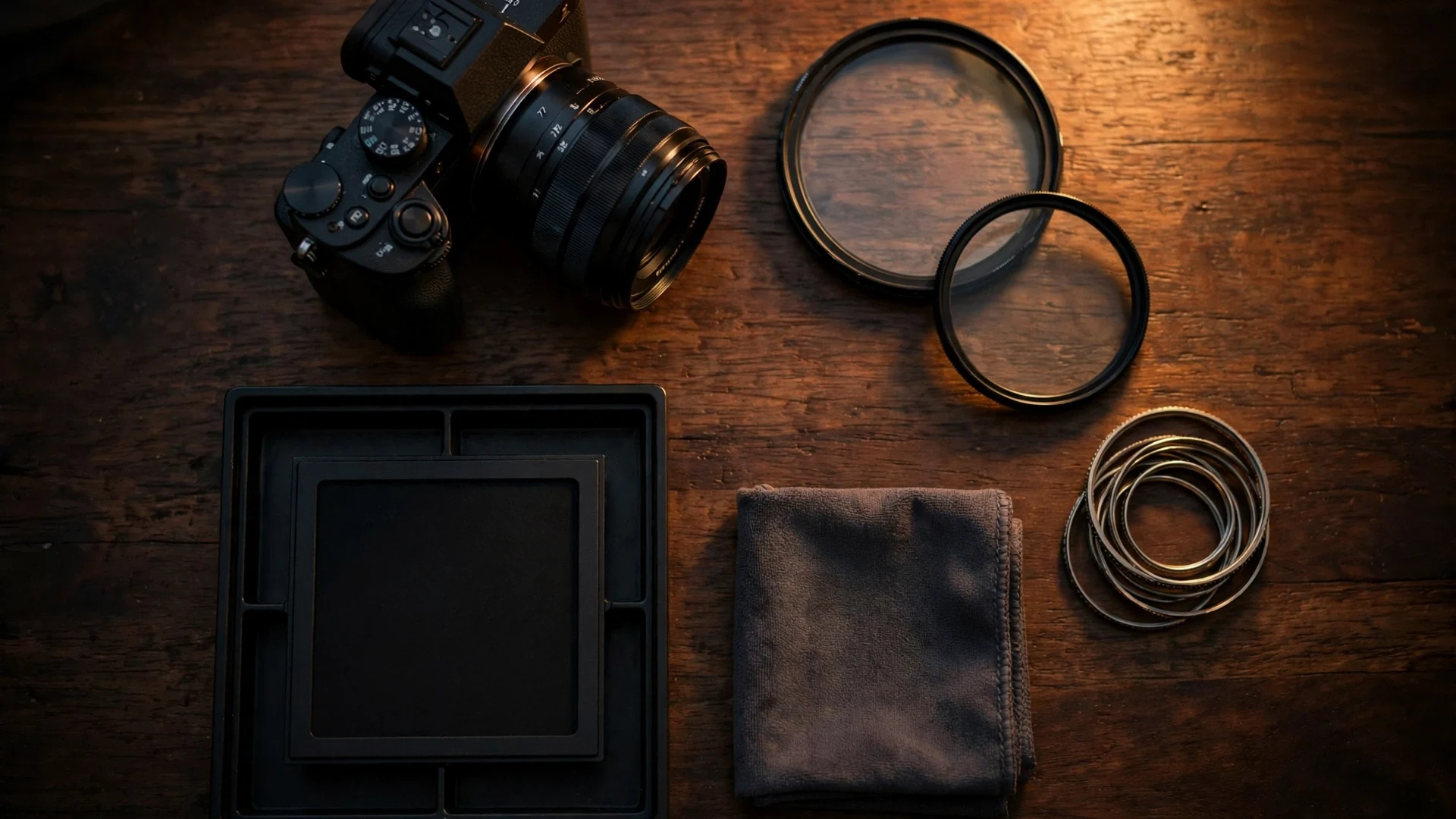
Magnetic systems exist for speed. Tiffen’s Magnetic Control System threads an adapter onto the lens once, then filters snap on and off magnetically, with Black Pro-Mist and Glimmerglass offered in 77mm and 82mm at grades from 1/8 to 1. PolarPro’s Helix MagLock works the same way: a threaded base plate per lens, filters that attach magnetically with a quarter turn to lock. For swapping diffusion on and off mid shoot, the snap beats the thread.
Matte boxes are the third route: rectangular 4×5.65 inch glass sliding into a tray in front of the lens. That is the cinema standard size and the only home of some cinema only grades, but for a solo vlogger it is usually more rig than the job needs. Fixed lens cameras are the awkward case, since many have no thread at all; adapter rings sold for the popular models restore it. If you are still choosing the lens itself, start with our guide to the best lens for vlogging, because the lens shapes your footage far more than any filter in front of it.
One caution for every system: stacks get thick. A diffusion filter over an ND on a wide vlogging lens can darken the corners of the frame, so test your widest lens with the full stack first.
Diffusion versus ND: two filters, two different jobs
An ND filter darkens the whole image evenly, so you can hold a wide aperture and a natural shutter speed in bright light. A diffusion filter barely darkens anything; it reshapes how highlights bloom and contrast renders. One controls exposure, the other controls character, and confusing them leads to buying the wrong glass.
Neutral density is about the quantity of light; diffusion is about its behavior. An ND lets you film at f/1.8 under midday sun without the shutter speed climbing into choppy territory; a diffusion filter at that moment would leave the exposure problem untouched while adding glow the scene may not want. Our ND filters for video guide covers that side of the shelf in full, including variable ND behavior and the shutter rules behind it.
The two also combine happily. Stack diffusion over the ND, or buy the jobs fused into one piece of glass: Tiffen sells a FusionVND line pairing Black Pro-Mist or Glimmerglass with variable ND, and Moment sells a CineBloom variable ND for the same reason. Fused glass means one surface to clean and no extra thickness, at the cost of fixing your diffusion strength at purchase.
When diffusion is the wrong tool
Take it off when the detail is the content. Tutorials showing screens, settings menus or product labels, reviews that zoom into texture, and anything a viewer is meant to read all suffer when fine contrast is smoothed away.
Product reviews are the clearest case. A viewer deciding on a lens or microphone wants machining, fabric weave, print on a dial, exactly the micro contrast a diffusion filter exists to soften. The same goes for cooking channels, where food texture carries the appeal, and screen-based tutorials, where menu text softens through anything stronger than the gentlest grade.
Diffusion also doubles up. A soft vintage lens, a camera with sharpening turned right down, or a hazy room each add their own softness, and stacking the filter on top can push a pleasant rendering into a foggy one. Multi camera shoots have the opposite problem: use matched filters at matched strengths, or every angle change visibly changes the skin.
Finally, remember the exit cost. Editing glow can imitate some of the bloom, and our color grading guide for vloggers shows how far a grade can lean into a soft look, but a plugin spreads the highlights that survived recording while the filter spreads light before the sensor clips it. Choose at the lens, on the day, with open eyes.
Looking after diffusion glass
Treat it like the lens underneath it. The effect layer lives in or on the glass, so the routine is blower first, microfiber second, never a dry wipe across grit, and the case or caps on whenever it leaves the lens.
A fingerprint is itself a diffusion filter, an unplanned one with an uneven glow that shows up the moment a bright light enters the frame. Handle filters by the ring, clean prints with a fresh microfiber cloth after blowing dust away, and check the glass against a lamp before an important shoot. Tiffen laminates its effect layer between panes of optical glass, which protects the particles, but the outer surfaces still scratch and smear like any glass.
Storage matters more than cleaning technique. A filter rattling loose in a bag picks up micro scratches that scatter light in all the wrong ways. Keep it in its case, keep magnetic caps on magnetic filters, and keep step-up rings threaded in a stack so the threads stay clean. Looked after, a diffusion filter outlives the lens it was bought for.
Frequently asked questions
The questions vloggers ask before their first diffusion filter, and after their first roll of glowing footage.
What does a Black Pro-Mist filter do in video?
It blooms highlights into a soft halation, lowers contrast slightly, and smooths fine skin detail, while its black particle layer keeps blacks deeper than older white diffusion styles. It is the reference look most creators mean by a mist filter on a vlogging camera.
Which Black Pro-Mist strength should a beginner start with?
Start with 1/8 for a filter you can leave on the lens, or 1/4 if you want the glow plainly visible around lights at night. Live with one grade across a few shoots before stepping up. Beginners who start at 1/2 often end up shelving the filter.
What is the difference between Black Pro-Mist and Glimmerglass?
Black Pro-Mist concentrates its halation around bright lights and lowers contrast while holding blacks. Glimmerglass uses silver sparkle particles to soften fine detail with a milder glow and less contrast loss, so at the same fraction it reads subtler. For an always on filter, Glimmerglass is quieter; for visible night glow, Black Pro-Mist is stronger.
How is CineBloom different from Black Pro-Mist?
CineBloom is Moment’s take on the same black particle idea, sold in percent strengths of 10 and 20 instead of fractions. Moment likens 10 percent to a traditional half strength and 20 percent to a full strength. That is Moment’s own comparison, not a position on Tiffen’s fraction ladder. Its glow spreads more evenly across the frame, where Black Pro-Mist hugs its halation closer to the light source.
Can I leave a diffusion filter on my lens all the time?
Yes. At the gentle grades plenty of vloggers do exactly that, and it gives a channel a consistent rendering. Remember it is on for everything, including the detail shots where you may not want it, and it changes how practical lights bloom in every scene.
Can I add the diffusion look in editing instead?
Partly. Glow effects in an editor spread the highlights in recorded footage and get you into the same neighborhood, but optical diffusion spreads light before the sensor records it, including around highlights that would otherwise clip to featureless white. Close cousins, not identical twins, and the filter costs zero render time.
Does a diffusion filter make my footage less sharp?
Your focus does not change; fine contrast does. At 1/8 and 1/4 most viewers read the result as softer rendering rather than blur, and eyes stay crisp. Sharpness becomes a genuine complaint only at the strong grades, or stacked on an already soft lens.
Can I use a diffusion filter together with a variable ND?
Yes, either stacked or fused. Tiffen’s FusionVND and Moment’s CineBloom VND build both into one filter. With a stack, check your widest lens for dark corners and keep both surfaces clean; every extra layer of glass is another chance for flare.
What size diffusion filter should I buy for several lenses?
Buy the thread size of your largest lens plus step-up rings, so one filter fits everything else. Magnetic systems take the same approach with a base plate per lens. One filter serving the whole kit beats three in three sizes.
Will a diffusion filter fix harsh light on my face?
No. Diffusion softens how tones render, not where shadows fall, and a small hard light still draws hard shadow edges through any filter. Enlarge the light or move it closer first; then let a gentle grade polish the result.
Do diffusion filters work on phones and compact cameras?
The same glass idea reaches both. Moment sells CineBloom in its QuickLock mount for recent iPhones used with a Moment case, and adapter rings give many fixed lens compacts the thread they lack. The effect behaves the same: gentle in daylight, obvious around lights at night.
Keep exploring
The lens underneath the filter, the settings that feed it, the light it cannot replace, and the grade that follows it.