
Last updated: October 2026
The best headphones for video editing are wired studio headphones that tell you the truth about your dialogue. The Sony MDR-7506 is the pair most editors should buy first, because its clear, forward sound exposes buzz, room echo and uneven levels in a voice recording faster than anything else here.
Most headphone roundups judge editing headphones the way they judge music headphones, on how enjoyable they sound. That is the wrong test for video work. A vlogger’s headphones do two jobs. They help you edit, judging voices, cutting mouth noise and setting levels that survive a phone speaker. And they help you record, monitoring your own voice beside a live microphone without leaking sound into the take. Six of the seven picks below are closed-back for exactly that reason, and every one is wired, because Bluetooth delay makes lip-sync checks and live monitoring meaningless.
If you only read one line: buy the Sony MDR-7506 for dialogue editing and recording in one pair, or the Audio-Technica ATH-M40x if the budget is tight. The reasoning, including the one open-back pick and why it must never be used beside a live microphone, is below. If you are choosing the camera first, start with our best vlogging camera guide.
As an Amazon Associate I earn from qualifying purchases.
Quick picks: the best headphones for video editing
- Best overall: Sony MDR-7506. The long-running studio standard for dialogue work: closed-back, folding, and detailed where voices live.
- Best budget: Audio-Technica ATH-M40x. Tuned flat by its maker for accurate monitoring, with detachable cables and a folding build.
- Best all-rounder and portable pick: Audio-Technica ATH-M50x. The popular step-up: stronger build, three detachable cables, and swivelling earcups for one-ear checks.
- Best comfort for long edits: beyerdynamic DT 770 PRO (80 Ohm). Soft velour pads, a gentle clamp, and every part replaceable.
- Best isolation for location monitoring: Sennheiser HD 280 PRO. Up to 32 dB of ambient noise attenuation, so you can judge a take on a noisy shoot.
- Best for creators who record as well as edit: RØDE NTH-100. Built for creators, with gel-cooled Alcantara cushions and a cable that locks into either earcup.
- Best open-back for quiet rooms: Sennheiser HD 560S. A wide, natural soundstage for final judgment calls in a quiet edit room. Never beside a live mic.
On this page
- Quick picks
- Comparison table
- The 7 best headphones for video editing
- Monitoring while you record
- Editing dialogue: what good headphones reveal
- Impedance, explained in plain English
- Comfort over a long edit
- Why every pick here is wired
- Check your mix on speakers before you publish
- FAQs
- The bottom line
- Keep exploring
The best headphones for video editing at a glance
Seven wired studio headphones, ranked for a vlogger’s two jobs: editing dialogue and monitoring a recording. The Sony MDR-7506 leads on dialogue clarity and value. Six picks are closed-back for use beside a microphone; the one open-back pick, the HD 560S, is for quiet-room editing only.
| Headphones | Design | Impedance | Best for |
|---|---|---|---|
| Sony MDR-7506 | Closed-back | 63 Ω | Best overall |
| Audio-Technica ATH-M40x | Closed-back | 35 Ω | Best budget |
| Audio-Technica ATH-M50x | Closed-back | 38 Ω | Best all-rounder |
| beyerdynamic DT 770 PRO (80 Ohm) | Closed-back | 80 Ω | Best comfort for long edits |
| Sennheiser HD 280 PRO | Closed-back | 64 Ω | Best isolation for location monitoring |
| RØDE NTH-100 | Closed-back | 32 Ω | Creators who record as well as edit |
| Sennheiser HD 560S | Open-back | 120 Ω | Best open-back for quiet rooms |
The 7 best headphones for video editing
Ranked for a creator’s working week: recording voiceovers and pieces to camera, then editing that dialogue for hours at a desk. Every card states plainly whether the pick suits recording, editing, or both, and every specification is the manufacturer’s own figure.
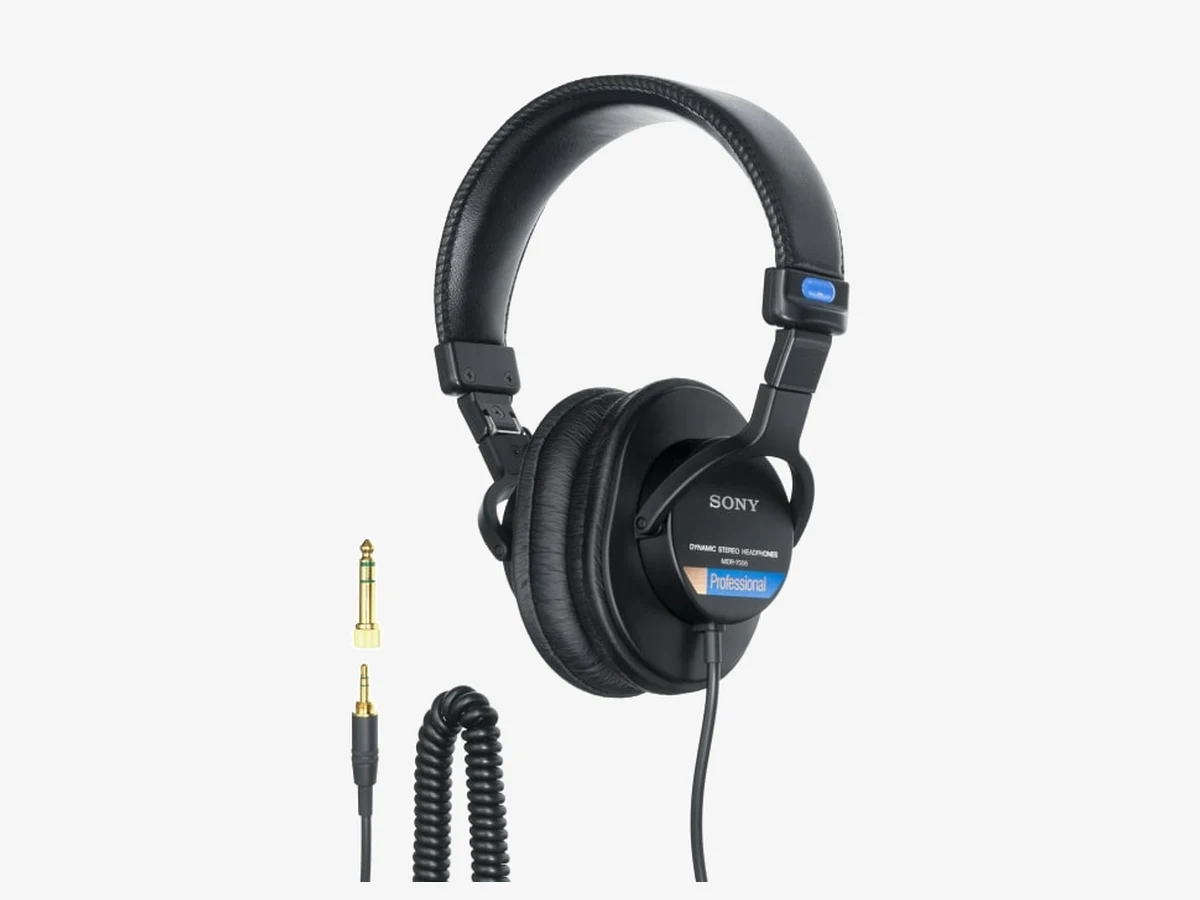
Photo: Sony
Key specs
🏆 Best overall
1. Sony MDR-7506
The MDR-7506 is the editing and monitoring headphone the broadcast world settled on decades ago, and it still earns the top spot: a closed-back design, a clear and detailed voice range, and a folding body that lives happily in a camera bag.
For editing, what matters is how this headphone presents voices. Sony rates sensitivity at 106 dB/mW, so it plays loudly from any laptop, camera or interface, and its presentation is detailed exactly where dialogue problems hide: the buzz of a bad cable, the echo of an untreated room, mouth clicks between words, and the level jump when a speaker leans toward the mic. Problems you can hear are problems you can fix, and the 7506 makes them hard to miss. One warning before you buy: the older Sony MDR-V6 still appears in some roundups and looks nearly identical. It is a different, older model. The current studio standard is the MDR-7506 listed here.
For recording, the closed-back earcups keep your own monitoring out of the microphone, and the folding design with its protective pouch suits location work. The fixed coiled cable stretches to about 3 m when extended, which reaches a camera or interface without an extension lead. At about 230 g without the cable it is the lightest pick in this guide, which helps on long edit days, though the earpads are the part that wears first after years of use.
Technical features
- Type: Closed-back, dynamic, circumaural
- Driver: 40 mm dome, CCAW voice coil, neodymium magnet
- Impedance: 63 Ω at 1 kHz
- Sensitivity: 106 dB/mW
- Frequency response: 10 to 20,000 Hz
- Power handling: 1,000 mW
- Cable: Coiled, approx. 1.2 m (approx. 3 m extended), fixed
- Plug: Gold-plated Unimatch 3.5 mm with 6.3 mm adaptor
- Weight: Approx. 230 g without cable
- Extras: Folding construction, protective carry pouch included
Pros
- Detailed voice range exposes dialogue problems early
- Closed-back isolation works beside a live microphone
- Lightest pick here, and folds into its own pouch
- Runs loudly from cameras, laptops and interfaces alike
Cons
- Fixed cable: a damaged cord means a repair, not a swap
- Earpads wear and flake after years of heavy use
- Easy to confuse with the older MDR-V6 when shopping
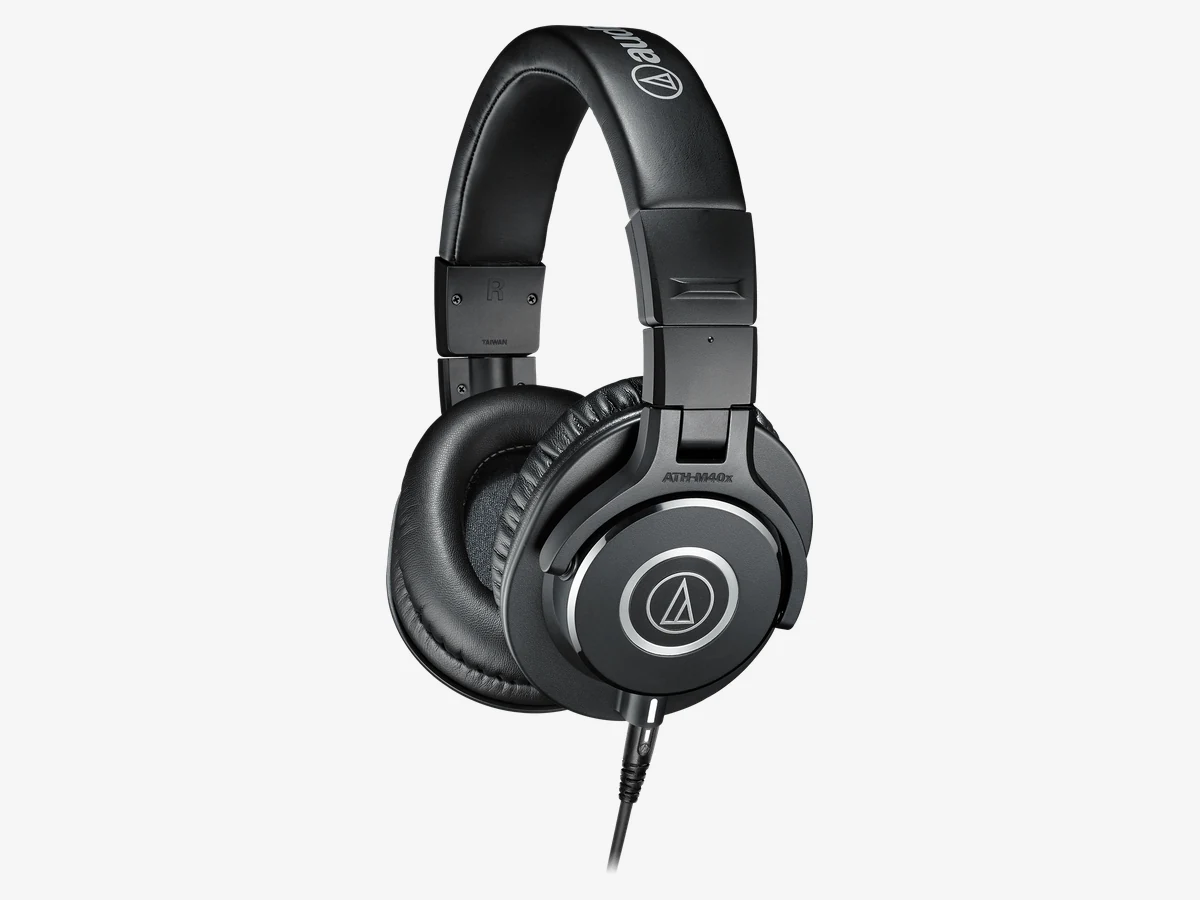
Photo: Audio-Technica
Key specs
💰 Best budget
2. Audio-Technica ATH-M40x
The M40x is the sensible way into Audio-Technica’s M series: a closed-back headphone its maker describes as tuned flat for accurate monitoring, with detachable cables and a collapsible build at the lowest commitment in this guide.
Flat tuning is the point. Consumer headphones lift the bass and treble to flatter music, which is precisely what you do not want when judging whether a voice sounds boomy or thin. The M40x’s flatter response makes it the safer budget tool for dialogue decisions, even over its better-known sibling below. Its 35 Ω impedance and 98 dB sensitivity mean phones, cameras and laptops all drive it without strain, and the earcups swivel 90 degrees, so you can drop one cup and hear the room while you record.
For recording, the closed-back design and circumaural pads give useful isolation beside a mic, and the detachable cable system is a genuine working advantage: a coiled cable for the desk and a straight cable for location, and if a cable dies you replace the cable, not the headphones. At 240 g without cable it stays comfortable through long sessions, and it collapses flat for a kit bag.
Technical features
- Type: Closed-back, dynamic, circumaural
- Driver: 40 mm, neodymium magnet, CCAW voice coil
- Impedance: 35 Ω
- Sensitivity: 98 dB
- Frequency response: 15 to 24,000 Hz
- Maximum input power: 1,600 mW at 1 kHz
- Cables: Detachable 1.2 to 3.0 m coiled and 3.0 m straight, locking connector
- Weight: 240 g without cable
- Extras: Collapsible design, 90 degree swivelling earcups, tuned flat for accurate monitoring
Pros
- Flat tuning suits dialogue judgment better than bass-lifted rivals
- Detachable cables: swap lengths, replace only the cable if it fails
- Easy to drive from any device at 35 Ω
- Folds flat and swivels for one-ear recording checks
Cons
- Plainer build and pads than the M50x step-up
- Isolation is good rather than class-leading
- Sound will feel less exciting for music than consumer pairs
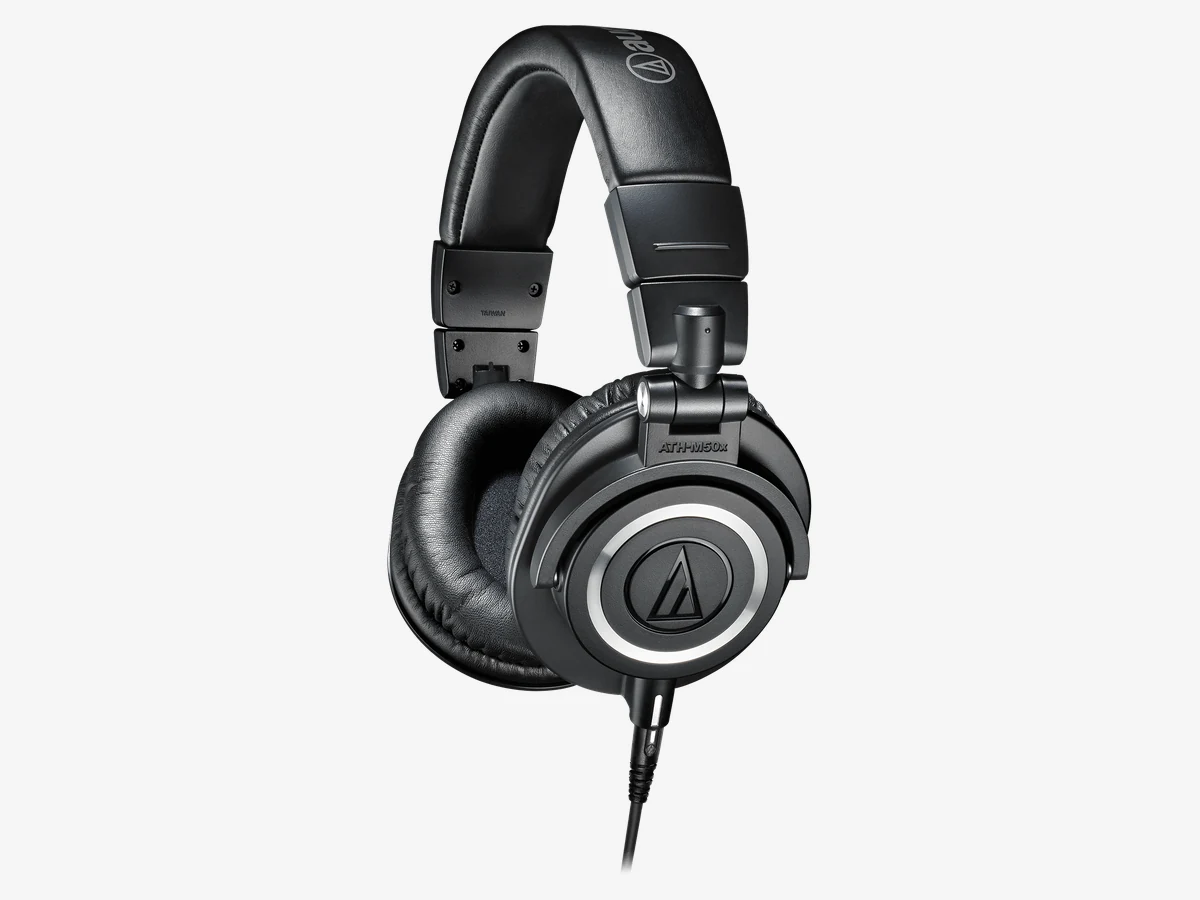
Photo: Audio-Technica
Key specs
🎧 Best all-rounder and portable pick
3. Audio-Technica ATH-M50x
The M50x is the step-up most creators end up with: a bigger 45 mm driver, a sturdier build, three detachable cables in the box, and the collapsible, swivelling design that makes it the natural travel pair in this guide.
This is the wired black M50x. Audio-Technica also sells a Bluetooth version, the M50xBT2, which is a different product with a different job; for editing and monitoring, the wired model here is the right one, with no wireless delay and no battery to manage. Against the M40x above, you get a wider 15 to 28,000 Hz response, a touch more sensitivity at 99 dB, and a more substantial build that stands up better to being folded into a bag every day. The sound carries a little more low-end weight than the flatter M40x, which many editors enjoy on music breaks; for pure dialogue neutrality the M40x argues back, which is why both are here.
For recording, the closed-back cups isolate well, and the 90 degree swivel makes the classic one-ear-off check easy when you want to hear your voice in the room and in the headphones at once. Three cables, coiled, long straight and short straight, cover desk, location and travel without adapters or spares shopping.
Technical features
- Type: Closed-back, dynamic, circumaural
- Driver: 45 mm, neodymium magnet, CCAW voice coil
- Impedance: 38 Ω
- Sensitivity: 99 dB
- Frequency response: 15 to 28,000 Hz
- Maximum input power: 1,600 mW at 1 kHz
- Cables: Detachable 1.2 to 3.0 m coiled, 3.0 m straight and 1.2 m straight
- Weight: 285 g without cable
- Extras: Collapsible design, 90 degree swivelling earcups
Pros
- Three detachable cables cover desk, location and travel
- Sturdier build than the M40x for daily bag duty
- Swivelling cups suit one-ear recording checks
- Easy to drive at 38 Ω from any source
Cons
- Slightly more low-end weight than the flatter M40x
- Heavier than the M40x and MDR-7506
- Do not confuse it with the Bluetooth M50xBT2 when buying
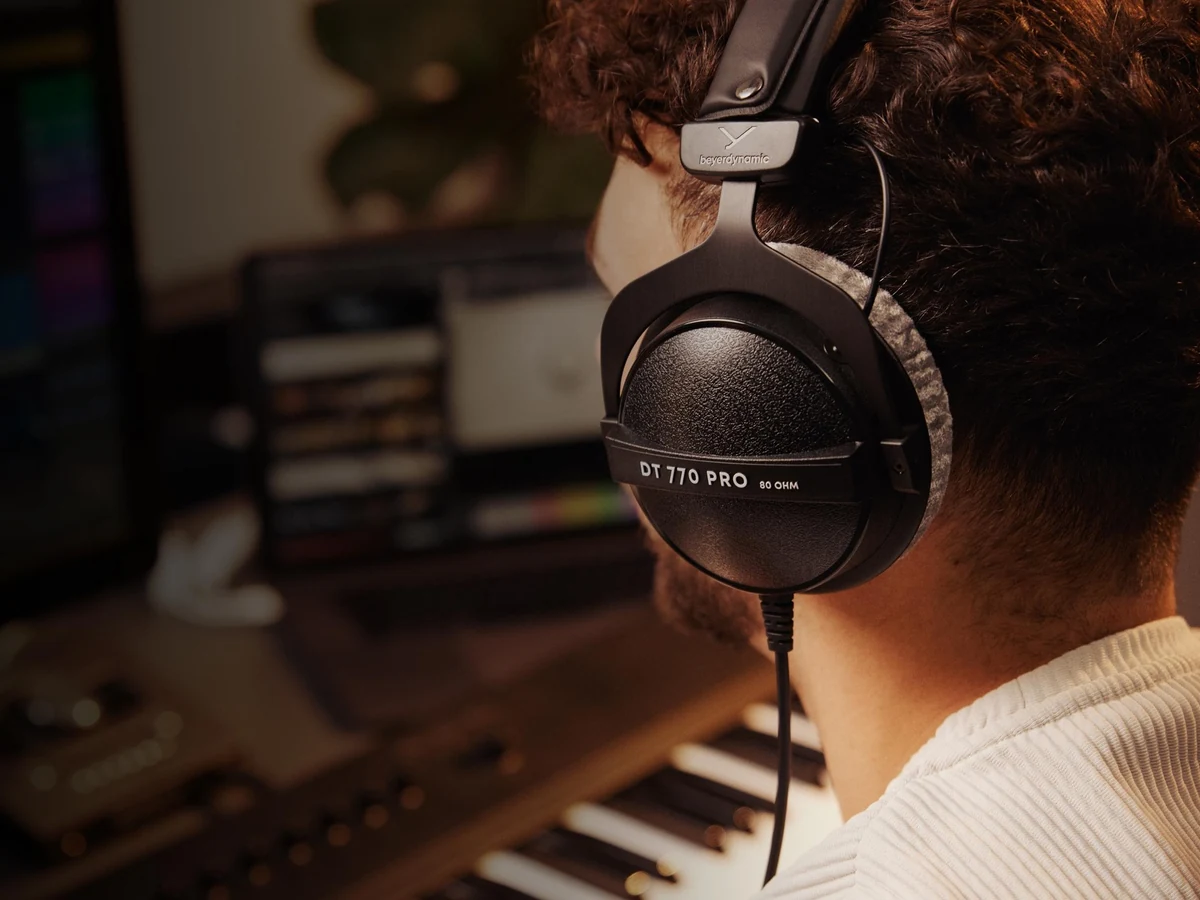
Photo: beyerdynamic
Key specs
🛋️ Best comfort for long edits
4. beyerdynamic DT 770 PRO (80 Ohm)
The DT 770 PRO is the closed-back studio classic built for all-day wear: soft velour ear pads, a spring steel headband with a gentle clamping force of about 3.5 N, and a build where every component can be replaced. This pick is the 80 Ohm version only.
Version discipline matters with this headphone more than any other here. beyerdynamic sells the DT 770 PRO in 32, 80 and 250 Ohm versions, plus a separate PRO X line with detachable cables. The 80 Ohm is the right middle for creators: it runs happily from audio interfaces and laptops, keeps the velour pads, and suits both editing and recording. The maker’s own guidance recommends closed-back headphones for use with a microphone, because they leak less sound into the recording, and the DT 770 PRO is the closed model in its classic range, with about 18 dBA of ambient noise attenuation.
For long edits, comfort is the headline: velour breathes better than leatherette over hours, the clamp is gentler than the HD 280 PRO below, and because every part is replaceable, worn pads or a tired headband pad are spares orders rather than a new headphone. The trade is the fixed 3.0 m straight cable. It is single-sided so it stays out of the way, but it does not unplug, so treat it kindly.
Technical features
- Type: Closed-back, dynamic, circumaural
- Impedance: 80 Ω (this version only)
- Frequency response: 5 to 35,000 Hz
- Nominal sound pressure level: 96 dB
- Ambient noise attenuation: Approx. 18 dBA
- Headband pressure: Approx. 3.5 N
- Cable: 3.0 m straight, single-sided, fixed
- Plug: Gold-plated 3.5 mm with screw-on 6.35 mm adapter
- Weight: 270 g without cable
- Extras: Velour ear pads, all components replaceable, handmade in Germany, drawstring bag
Pros
- Velour pads and gentle clamp suit multi-hour edits
- Every component replaceable: a headphone you keep for years
- Closed-back with real isolation for recording work
- 80 Ohm version suits interfaces and laptops alike
Cons
- Fixed cable, unlike the separate PRO X line
- Easy to buy the wrong impedance version by mistake
- Velour pads isolate slightly less than leatherette
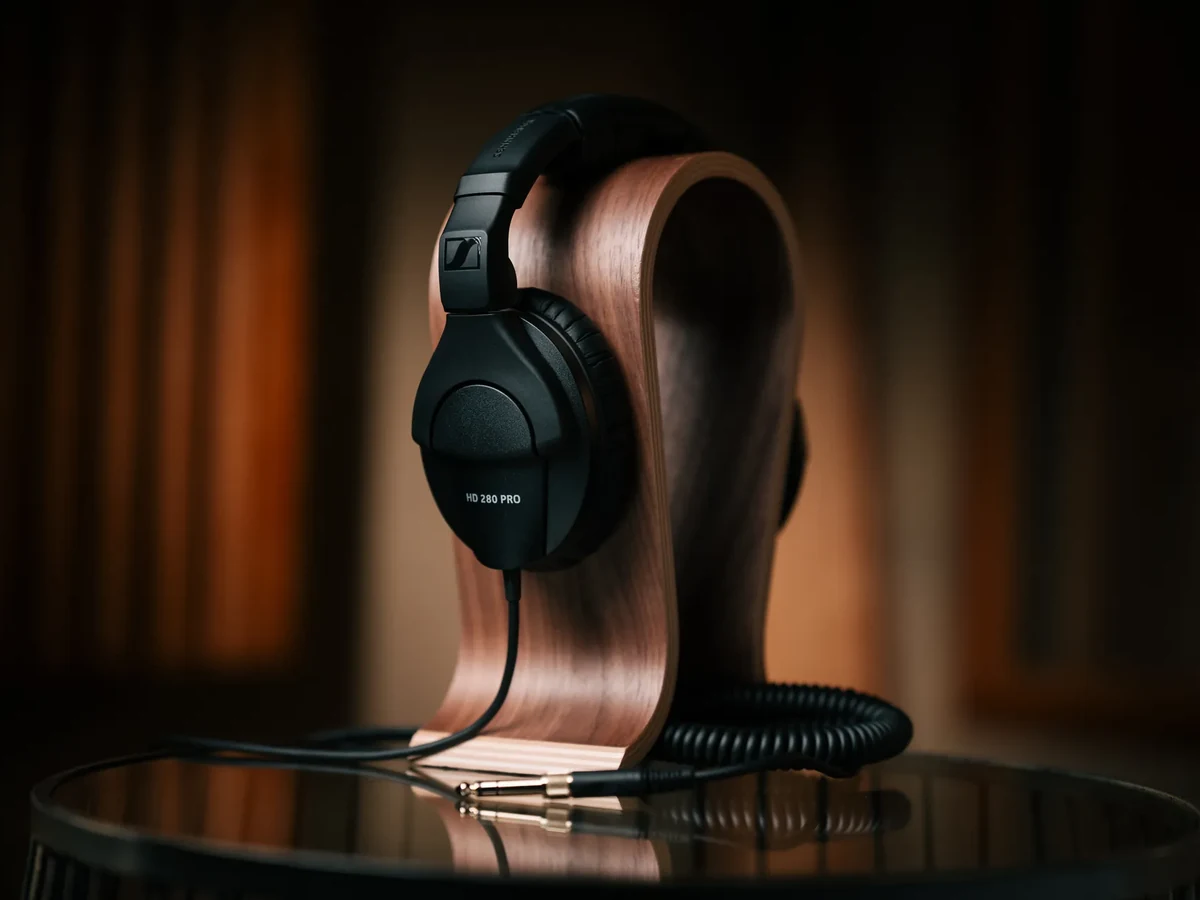
Photo: Sennheiser
Key specs
🔇 Best isolation for location monitoring
5. Sennheiser HD 280 PRO
The HD 280 PRO is the isolation specialist: a closed-back, circumaural design with up to 32 dB of ambient noise attenuation, the strongest figure in this guide, in a tough folding body built for location work.
That isolation cuts both ways, and both directions earn their keep. Noise from a busy set, a café or a house full of family stays out, so you can judge a take where you recorded it instead of guessing until you get home. Your monitoring also stays in, which matters when a microphone sits inches away. Sennheiser positions this headphone for tracking, monitoring and voiceover work, with a smooth, linear response from 8 Hz to 25 kHz for judging voices honestly, and a 64 Ω impedance that its maker describes as ensuring universal connectivity across cameras, interfaces and laptops.
The comfort trade is real and worth knowing before a long edit: the contact pressure is about 6 N, noticeably firmer than the DT 770 PRO, because that clamp is part of how the isolation works. Many recordists love it on set and reach for something gentler at the desk. The folding headband and swivelling earcups pack it flat, the polycarbonate build shrugs off daily knocks, and ear cushions, headband cushion and cable are all replaceable parts.
Technical features
- Type: Closed-back, dynamic, circumaural
- Impedance: 64 Ω
- Frequency response: 8 to 25,000 Hz
- Ambient noise attenuation: Up to 32 dB
- Sound pressure level: 113 dB at 1 kHz / 1 Vrms
- Contact pressure: Approx. 6 N
- Cable: Single-sided coiled, 1.3 to 3 m, 3.5 mm plug with screw-on 6.35 mm adapter
- Weight: Approx. 285 g without cable
- Extras: Folding headband, swivelling earcups, replaceable ear cushions, headband cushion and cable
Pros
- Strongest isolation here: judge takes anywhere
- Keeps monitoring out of live microphones
- Tough folding build with replaceable wear parts
- Linear response suits voiceover and dialogue checks
Cons
- Firm 6 N clamp can tire you on very long edits
- Utilitarian looks and feel
- Current model is easy to confuse with the legacy listing when shopping
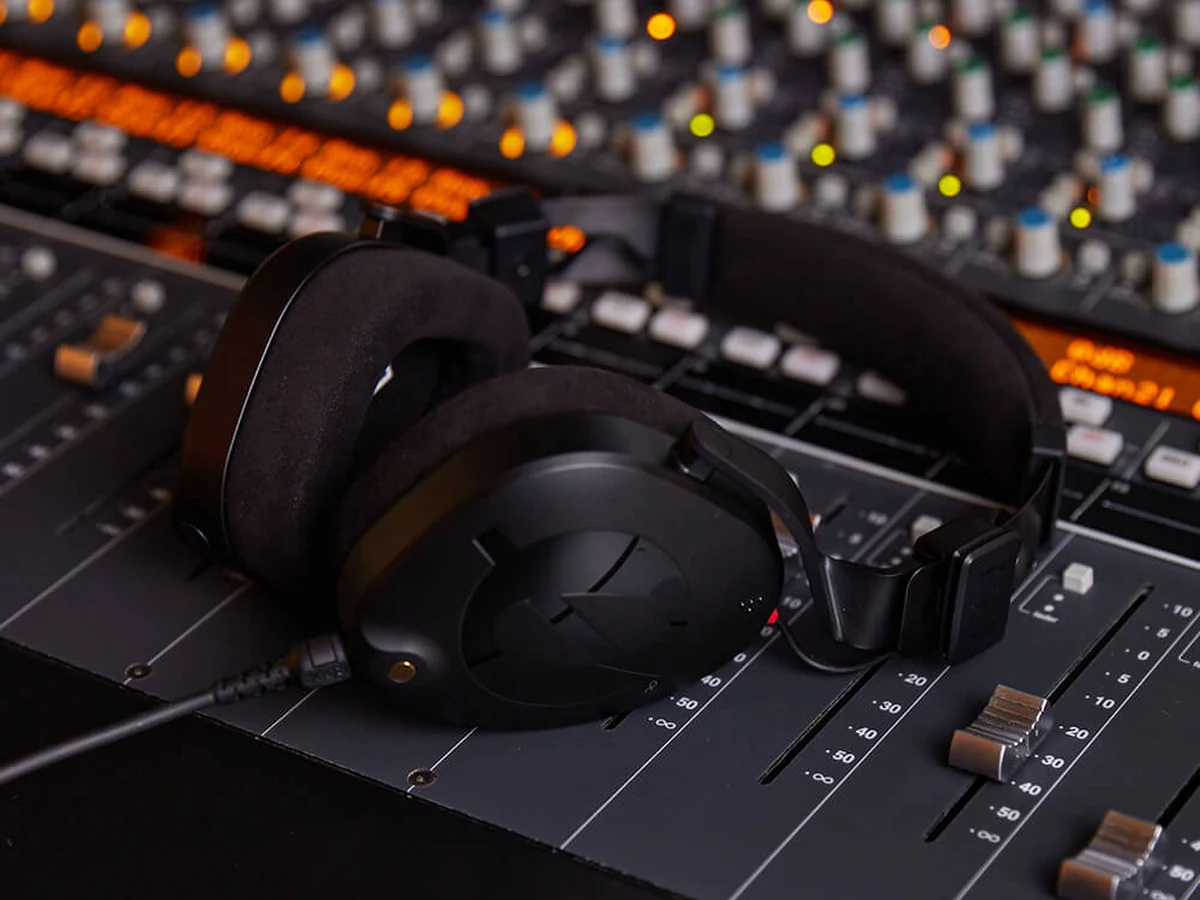
Photo: RØDE
Key specs
🎙️ Best for creators who record as well as edit
6. RØDE NTH-100
The NTH-100 is the one pick designed from a blank page for content creators: RØDE built it for audio editing, podcasting, streaming and location recording, with comfort engineering aimed at sessions that run for hours.
Comfort is the engineering story. The ear cushions combine Alcantara, a soft suede-like material, with CoolTech gel that absorbs heat, over memory foam, and the headband uses RØDE’s FitLok system to hold your adjustment instead of creeping. RØDE rates ambient noise attenuation at 20 dBA, so the closed-back design keeps a live mic safe while you monitor, and the custom-matched 40 mm drivers cover 5 Hz to 35 kHz. At 32 Ω it runs from anything, camera, phone or interface, with volume to spare.
Two creator-first details stand out. The locking cable can attach to either earcup, so the cord falls on whichever side keeps it away from your mouse or camera, and it removes completely for packing or replacement. Cushions and cable are user-replaceable, and RØDE covers the headphones with a lifetime warranty. At 350 g it is the heaviest pick here, which the padding mostly hides, but smaller heads should know before buying.
Technical features
- Type: Closed-back, dynamic, circumaural
- Driver: 40 mm custom-matched dynamic
- Impedance: 32 Ω
- Sensitivity: 110 dB at 1 kHz
- Frequency response: 5 Hz to 35 kHz
- Ambient noise attenuation: 20 dBA
- Cable: Removable locking cable, 2.4 m, attaches to either earcup
- Weight: 350 g
- Extras: Alcantara cushions with CoolTech gel, FitLok headband, replaceable cushions and cable, lifetime warranty
Pros
- Comfort system designed for long creator sessions
- Cable attaches to either earcup and removes for packing
- Strong isolation for recording beside a mic
- Lifetime warranty and replaceable wear parts
Cons
- Heaviest pick in this guide at 350 g
- Does not fold flat like the Sony and Audio-Technica picks
- Newer design with a shorter track record than the classics
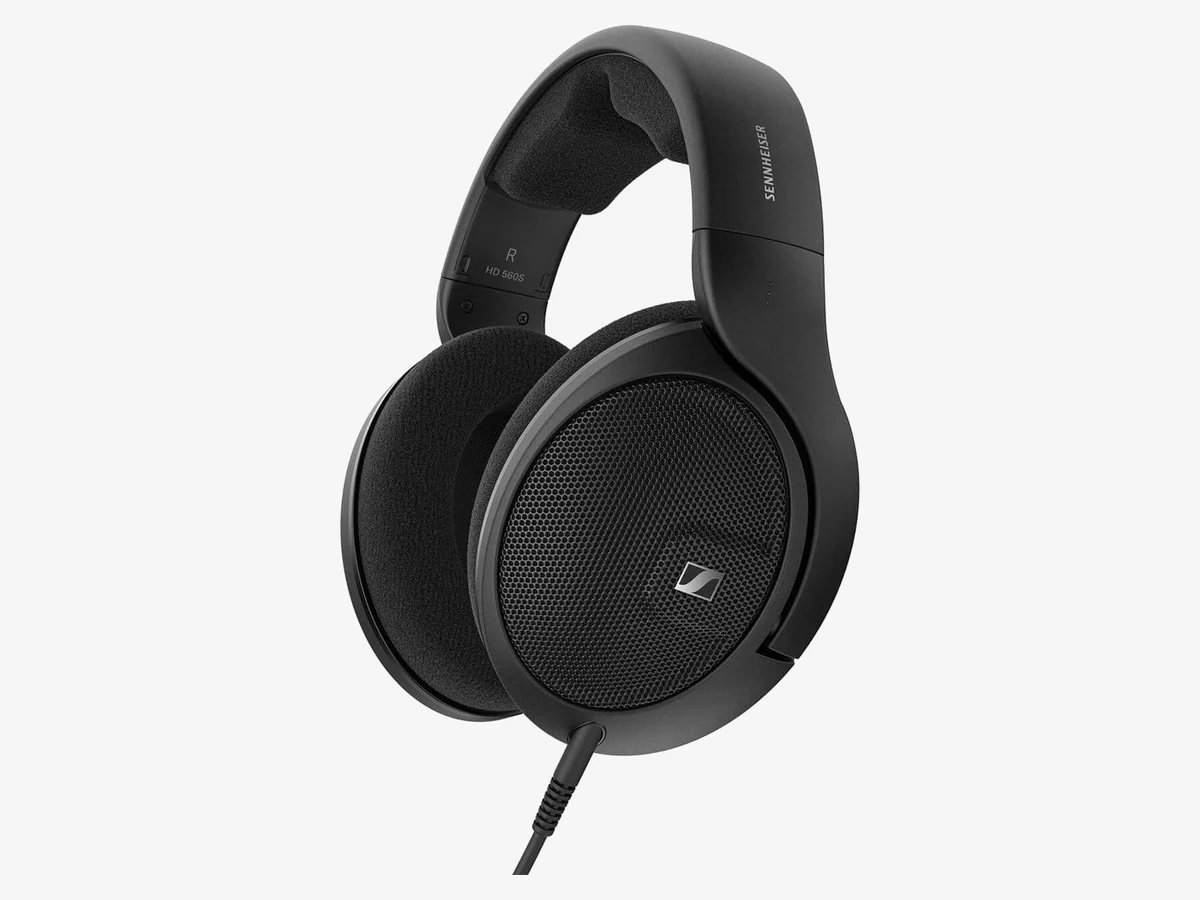
Photo: Sennheiser
Key specs
🎵 Best open-back for quiet rooms
7. Sennheiser HD 560S
The HD 560S is the judgment pick: an open-back reference headphone whose wide, natural soundstage makes it easier to hear how dialogue sits against music and room tone before you export. It is for quiet edit rooms only, and never for recording.
Sennheiser built this headphone for analytical listening: a dynamic, open transducer covering 6 Hz to 38,000 Hz, angled drivers that recreate the triangle you get from good speakers, and velour earpads in a light 280 g frame that vents heat instead of trapping it. In a quiet room that openness is a genuine editing tool. Reverb tails, background music creeping under speech, and the space around a voice all read more naturally than on a sealed cup, which is why open-back headphones are the traditional final-check tool.
Now the caveat, stated as plainly as it deserves: open-back means sound leaks both ways. Your editing audio spills into the room, and room noise reaches your ears, so the HD 560S cannot monitor beside a live microphone without bleeding into the take, and it is the wrong pick for cafés, shared rooms and location work. Its 120 Ω impedance also asks more of weak headphone outputs, covered in the impedance section below. Treat it as a second, specialist pair for final decisions at a quiet desk, and it earns its place.
Technical features
- Type: Open-back, dynamic, circumaural
- Driver: 38 mm with polymer-blend membrane
- Impedance: 120 Ω
- Frequency response: 6 Hz to 38,000 Hz
- Sound pressure level: 110 dB at 1 kHz / 1 Vrms
- Total harmonic distortion: Less than 0.05 percent at 1 kHz / 90 dB SPL
- Cable: Detachable 1.8 m with 3.5 mm plug, 3.5 to 6.3 mm adapter included
- Weight: 280 g
- Extras: Angled transducers (E.A.R.), velour ear pads
Pros
- Natural soundstage for judging dialogue against music
- Light, ventilated and easy to wear for hours
- Detachable cable with both plug sizes covered
- Honest, linear response for final export checks
Cons
- Leaks sound both ways: unusable beside a live microphone
- Needs a quiet room and a decent headphone output at 120 Ω
- No isolation at all for travel or shared spaces
Monitoring while you record: the half of the job most guides skip
When you record your own voice, wear closed-back headphones. They keep the monitoring signal inside the cups instead of letting it escape into your microphone, and they let you hear problems, hum, echo, a drifting mic, as they happen instead of in the edit.
Headphone leakage is the quiet take-ruiner. A microphone does not know the difference between your voice and the click track, backing music or your own delayed monitoring spilling out of open or poorly sealed earcups. It records all of it, and once that bleed is printed under your dialogue you cannot cleanly remove it. This is why studios hand singers closed-back headphones, and why beyerdynamic’s own buying guidance recommends closed-back models for use with a microphone. Six of the seven picks in this guide are closed-back for this reason; the open-back HD 560S is the deliberate exception, and it stays at the editing desk.
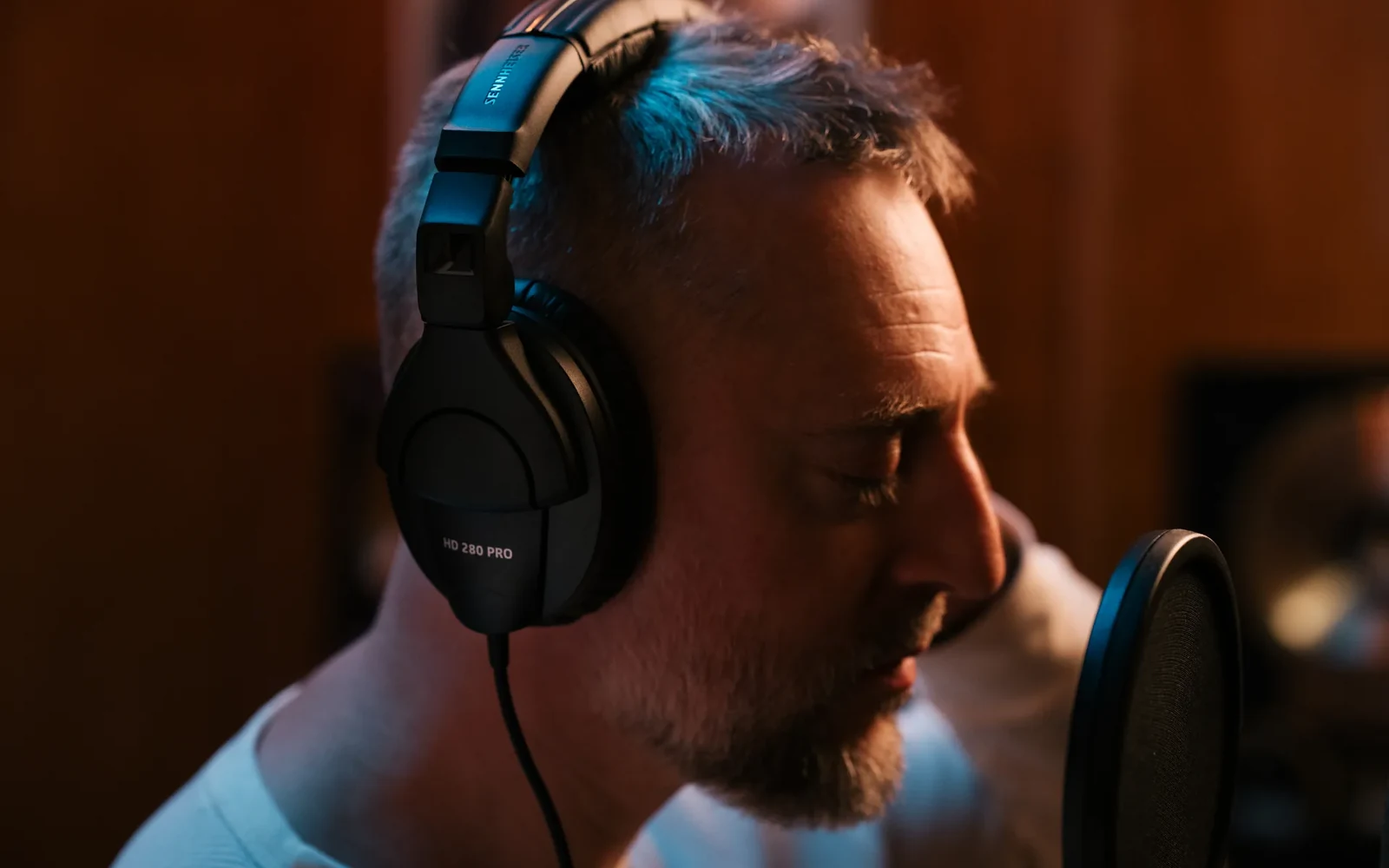
Monitoring also changes how you perform. Hearing your voice clearly, at a sensible level, with zero delay, keeps your distance to the mic consistent and your delivery natural. Good isolation lets you do that at lower volume, which protects both the take and your ears. Our guide to how to record better vlog audio covers the recording chain end to end, and microphone patterns and placement explains the mic side of the same problem. If you write your material before recording it, record one rehearsal take and listen back the same way before the real one.
One practical check: before a real take, record ten seconds of silence while your headphones play a loud section of audio. Play it back. If you can hear the playback in the silent recording, your cups are leaking or your monitoring is too loud, and both are fixable in the moment.
Editing dialogue: what good monitoring headphones actually reveal
Dialogue editing is defect hunting. The right headphones surface harsh sibilance, plosive thumps, mouth clicks, room echo, low-end rumble and level jumps between sentences, while a flattering pair hides them until your viewers hear them on a phone speaker.
Work through a voice recording on any pick in this guide and the same cast of problems appears. Sibilance is the sharp hiss on S and T sounds that fatiguing tuning exaggerates and dull tuning hides. Plosives are the low thumps when breath hits the mic on P and B sounds. Under both sits room tone: the echo and boxiness of an untreated space, plus rumble from traffic, fridges and handling noise that small speakers never reproduce but headphones reveal instantly. Hearing that rumble matters, because it eats headroom and muddies compression even when viewers cannot consciously hear it.
This is also where honest tuning beats enjoyable tuning. A bass lift makes voices sound fuller while you edit, then thin on a phone. A treble lift makes everything sound detailed, then harsh at volume. The flatter picks here, the M40x and HD 280 PRO especially, are boring in the best way: what you hear is close to what you recorded. When the damage is already in the recording, our guide to how to remove background noise from video covers the repair side, and better monitoring is how you judge whether the repair worked or just moved the problem.
Impedance, explained in plain English
Impedance, measured in ohms, is how hard a headphone is to drive. Low numbers, like the 32 to 38 Ω Audio-Technica and RØDE picks, play loudly from anything. Higher numbers, like the HD 560S at 120 Ω, play quieter from weak outputs and may need an audio interface or headphone amp to reach full volume.
The picks in this guide span 32 Ω to 120 Ω, and every common source handles them differently. Cameras have modest headphone outputs meant for monitoring checks. Laptop headphone jacks are stronger than most people expect and drive everything here, including the 120 Ω HD 560S, to useful levels. Phones sit at both extremes: models with proper headphone outputs do fine, while small USB-C dongles are the weakest source most creators own, and they are where a 120 Ω headphone can end up too quiet. Audio interfaces, the box most creators already use for their microphone, usually have the strongest and cleanest headphone stages of all.
Two rules cover almost every case. First, low impedance means easy volume, not better sound: the 35 Ω M40x and 63 Ω MDR-7506 are not lesser headphones than the 120 Ω HD 560S, they are simply matched to weaker sources. Second, when a high-impedance headphone sounds quiet and a little lifeless from a dongle or camera, the fix is power, not a different headphone: run it from an interface or an inexpensive headphone amp and it wakes up. If you already record through an interface, which our microphone guides assume, you already own the right source for every pick here, including the 80 Ω DT 770 PRO and the HD 560S.
Comfort over a long edit: clamps, pads and glasses
The most accurate headphones lose to the pair you can stand wearing. Judge comfort by clamping force, pad material and weight: gentle clamp and velour for desk marathons, firmer clamp and leatherette when isolation matters more.
The makers publish the clamp story if you read their numbers. The DT 770 PRO presses at about 3.5 N, the HD 280 PRO at about 6 N, and you can feel that gap within an hour: the beyerdynamic rests, the Sennheiser grips, and the grip is part of its isolation. Pad material splits the same way. Velour, on the DT 770 PRO and HD 560S, breathes and stays cooler, at a small cost in isolation. Leatherette and protein leather, on the Sony and Audio-Technica picks, seal better and wipe clean. The NTH-100 splits the difference with memory foam under Alcantara and gel that absorbs heat.
Glasses change the maths: arms break the seal of closed-back cups, leaking bass out and monitoring sound with it, and they give clamping force a pressure point. Softer pads and gentler clamps forgive glasses best, so glasses wearers editing for hours should look hardest at the DT 770 PRO and NTH-100. Whatever you choose, treat pads as consumables. Every pick here has replaceable ear cushions, and fresh pads after a few years restore both comfort and the seal the sound depends on.
Why every pick here is wired
Bluetooth adds delay, and delay breaks the two things these headphones exist for. Codec latency shifts audio late against picture, so lip-sync judgments go wrong, and live monitoring of your own voice arrives echoed, which no one can record against.
The delay is not a flaw in any one product; it is how Bluetooth audio works. The signal is encoded, transmitted and decoded, and even good implementations cost tens to hundreds of milliseconds. Picture and sound that leave together arrive apart. While editing, that offset quietly corrupts every sync decision: cuts feel late, lips look wrong, and you chase problems that are not in your timeline. While recording it is worse, because hearing your own voice late is like speaking in a canyon, and Bluetooth monitoring paths add their own delay on top. This is why no Bluetooth model appears in this guide, including from brands whose wired models we recommend.
Wired also removes the small frictions: no batteries to die mid-session, no pairing dance between laptop and phone, no dropouts, and the same pair works in a camera’s monitoring jack, which has no Bluetooth at all. Wireless headphones are lovely for watching the finished video on a train. For making it, plug in.
Check your mix on speakers before you publish
Headphones are for finding problems; speakers are for judging how the video will actually sound. Before exporting, check dialogue on a phone speaker, laptop speakers or a TV, at the volumes real viewers use.
Headphones separate sound in a way speakers do not: every detail sits close and clear, stereo is wide, and low rumble is easy to hear. Most viewers get none of that. They hear a phone speaker in a kitchen, where bass disappears, background music competes harder, and dialogue that seemed present can sink under it. The mix that survives is the one checked in both worlds: edited on honest headphones, then auditioned on the worst speaker your audience owns.
Make it a two-minute habit. Export a short section, play it on your phone at half volume, and listen for three things: can you follow every word without trying, does the music sit under the voice rather than beside it, and do level jumps between clips still jar? If it passes on the phone and the headphones agree, publish with confidence.
Frequently asked questions
Can I use Bluetooth headphones for video editing?
Not for serious editing or monitoring. Bluetooth adds codec delay, so audio arrives late against the picture and lip-sync judgments go wrong, and monitoring your own voice while recording becomes an echo you cannot perform against. Use wired headphones for editing and recording, and keep wireless pairs for watching the finished video.
What is the difference between closed-back and open-back headphones for editing?
Closed-back cups seal sound in and noise out, which is what you want beside a microphone and in shared or noisy rooms. Open-back cups let sound pass both ways, giving a wider, more natural soundstage for judging a mix in a quiet room, at the cost of any isolation. The HD 560S is this guide’s one open-back pick, and it should never be used while recording.
Do I need a headphone amp or audio interface for editing headphones?
Usually not. Everything at 64 Ω and below in this guide runs loudly from laptops, cameras and phones. The 80 Ω DT 770 PRO is happiest from an interface or laptop. The 120 Ω HD 560S can sound too quiet from weak phone dongles, and an interface or small headphone amp fixes that properly.
Are the Sony MDR-7506 good for YouTube videos?
Yes, they are the default recommendation in this guide for exactly that work. The closed-back design suits recording voiceovers and pieces to camera, the detailed voice range exposes dialogue problems while editing, and at 63 Ω they run loudly from any camera, laptop or interface. Just make sure you are buying the MDR-7506, not the older MDR-V6.
Can I use the same headphones for recording and editing?
Yes, and most creators should. Any closed-back pick here does both jobs: isolation and low leakage for recording, honest sound for editing. The exception is an open-back pair like the HD 560S, which is an editing-only tool for quiet rooms and works best as a second pair alongside a closed-back workhorse.
Why does my edit sound different on my phone speakers?
Because headphones flatter a mix: detail is close, bass is present, and stereo is wide. A phone speaker removes bass, narrows everything toward mono and competes with room noise, so buried dialogue and level jumps show up there first. Edit on headphones, then always audition the result on a phone before publishing.
How long do studio headphones last, and what wears out first?
Years, with care. The models here are studio tools built for daily professional use, and several are designed so every component can be replaced. Earpads wear first, flattening and flaking after a few years of heavy use, followed by headband padding and cables. Every pick in this guide has replaceable pads, and most have replaceable cables, so budget for pads, not a new headphone.
What impedance should I choose for a laptop or camera?
For a camera’s monitoring output, stay at the lower end: 32 to 64 Ω picks like the NTH-100, the two Audio-Technicas, the MDR-7506 and the HD 280 PRO all play loudly from modest outputs. A laptop drives everything in this guide. Save the 80 Ω and 120 Ω models for a desk setup with an audio interface, which is where they perform best.
Why does my voice sound harsh or hissy in my recordings?
Often it is sibilance, sharp energy on S and T sounds, made worse by close mic placement and bright microphones. Honest monitoring headphones reveal it accurately so you can fix the cause, mic angle, distance, or gentle de-essing in the edit, instead of guessing. Dull consumer headphones hide it, and bass-heavy ones bury it under low end.
Are expensive headphones always better for dialogue editing?
No. For dialogue, honesty beats luxury: a flat, detailed midrange at a modest price, like the ATH-M40x, tells you more truth about a voice recording than an expensive pair tuned to flatter music. Spend more for comfort, build quality and replaceable parts, the things that decide whether a pair survives years of daily edits.
Can I edit video with earbuds or a gaming headset?
You can cut pictures with anything, but judging audio is where they fall short. Earbuds and gaming headsets are tuned for excitement, with lifted bass and treble that hide dialogue problems, and gaming headsets add processing you cannot switch off. A wired studio headphone from this guide costs less than most gaming headsets and tells you the truth.
Which headphones are best for recording voiceovers?
A closed-back pair with strong isolation. The HD 280 PRO leads on isolation alone, up to 32 dB of attenuation, while the MDR-7506, DT 770 PRO and NTH-100 all keep monitoring out of the microphone and stay comfortable through long scripts. Pair them with the recording technique in our vlog audio guide and you have the full setup.
The bottom line
Buy the Sony MDR-7506 if you want one pair that records and edits dialogue brilliantly. Buy the ATH-M40x to spend less for a flatter response, the DT 770 PRO for long-session comfort, or the HD 280 PRO if isolation is your working condition. Add the HD 560S later, as a quiet-room second pair, only if your final checks demand it.
Every pick here will make your dialogue editing more honest. They split on the work around the edit: how they clamp over a long day, how much of the room they keep out of a recording, and whether your camera, laptop or interface can drive them properly. Match the pair to your sources and your room, keep them wired, and audition every finished video on a phone speaker before it ships.
Start with the Sony MDR-7506 for the all-round job, the Audio-Technica ATH-M40x on a budget, and the RØDE NTH-100 if you record as much as you edit.
This guide is research-based curation: we compared manufacturer specifications, published reviews, and current prices. Read how we choose.