Last updated: October 2026
Your camera kit is probably one of the most expensive things you own that regularly leaves the house. It films on public streets, rides in bags and car trunks, and gets rained on, knocked over and lent out. Then a bag goes missing or a camera body hits the pavement, and the creator discovers the fact nobody wants to hear: the home insurance they were counting on was never really covering this. This guide explains how camera gear insurance works for vloggers: the four routes to covering a kit, the two policy lines that decide what a claim pays, the records every claim stands on, and the questions to ask before you spend anything. It is general information to prepare you for a conversation with an insurer or a broker, not personal financial advice, and wording differs between insurers and countries. The frame here is the United States; the concepts travel, the details may not.
The short version
- A standard home or renters policy caps camera gear, may settle at depreciated value, and is not designed for equipment that earns money.
- Creators insure a kit four ways: a scheduled add-on to a home policy, a standalone personal articles policy, a dedicated equipment policy, or a business policy that adds liability.
- Two lines decide what a claim pays: scheduled or blanket cover, and replacement cost or actual cash value.
- Every route stands on one foundation: a written inventory with serial numbers, receipts and photos, made before anything goes wrong.
- Liability is separate: gear cover pays for your property, not for harm your filming causes to someone else or their property.
On this page
- Why your home insurance probably does not cover your vlogging kit
- The four routes to insuring a creator’s kit
- Scheduled or blanket: the first line that decides your claim
- Replacement cost or actual cash value: the second line
- The gear inventory: the list every policy and claim stands on
- What gear cover usually pays for, and what it leaves out
- Rented and borrowed gear is not automatically covered
- Liability: the risk that is not your gear at all
- Travel insurance is not a gear policy
- If the worst happens: how a gear claim actually runs
- Questions to ask before you pay for any policy
- When cover is worth it, and when it honestly is not
- Frequently asked questions
- Keep exploring
Why your home insurance probably does not cover your vlogging kit
A standard homeowners or renters policy treats your camera as ordinary household contents, and that creates three problems at once: category limits that cap what one class of belongings can claim, settlement based on depreciated value on many policies, and business use that a home policy was never designed to cover. The NAIC, the association of US insurance regulators, makes the limits and business-use points in its consumer guide to home insurance: some items are worth more than a homeowners policy’s normal limits, and homeowners insurance is not designed to cover most business uses of a home.
Start with the limit problem. A home policy insures your contents as a pool, then quietly caps certain categories inside that pool. Fine for furniture; thin for a camera bag whose body alone can outweigh a household cap. The NAIC guide describes the standard fix by name: a scheduled personal property endorsement, also called a personal article floater, an add-on to that home policy rather than a separate policy, exists for items worth more than the normal limits. If your policy has never heard your camera’s name, the camera rides on the pool and the cap.
Then the earning problem. A vlogging kit behind a monetized channel is, in an insurer’s eyes, equipment used for business. That does not make your home policy worthless, but the honest answer to “is my gear covered?” becomes “it depends what you told them it is for.” A claim is the worst moment to discover the use on record is “hobby” while the channel is earning money. Once a channel earns through ads, affiliates and sponsorships, many insurers will treat you as running a small business on that kit whether it feels like one or not; our guide to how to make money vlogging maps those income routes.
The third problem, settlement at depreciated value, gets its own section below, under replacement cost or actual cash value.
The four routes to insuring a creator’s kit
There are four established routes: schedule the gear onto a home or renters policy you already hold, buy a standalone personal articles policy, buy a dedicated equipment policy of the kind insurers call inland marine, or buy a business policy that adds liability. Insurers appear below only as examples of where each type is sold, not as recommendations, and no route is priced here because premiums depend on your gear, your claims record and your state.
| Route | How it works | Watch out for |
|---|---|---|
| Scheduled add-on to a home or renters policy | An endorsement or floater lists your valuable items on the home policy you already have, lifting them above the category caps. The NAIC describes it as the standard way to cover items worth more than the normal limits. | Still a personal policy: the business use question does not go away, and a claim touches your household record. |
| Standalone personal articles policy | A separate policy for listed valuables, sold by mainstream insurers such as State Farm. State Farm describes its version as covering items wherever they travel, paying replacement cost without deducting depreciation up to the limit, and generally carrying no deductible. | A personal cover: gear that earns its living may need the business form instead. |
| Dedicated equipment policy (inland marine) | The business form built for property that moves. Insurers describe equipment cover as a floater policy: it follows gear in transit, in storage and on location rather than tying it to one address. | The strange name is historical, from cargo insurance that followed goods inland; for a vlogger it simply means the cover travels with the kit. What matters is the wording: which perils, which territories, which conditions. |
| Business policy with liability | A small business policy pairing equipment cover with general liability, sold by insurers such as Hiscox and Next Insurance and by creator focused specialists such as Full Frame Insurance. The photographers’ association PPA (Professional Photographers of America) also bundles equipment cover into its membership as PhotoCare. | Equipment and liability are separate sections with separate terms, and association cover can be secondary to other policies, meaning it pays only after another policy you hold has paid. |
All four routes share one foundation: a list of your gear and a statement of how you use it. The next two sections cover the two choices inside every route that decide what a loss actually pays.
Scheduled or blanket: the first line that decides your claim
Scheduled cover names your gear item by item: make, model, serial number and an insured amount for each piece. If an item is not on the schedule, it is not covered under the scheduled portion (though a blanket portion may still cover it, as below). Blanket cover skips the list and insures a class of property up to one overall amount, simpler to run but with possible per item caps inside it. Many policies mix the two.
Scheduling takes effort up front and pays off at claim time. Agreeing each item’s identity and value while everyone is calm is what makes a claim fast later: the insurer is not meeting your lens for the first time in a police report.
That precision only works if you keep the list current. A scheduled lens you sold last spring is premium wasted; a list never updated after buying your new body is a body with no cover at all. The rule is mechanical: buy it, add it to the schedule in the same week, and until it is listed, do not assume it is covered under the scheduled portion. Blanket cover forgives that admin, which suits the churn of cables, mounts and small lights, but read for a per item ceiling before assuming the pool covers a pricey outlier.
Replacement cost or actual cash value: the second line
Replacement cost pays to repair or replace the item with one of like kind and quality, without deducting for the years you have used it, up to the policy limit. Actual cash value pays what the item was worth on the day of the loss, depreciation deducted first. Same stolen camera, same limit on paper, two very different settlements.
The Insurance Information Institute explains the gap with a household example that translates directly: under replacement cost, the insurer pays for a new machine; under actual cash value, it pays a percentage of that cost because the old one had years of use in it. A three year old camera body settled at cash value leaves you funding a large part of its replacement.
Even replacement cost wording deserves a second read. PPA’s own equipment cover page states that its replacement basis runs up to the item’s original purchase price and no further, a sensible term that is still a ceiling worth knowing. So ask whether the ‘replacement cost’ on offer is full replacement or capped at the original price, and ask two questions of any policy: which basis settles my claim, and is the scheduled amount guaranteed or a cap? The answers, in writing, beat any sales summary.
The gear inventory: the list every policy and claim stands on
Before any policy conversation, build the inventory: every item you would want back, with its make and model, serial number, when and where you bought it, what you paid, a photo of the item and of its serial plate, and the receipt kept with the list. Insurers schedule from this document, and claims are proven with it. One afternoon of work, and the most valuable time you will spend on this topic.
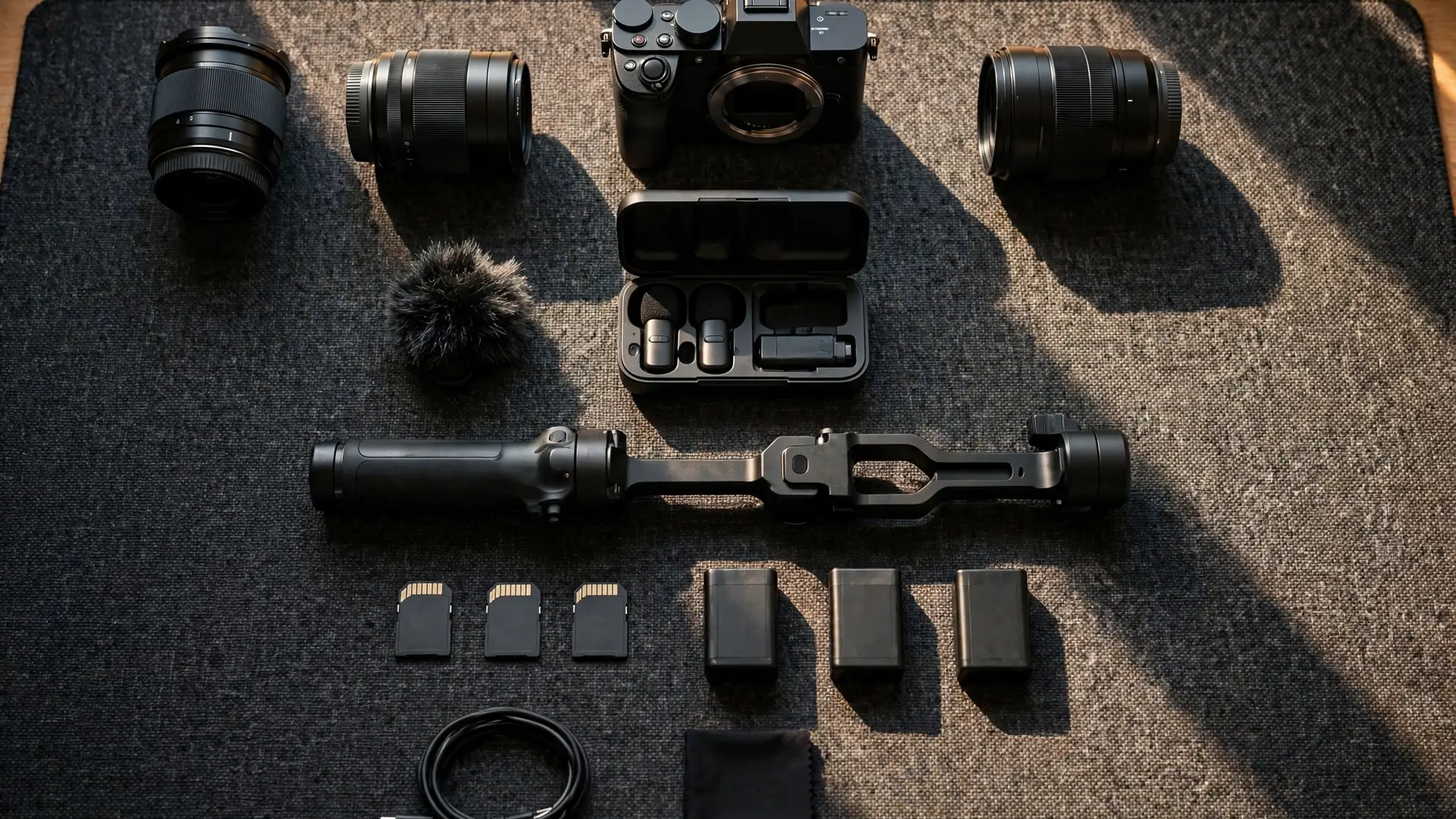
Lay the whole kit out and work through it piece by piece. Serial numbers live on the body’s base plate or inside the battery door, around lens barrels, and on the box labels you were about to throw away. Photograph each plate rather than typing numbers from memory; one transposed digit can stall a claim. Photograph items with no serial at all, like tripods and lights, too.
Store the list and its receipts somewhere that survives losing the gear itself: a cloud folder, not a notebook in the stolen bag. It is the same records habit that protects your footage and files, the other half of a shoot, and our guide to how to back up video footage builds this discipline for your files. Update your own inventory the day new gear arrives, photo first, and add the item to the policy schedule in the same week.
What gear cover usually pays for, and what it leaves out
Equipment cover is generally built around sudden physical loss: theft, accidental damage such as drops and knocks, and fire are the core perils, and many policies add water damage and loss in transit. The exclusions are just as consistent: wear and tear is not covered, breakdowns are not accidents, and gear that simply vanishes, with no evidence of what happened, is excluded or sold as an extra on many policies.
Read insurer pages and the pattern holds. Insureon’s equipment insurance page states plainly that inland marine cover pays for repair or replacement after events like theft, vandalism and accidents, and does not cover general wear and tear. Full Frame Insurance states on its camera equipment page that mysterious disappearance is not covered: gear that simply vanishes, with no evidence of what happened, is different from a theft from an unattended place, and gear left unattended or unsecured may fall outside cover depending on the policy’s conditions, which makes how you store gear in a locked car, or keep a bag on your shoulder, a matter of policy conditions, not just habit.
Two more exclusions catch creators. Drones are their own category for some insurers, needing a separate section or policy rather than riding inside camera cover. And insurance pays only after damage happens; prevention is the cheaper half of the pair, and our camera and lens care guide covers the cleaning, storage and handling habits that keep gear out of trouble.
Rented and borrowed gear is not automatically covered
Your policy covers the property it names, and a rented cinema lens or a friend’s borrowed body belongs to somebody else. Other people’s gear enters your cover only if the policy has a section for rented or non owned equipment, with its own limit and conditions. Rental houses know this, which is why they ask for proof of insurance or offer their own damage waiver at the counter.
Before a rental, ask your insurer three things: does my policy cover equipment I rent or borrow, up to what amount, and do you issue the certificate the rental house wants? A certificate of insurance is the insurer’s formal proof that a policy exists, showing the cover, limits and dates the rental house needs. If your policy says no to rentals, the rental house’s own waiver is a legitimate per trip purchase, priced into the shoot, but a waiver is not insurance, so read exactly what it covers before relying on it.
Liability: the risk that is not your gear at all
Gear cover pays for your property. Liability cover answers a different event entirely: your filming injuring someone, or damaging something of theirs. A tripod leg across a pavement, a light stand toppling onto a parked car, a cable run through a shop doorway that someone trips over. It is sold as general liability, on its own or inside a business policy, and a personal gear policy does not contain it.
Keep the two covers separate when comparing quotes: a policy can be generous on equipment and silent on liability, or the reverse.
Travel insurance is not a gear policy
A travel policy’s baggage section is built for suitcases: a modest per item cap, claims judged as lost vacation property, and no interest in your serial numbers. A gear policy or floater is built to follow named equipment, and mainstream versions provide worldwide cover that travels with the item. If your kit flies with you, compare those two honestly.
Whichever route you hold, read three lines before a trip: the territory wording, any limit on trip length, and the conditions on vehicles and unattended gear. Packing and carrying the kit is its own craft, and our guide to flying with camera gear covers cases, batteries and airline rules in full.
If the worst happens: how a gear claim actually runs
In general terms, the sequence is the same everywhere: report a theft to the police and keep the report number, tell the insurer promptly, send the inventory entry for the item with its receipt, serial number and photos, and provide a repair estimate for damage, or a replacement quote for a loss. The insurer then settles on the policy’s valuation basis, less any deductible. Keep the damaged gear until the insurer says otherwise; it is evidence, not trash.
This is where the inventory stops being admin and becomes the claim. A scheduled item with a photographed serial plate and a stored receipt is a short conversation. An unscheduled item described from memory is a negotiation, conducted when you can least afford the delay, because the channel has no camera.
Two honest warnings. Timelines vary by insurer and by loss, and no guide can promise a settlement date, so plan around a repair or rental gap rather than around a payout. And never inflate a claim or invent a circumstance to fit the wording: that is insurance fraud, the one move guaranteed to turn a bad week into a catastrophe.
Questions to ask before you pay for any policy
Take this list into every quote conversation. The answers separate a policy that fits a working creator from one that only mentions cameras.
- Is my gear covered while I earn money with it, or is this personal use only?
- Is each item scheduled by serial number, or covered under one blanket amount with a per item cap inside it?
- Do you settle at replacement cost or actual cash value, and is the scheduled amount guaranteed or a ceiling?
- What is the deductible, and does it apply per claim or per item?
- Are accidental drops and liquid spills covered, or only named events like theft and fire?
- What are the exact conditions on gear left in a vehicle or unattended on location?
- Is cover worldwide, and are any countries or trip lengths excluded?
- How do I add a new lens mid policy, and from what moment is it covered?
- Are rented and borrowed items covered, and can you issue certificates for rental houses and venues?
- What proof will you ask for at claim time?
When cover is worth it, and when it honestly is not
Cover earns its premium when replacing the kit from savings would stop the channel, when the gear works in public and travels, and when clients or venues start asking for insurance certificates. It is harder to justify when the whole kit is small enough to replace without pain, where keeping your own repair and replacement fund is a rational alternative many creators choose.
Think of what the premium actually buys: continuity. A working creator’s real loss in a theft is rarely the camera; it is the month of missed uploads and the sponsor deliverable shot on a borrowed body (borrowed gear needs its own cover, as the rented section explains). Insurance, plus a rental plan for the gap, keeps you publishing through it.
Where the kit is small enough to replace without pain, that savings pot is the honest alternative: no premium, no claim paperwork, just money set aside for repair or replacement.
If you are still assembling the kit, sequence matters more than cover: our guide to how to start vlogging puts gear in its proper order, after the channel idea and the publishing habit. Insure what exists once it would hurt to lose, and go in with three things ready: a written inventory, an honest statement of use, and a policy whose two deciding lines you have actually read.
Frequently asked questions
Does homeowners insurance cover camera gear I use for YouTube?
Often only partly, and sometimes not at all. A home policy treats the camera as household contents, subject to category limits, and homeowners insurance is not designed for most business uses of a home, as the NAIC’s consumer guide puts it. A small hobby kit may fit with a scheduled endorsement; a monetized channel’s kit deserves the business use conversation first.
What is the difference between scheduled and blanket coverage?
Scheduled coverage lists each item individually with its make, model, serial number and insured amount; an item that is not listed is not covered. Blanket coverage insures a whole class of property up to one total amount without listing items, though a per item cap may sit inside it. Many policies blend both: big items scheduled, small accessories blanketed.
Does camera gear insurance cover accidental drops and spills?
On equipment and personal articles policies, yes: accidental damage is a core peril. State Farm, for example, describes its personal articles cover as insuring against theft and accidental direct physical damage, including drops and spills, with limitations and exclusions. A base home policy is narrower, and wear and tear and mechanical breakdown sit outside all of these.
Is my gear covered when I travel abroad with it?
It can be: mainstream personal articles policies provide worldwide cover that travels with the item, and equipment floaters are built for gear away from home. But territory wording, trip length limits and unattended gear conditions vary by policy, so confirm your wording before a trip. A vacation travel policy’s baggage cap is not a substitute; it was written for suitcases.
Do I need separate cover for rented camera gear?
Unless your policy includes a rented or non owned equipment section, yes. Your cover names your property; a rental house’s lens is theirs. Rental houses commonly accept your insurer’s certificate, sell their own damage waiver, or both. Check which applies before collection day.
What is a deductible on a camera policy?
The deductible is the first slice of a loss you pay yourself before the insurer pays the rest. It may apply per claim or per item, and floaters and personal articles policies often run with a low deductible or none: On these policies there is generally no deductible, though State Farm notes you can add one if you want it.
What records do I need before I can make a claim?
The inventory, built before the loss: each item’s make, model and serial number, its receipt, and photos of the item and its serial plate. Add the police report for a theft and a repair estimate or replacement quote for damage. A scheduled policy has much of this on file already, which is why scheduled claims run faster.
Does gear insurance cover me if someone trips over my tripod?
No. That is liability, a separate cover for injury or damage you cause to others and their property. Gear cover pays for your equipment only. Liability comes as general liability cover, and it is what venues ask for when they request a certificate of insurance.
Is a drone covered under camera gear insurance?
Not automatically. Some insurers place drones in their own category with a separate section or policy. If a drone is part of your kit, name it explicitly during the quote and get the answer in writing.
Keep exploring
Protecting the files your gear captures, earning from the kit you protect, and getting started.