
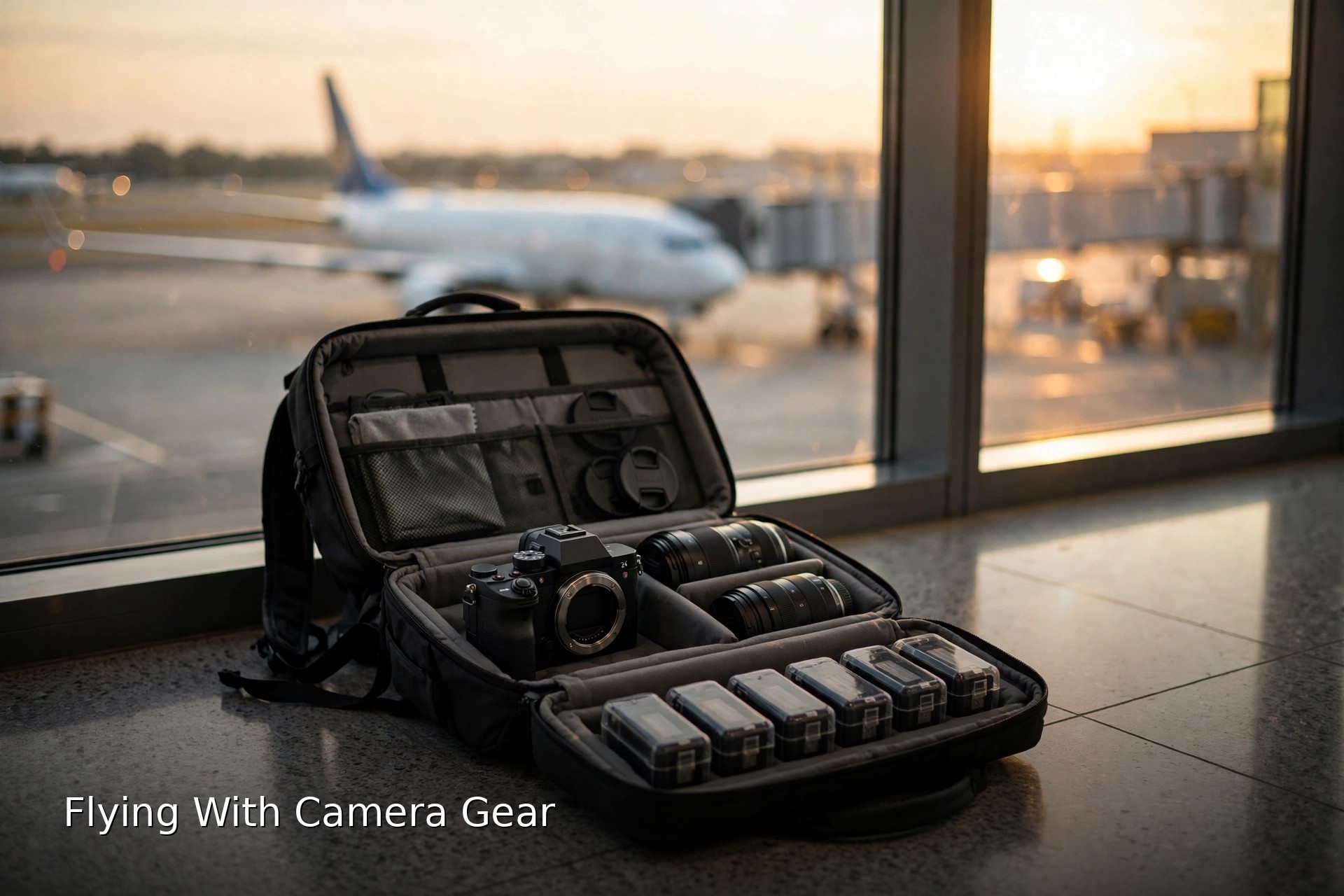
Last updated: October 2026
Airlines do not really care about your camera. They care about what powers it. Nearly every problem a vlogger hits at an airport comes down to batteries: where they are packed, how big they are, and whether their terminals are protected. The good news is that the rules are simpler than they look, and once you know the handful that matter, a full camera kit flies without drama. This guide explains the battery rules in plain terms, then covers packing, protection, security, and the international differences that catch people out.
The short version
- Spare batteries live in your carry-on, always. Loose batteries and power banks are banned from checked bags on effectively every airline.
- 100 watt hours is the magic number. Every normal camera battery sits far below it. From 101 to 160 Wh you need airline approval and may carry at most two spares. Above 160 Wh is cargo only.
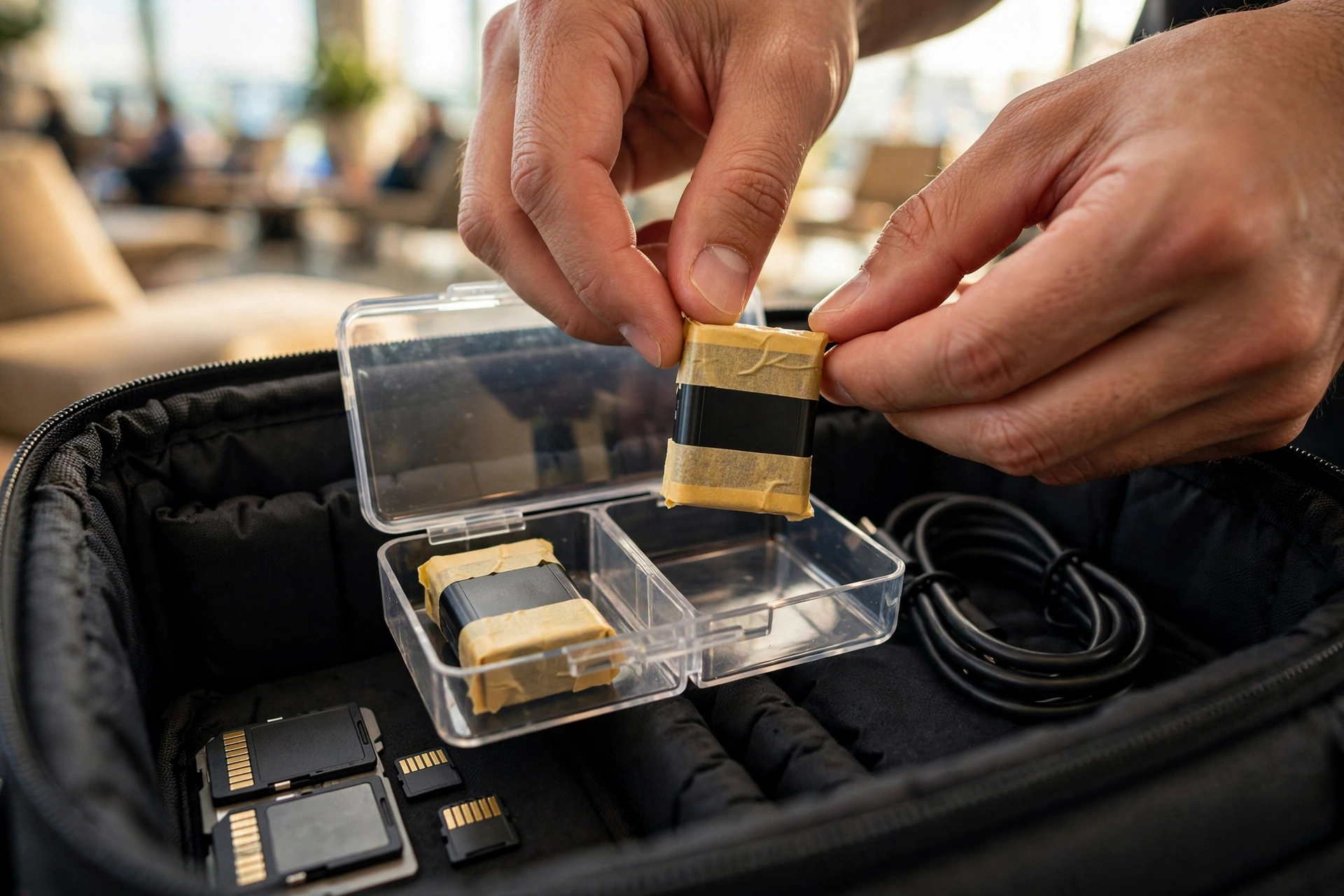
- Protect every terminal: a battery case, the original packaging, or tape across the contacts.
- Cameras, lenses, batteries, and memory cards belong in the cabin, not the hold. Checked bags are for clothes, tripods, and things that survive being thrown.
- Check your airline’s own page before you fly. The global baseline is stable, but carriers can and do add stricter limits.
On this page
- The battery rules in plain English
- Watt hours: finding the number that decides everything
- How many spare batteries can you actually take?
- Chargers and power banks
- Packing a camera bag as hand luggage
- Protecting your kit, and what never goes in the hold
- Getting a bag of electronics through security
- International flights: where the rules shift
- The night-before pre-flight checklist
- Flying with gear questions, answered
- Keep exploring
The battery rules in plain English
Three rules cover almost everything. Spare lithium batteries travel in the cabin only, never in a checked bag. Batteries up to 100 watt hours (Wh) need no permission. Spares between 101 and 160 Wh need airline approval and are capped at two per person, and anything over 160 Wh cannot fly as passenger baggage at all.
These rules come from a shared baseline: the FAA’s PackSafe guidance in the United States, TSA screening rules, and the IATA guidance that airlines worldwide build their policies on. Individual airlines then publish their own versions, sometimes stricter. Delta, for example, repeats the carry-on rule and adds that spares should stay accessible under the seat rather than in the overhead bin. United states the same limits: devices under 100 Wh, and up to two larger batteries with approval. The wording differs; the shape does not.
| Battery size | In your carry-on | In a checked bag | Approval needed? |
|---|---|---|---|
| Up to 100 Wh | Yes, spares and devices | Devices only, fully switched off. Spares never. | No |
| 101 to 160 Wh | Yes, maximum two spares per person | No | Yes, from the airline, before you fly |
| Over 160 Wh | No | No | Cannot fly as baggage; cargo only |
One definition explains the whole table: in airline wording, a “spare” is any battery carried on its own rather than installed in the device it powers. The battery inside your camera is installed. The four in your pouch are spares, and so are your power bank and the battery in a charging case, because neither is installed in a camera: airlines count power banks and charging cases as spares, and spares are what the checked bag ban targets. The reasoning is simple fire safety. If a battery overheats in the cabin, the crew can reach it and deal with it. In the hold, nobody can. That is also why a damaged, swollen, or recalled battery should never fly at all: leave it at home.
Watt hours: finding the number that decides everything
Watt hours measure a battery’s total energy, and airlines regulate by Wh rather than the milliamp hours printed in big type on power banks. Most batteries state Wh on the label. If yours only shows volts and amp hours, multiply them: volts times amp hours equals watt hours.
Run the numbers on a typical vlogging kit and the rules stop feeling scary. A full size mirrorless battery like Sony’s NP-FZ100 is rated around 16 Wh. Canon and Fujifilm equivalents land in the same range. Action camera batteries are smaller still, roughly 5 to 7 Wh. Even a serious drone battery usually sits well under the line: most consumer drone packs fall between about 20 and 80 Wh. A drone you cannot fly with is not much of a travel tool. The 100 Wh ceiling only starts to bite with cinema gear: V-mount batteries are commonly sold at 98 Wh precisely to stay legal, with 150 Wh versions sitting in the approval band.
Power banks need one conversion, because they advertise milliamp hours. Take the mAh figure, divide by 1000, and multiply by the voltage, usually 3.7 V. A 20,000 mAh power bank works out to 74 Wh, comfortably legal. A 27,000 mAh model lands just under 100 Wh, which is exactly why that odd size exists. If a battery’s label has worn away or never listed Wh, check the manual or the maker’s spec page before the trip. A small label of your own on the case can help you remember the number, but it is not a manufacturer rating, and staff can only go by what they can verify.
How many spare batteries can you actually take?
For batteries under 100 Wh, the FAA sets no fixed number: they must be for your own use, not for resale. IATA’s passenger guidance works on a ceiling of 20 spare batteries per person, and some airlines set their own caps, so a realistic vlogging load of four to eight camera batteries plus a power bank is well inside every limit.
The gap between the rules and reality matters here. A vlogger shooting travel days might carry six camera batteries, two drone batteries, a power bank, and batteries inside a gimbal and a wireless mic receiver. Counted as spares once removed, that is still only about eleven, roughly half the IATA ceiling. You would have to work hard to look like a battery vendor, and that is the actual test in the FAA wording: personal use, in reasonable quantities.
Where you do need to slow down is the big band. Spares from 101 to 160 Wh are capped at two per person, full stop, and the approval is not a formality to sort out at the gate. Contact the airline ahead of the flight, ideally when booking, and keep any confirmation with your travel documents. If your kit depends on large V-mounts, the cleaner solution is often two 98 Wh batteries instead of one 150 Wh: no approval, no cap worries, and they charge as fast.
Chargers and power banks
Wall chargers and cables have no battery inside, so they can go in any bag, but the smart place for them is the one you will open first at your destination. Power banks are batteries, so they follow spare battery rules exactly: cabin only, terminals protected, and under 100 Wh, or between 101 and 160 Wh with airline approval and at most two spares; anything over 160 Wh cannot fly as passenger baggage.
A few habits save trouble. Keep the power bank in your personal item rather than buried in the overhead bag, because several airlines now require spares to stay within reach during the flight, and a growing number of Asian carriers, Singapore Airlines and Thai Airways among them, prohibit using or charging from power banks on board at all since 2025. Charging your camera batteries from a power bank mid-flight can also draw questions; the calm approach is to board with everything charged and treat the power bank as arrival insurance.
Charging hubs deserve one thought before you pack them. A multi-bay charger that holds batteries is, at security, a box of batteries: fine in the cabin, a problem if it ends up in the hold with batteries inside. Travel with chargers empty and batteries in their case, and if you use a charging case for wireless mics, remember the case itself contains a battery and counts as a spare. Small things, but check-in staff and screeners think in exactly these categories.
Packing a camera bag as hand luggage
Your camera bag has to satisfy two different rulebooks at once: the battery rules, and the airline’s size and weight limits for cabin bags. Weight is the one that catches vloggers. Many international carriers cap cabin baggage at 7 to 10 kg total, and a mirrorless kit with two lenses can pass that before you add a laptop.
Build the bag in layers. The camera body with your main lens, all batteries, memory cards, and your footage drives form the untouchable core: this never leaves your possession, and if an airline forced a choice, this is what you would carry onto the plane in your hands. Around it go the second lens, gimbal, and audio kit. Tripods and light stands are the natural candidates for the checked suitcase, wrapped in clothes, since they hold no batteries and survive knocks.
Use the personal item properly. On most airlines you get a cabin bag plus a smaller personal item that fits under the seat, and one good use of that second allowance is for the battery case, power bank, and laptop. It keeps the items airlines most want accessible actually accessible, it spreads weight between two allowances on airlines that weigh bags separately (some carriers count both bags together, as noted in the international section), and if your main bag ever gets gate-checked, every spare battery and power bank is already on your person. That gate-check moment is the classic trap: TSA and the airlines both require you to pull every spare battery and power bank out of a bag before it goes into the hold. Having them pre-sorted into the personal item turns a scramble into a shrug.
At the weigh-in, honest tricks only, but use them: the camera around your neck with the heaviest lens mounted is worn, not weighed, on most carriers, and a battery case in a jacket pocket during check-in is a long standing photographer’s habit, as long as every terminal stays covered and the batteries go back in the case before security. If your kit is chronically over, the real fix is a lighter second lens or one body instead of two on leisure trips. Your shoulders will agree at the other end.
Protecting your kit, and what never goes in the hold
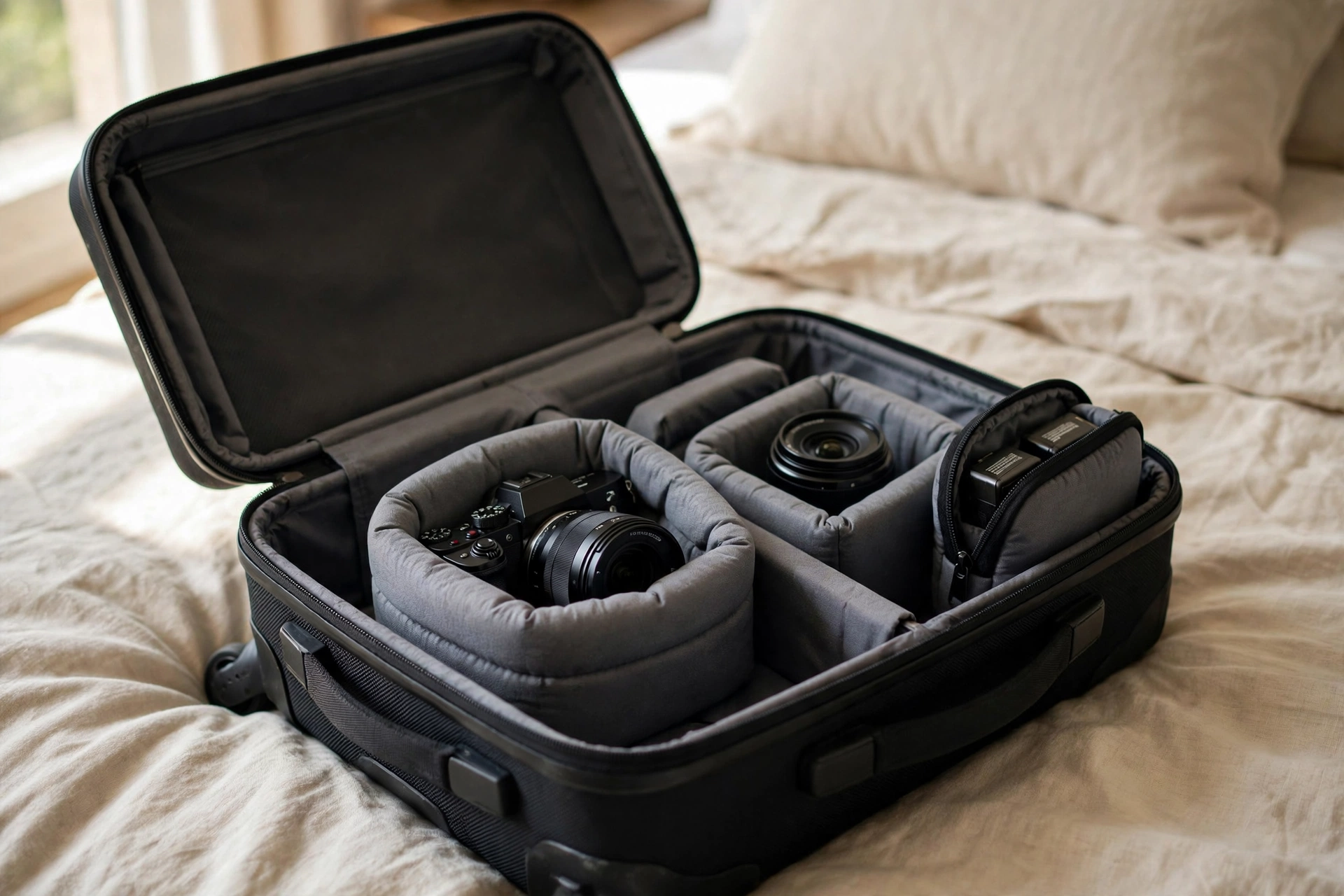
Protection has two jobs: stop batteries shorting, and stop glass and bodies breaking. Battery terminals get covered with a case, caps, original packaging, or tape. Cameras and lenses travel in padded dividers or wraps, with body caps on and hoods reversed. Cameras, lenses, batteries, cards, and drives belong in the cabin.
Checked bags are thrown, stacked, rained on, and occasionally lost, and airline liability for fragile electronics in the hold is limited even when they accept the claim. So the hold gets what survives it: clothes, tripods, monopods, empty cases, chargers with no batteries in them. Some vloggers check a hard equipment case with stands and grip gear inside a suitcase; that works because the contents are metal and plastic, not sensors and glass.
Inside the cabin bag, pack for the drop you hope never happens. Each lens gets its own padded cell, nothing glass touches anything metal, and the camera sits in the middle of the bag rather than against a corner. Padded wraps earn their keep for awkward shapes like gimbals and action cameras in a light travel setup. Keep one more rule for the footage itself: cards and drives stay on your person or in the personal item, and the day’s footage gets backed up before travel days whenever a laptop allows. Gear can be replaced mid-trip. Yesterday’s sunrise over a new city cannot.
Getting a bag of electronics through security
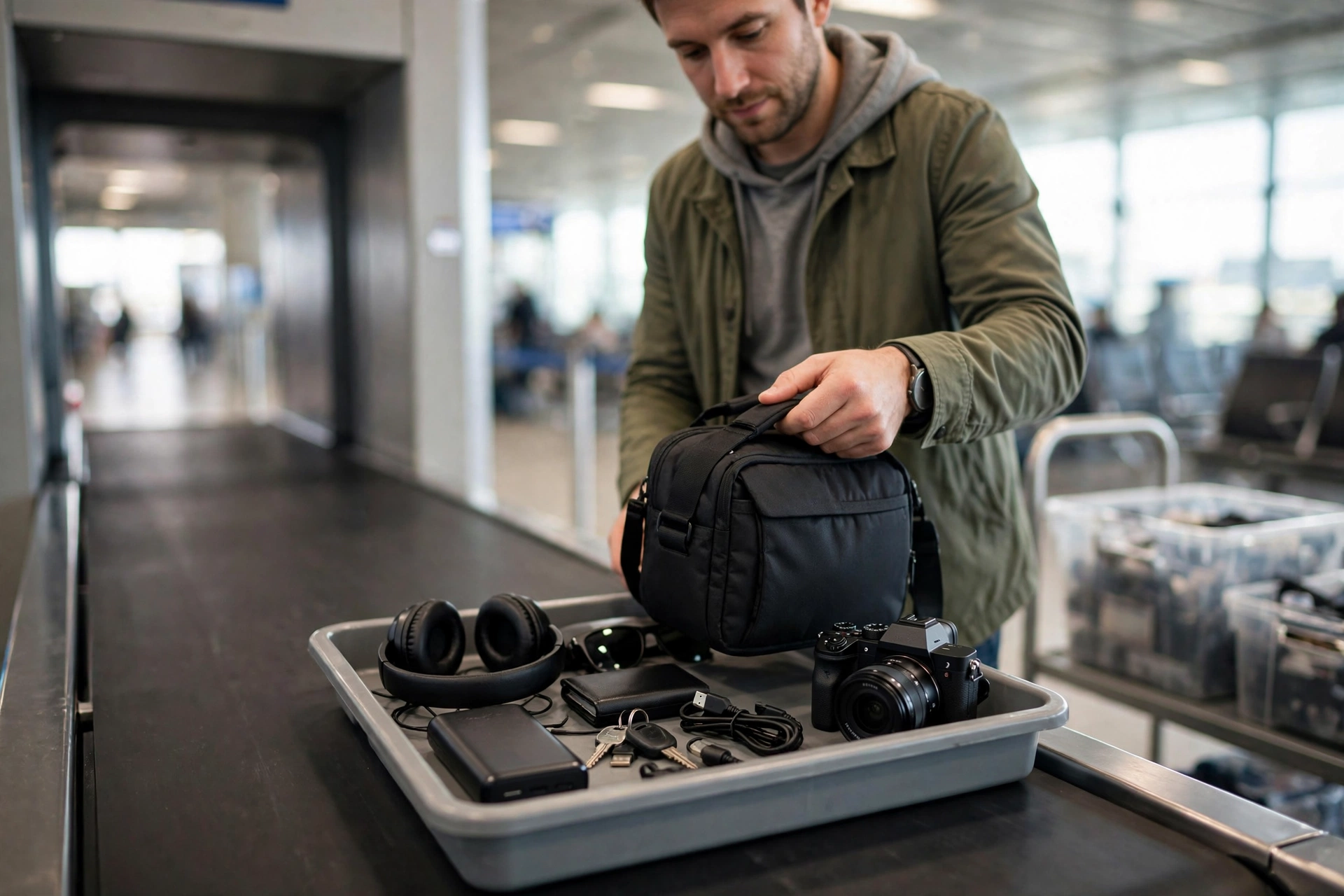
Security is rarely a problem when the bag is organized. Expect large electronics to be scanned, sometimes separately, and be ready to power a device on if asked. Batteries packed together in one visible case, with terminals covered, clear faster than batteries scattered through pockets and pouches.
Checkpoint rules vary by airport and scanner generation. Newer CT scanners at many airports now let cameras and laptops stay inside the bag; older lanes still want laptops and larger items in a tray. Follow the lane you are in rather than the last airport’s habit. What never changes: a dense bag full of electronics can be pulled for a hand check and a swab, and that is routine, not suspicion. Build five extra minutes into your connection time and it stops being stressful.
Small courtesies speed everything up. Put the battery case near the top so you can show it without unpacking. Keep the Wh ratings readable, on the batteries themselves, not worn smooth. If an officer asks what something is, answer in plain words: camera battery, microphone, gimbal stabilizer. Creators sometimes get asked to power on a camera, mainly on routes with enhanced screening; one more reason to board with a charged battery installed. And if you also shoot while you travel, the filming rules at the destination are a separate question from the flight, which our guide to starting a travel vlog touches on from the planning side.
International flights: where the rules shift
The battery baseline is nearly identical worldwide because it comes from the same ICAO and IATA framework, but three things change across borders: cabin weight limits get stricter, some airlines restrict power bank use in flight, and destination countries have their own rules for drones and filming that begin where the flight rules end.
Weight is the daily reality. United States carriers mostly police cabin bag size, while many European, Asian, and Oceanic carriers weigh cabin baggage and enforce caps around 7 to 10 kg. A kit that sails through a domestic US flight can be pulled up at an international check-in desk, which is why the personal item strategy and a worn camera matter more abroad. Some carriers also count both bags against one combined weight, so read your specific ticket’s allowance, not the airline’s headline number.
Power bank habits differ too. Following a series of cabin incidents, South Korean airlines require power banks to stay on your person or in the seat pocket rather than the overhead bin, and several major Asian carriers now ban using or charging from them during flight entirely. None of this stops you carrying one; it changes where it rides and what you can do with it at 35,000 feet. When in doubt, keep spares under the seat in front of you, which happens to be Delta’s stated preference at home as well.
Finally, the destination gets a vote. Drone rules are the big one: some countries require permits or registration, some restrict drones at customs, and a few ban them outright, no matter what the airline allowed. Our rundown of the best drones for vlogging covers the gear side; the legal side needs a check of your destination’s aviation authority before every trip. Customs can also ask questions about expensive kit on re-entry, so keeping purchase receipts or a gear list with serial numbers on your phone is a five minute job that can save an hour.
The night-before pre-flight checklist
The night before, run through this list: confirm every spare battery is in the cabin bag with terminals covered, check the Wh of anything unusual, charge everything, back up your cards, weigh the bag against your ticket’s limit, and read your airline’s battery page once more in case anything changed.
- Batteries: all spares in the battery case, terminals covered, case in the personal item or top of the cabin bag. Nothing lithium in the checked suitcase.
- Sizes: any battery over 100 Wh has written airline approval saved with your booking, or it stays home.
- Charge state: the battery in the camera fully charged so it can be powered on at security, and the batteries you plan to shoot with charged too. Spares that will sit unused can rest at a partial charge, roughly a third to a half, which is the kindest state for storage.
- Cards: footage backed up before the trip, cards and drives in the cabin bag.
- Gear split: cameras, lenses, cards, and drives in the cabin. Tripod and stands wrapped in the checked bag.
- Weight: cabin bag weighed at home against the allowance for this ticket, camera ready to wear if it is close.
- Documents: airline battery page checked, drone rules for the destination checked, receipts or a serial number list on your phone.
Run that list and the airport becomes the easiest part of the trip. The rules reward exactly one quality: being boringly prepared.
Flying with gear questions, answered
Quick answers to the questions vloggers ask most about batteries, carry-on packing, and getting expensive kit through the airport intact.
Can camera batteries go in checked luggage?
Spare batteries, no, never. Any lithium battery that is not installed in a device must travel in your carry-on, and that includes power banks. Technically, a battery installed inside a camera may be checked if the camera is fully switched off and protected from being turned on, but that is the rule for the battery, not a reason to check a camera: cameras, lenses, cards, and drives should still travel in the cabin.
How many spare camera batteries can I bring on a plane?
For batteries under 100 Wh, which covers every normal camera battery, there is no fixed FAA number as long as they are for your own use. IATA guidance works on a ceiling of 20 spares per person, and some airlines set lower caps. A typical vlogging load of four to eight camera batteries is comfortably inside every rule.
What does the 100 Wh limit mean for a power bank?
Multiply the power bank’s milliamp hours divided by 1000 by its voltage, usually 3.7 V. A 20,000 mAh bank comes out at 74 Wh and flies without approval. Around 27,000 mAh is the largest common size that stays under 100 Wh, which is why you see that exact capacity everywhere.
Can I fly with a large V-mount battery?
It depends on the rating. A 98 Wh V-mount flies like any other battery under 100 Wh. A 150 Wh V-mount sits in the approval band: cabin only, airline approval arranged in advance, and a maximum of two spares per person. Anything over 160 Wh cannot travel as passenger baggage at all.
Do I really need to tape my battery terminals?
Terminals must be protected from short circuit; tape is one accepted method, alongside the original packaging, a battery case, a sleeve, or an individual bag for each battery. A proper battery case is the easiest to live with and the fastest to show at security, but a strip of tape across the contacts does satisfy the rule.
What happens if my carry-on gets gate-checked?
You must remove every spare battery and power bank and keep them with you in the cabin before the bag goes into the hold. Gate staff expect this and will usually give you a moment. Keeping all batteries together in your personal item or one case makes the moment painless.
Can I charge my camera batteries during the flight?
Yes, from the seat’s own power: charging a camera battery in its charger from the seat’s USB or power outlet is generally fine. What airlines restrict is charging from a power bank: several Asian airlines ban using power banks in flight, and Delta advises against charging spare batteries on board. So charge from seat power, not from a power bank, and board with everything charged.
Are drone batteries treated differently from camera batteries?
The battery rules are the same: spares in the cabin, under 100 Wh without approval, terminals protected. Most consumer drone batteries fall between roughly 20 and 80 Wh. What differs is the destination: drone laws, permits, and import rules at the other end are separate from flight rules and need their own check.
Can my camera bag count as my personal item?
Only if it fits under the seat in front of you within your airline’s personal item dimensions. A compact camera sling or small backpack often qualifies, which some vloggers use deliberately: personal item for the camera kit, cabin bag for clothes. Measure your bag against the published sizes before relying on it. This is the alternative to the layout in the packing section, where the personal item instead holds the battery case, power bank, and laptop: either layout works, as long as batteries and power banks stay in the cabin and within reach.
What if one of my batteries is swollen or damaged?
Do not fly with it. Damaged, swollen, or recalled batteries are prohibited because they are the ones most likely to overheat, and airline staff can refuse any battery that looks compromised. Replace it before the trip and recycle the old one through a proper battery collection point.
Keep exploring
Packing the kit is one part of a filming trip. These guides cover planning the vlog itself and choosing gear that travels well.