
Last updated: October 2026
Most small vloggers wait for a brand to discover them, and most wait a long time. Brands rarely hunt for channels under 10,000 subscribers, yet they sign channels that size every week, usually because the creator moved first with a specific pitch, a tidy one-page media kit and a rate they could explain. This guide covers the whole path: what brands really buy, the kit that proves it, the pitch that earns replies, a rate-setting method that does not copy other people’s numbers, and the red flags that mark a bad offer.
The short version
- Brands buy a defined audience that trusts you, not a subscriber count.
- Your media kit is one page: identity, numbers, audience, formats, proof, contact.
- Pitch one specific video idea to one brand at a time, and follow up twice.
- Set your rate from your views, your time and the rights included, and hold a walk-away floor.
- Get deliverables, usage rights and payment terms in writing before you film a frame.
- Never pay to take part, and never hide a sponsorship. Both end careers early.
On this page
- What a brand is actually buying from a small vlog channel
- Get the channel pitch-ready before you send anything
- The one-page media kit, section by section
- The media kit, finished: scan, checklist, and tailoring
- Finding brands that already work with channels your size
- The pitch email: five parts and two worked examples
- Setting a rate when nobody publishes the real numbers
- How to price brand deals: formula, ladder, and rate card
- Agree the deal in writing, then deliver like a professional
- Red flags in inbound offers
- The one rule with no exceptions: disclose
- Brand deal questions, answered
- Keep exploring
What a brand is actually buying from a small vlog channel
A brand is not buying your subscriber count. It is buying access to a specific group of viewers who trust your judgement, a piece of content it could not make itself, and a video that keeps working in search results long after posting day.
Three things sit inside every deal, and a small channel can offer all three. The first is a defined audience in a decision-making mood. Vlog viewers research purchases: which camera, which bag, which app, which trip. A few thousand viewers all comparing the same kind of product are worth more to the right brand than a broad channel ten times the size.
The second is borrowed trust: a product appearing inside your real routine, used the way you actually use it, carries a weight no studio advert can match. The third is shelf life. A sponsored segment lives inside a video that can rank in search for years, while a feed post fades within days.
Deals come in a handful of shapes, and the shape tells you what to charge for.
| Deal shape | What the brand gets | What to watch for |
|---|---|---|
| Gifted product | A product sent to you, coverage hoped for but unpaid | Keep deliverables tiny; fine for proof, not a business model |
| Affiliate hybrid | Coverage plus a tracked link or code, paid as commission on sales | Check how sales are tracked, and for how long, before relying on it |
| Paid integration | A 60 to 90 second segment inside one of your normal vlogs | The standard format at this size; agree length and placement in writing |
| Dedicated video | A whole video built around the product or service | More filming work and more retention risk; price it as its own product |
| Multi-video series | Two or more videos across a few weeks | Where repeat relationships start, often growing out of one integration done well |
Brand deals are one stream among several, not the whole plan. Our guide to how to make money vlogging maps the full mix of ads, affiliates, products and deals, and where each one fits as a channel grows.
Get the channel pitch-ready before you send anything
A marketing manager checks your channel the way you would check a freelancer’s portfolio: recent uploads, comment quality, and whether your corner of the internet looks safe to stand next to.

Start with a clean-up pass: unlist, retitle or remove old rants, sloppy titles and anything you would not want read aloud in a brand meeting. Then make yourself contactable, with a business email in your About section and video descriptions. Deals quietly die in comments and direct messages because the person holding the budget cannot find a professional way to reach you.
Next, stock the shop window: publish two or three videos that show the formats you want to sell. A vlog where a product you already own plays a natural part, such as the editing app visible on your screen while you work, is a free demonstration of what a sponsor would be buying. Finally, read your comments the way a brand will. Viewers asking genuine questions, and getting answers, look like an audience; a wall of empty praise does not.
If your view counts are still thin, fix that side first: brands price from the views you reliably deliver. Our guide on how to get more views on YouTube works through the levers that move that number.
The one-page media kit, section by section
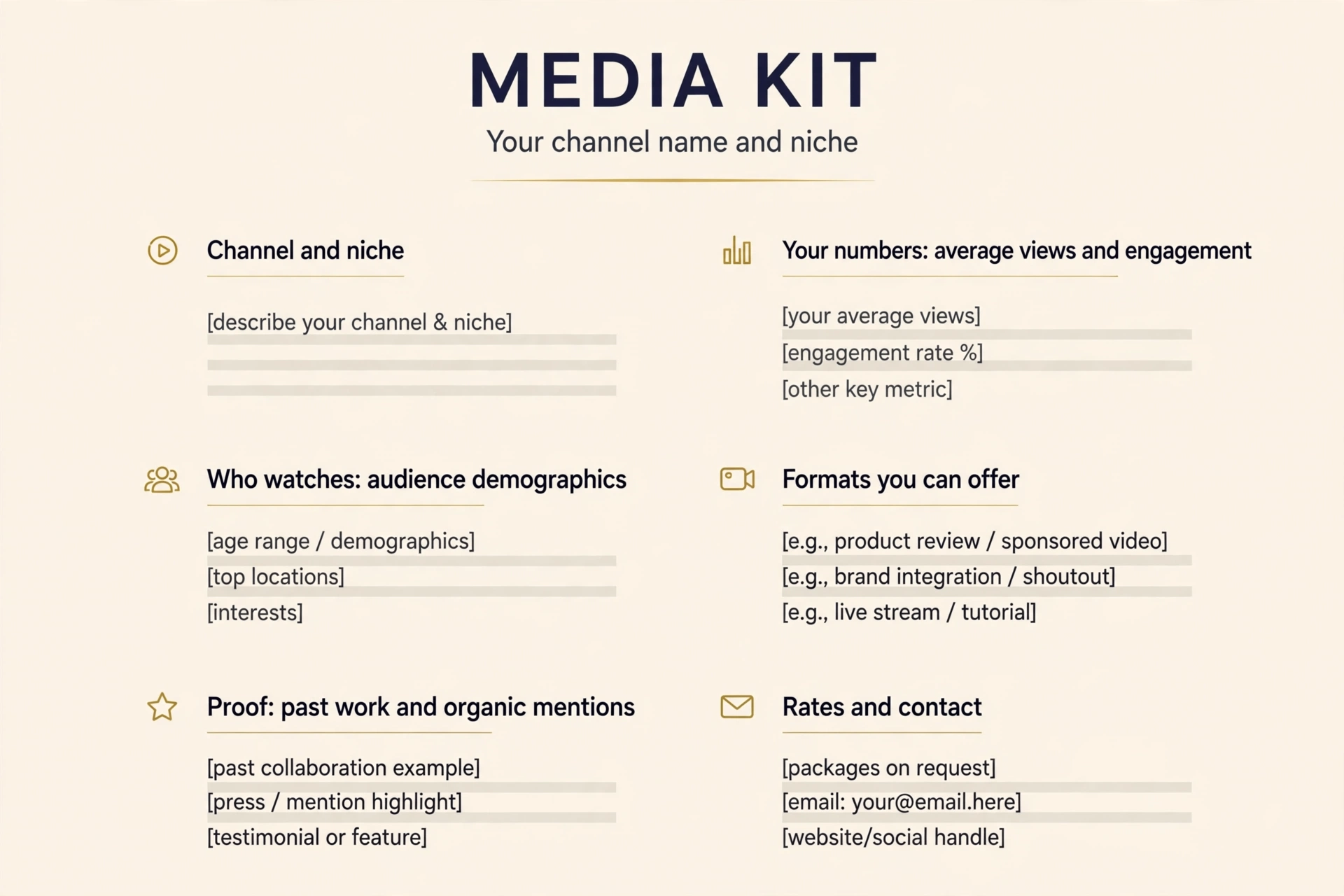
A media kit for a small vlogger is one page with six parts: who you are, the numbers that matter, who watches, what you can make, the proof, and how to reach you. Its job is to let a busy stranger say yes in under a minute.
1. Channel and niche, in one line
Open with a single sentence a stranger can repeat in a meeting: “Weekly vlogs putting budget camera gear through real shoots, for creators building their first channel.” Your channel name, your face or logo, and that sentence are the whole header.
2. Your numbers, the honest averages
Show average views per video across your last 10 to 20 uploads, your subscriber count, and typical likes and comments per video. Never lead with your single best video: brand staff do this maths themselves, and a kit whose averages collapse when they open your channel ends the conversation on the spot. Honest averages build the asset you are really selling: trust.
3. Who watches
Pull the basics from YouTube Studio: main age ranges, top countries, and the interest that defines the audience. For a vlogger this can be the strongest section on the page: “viewers setting up their first channel this year” is a customer profile a gear brand can act on immediately.
4. The formats you can offer
List the deal shapes you actually sell: integration, dedicated video, a Short built from the same shoot. A short menu turns a vague inquiry into a choice, and choices get approved faster.
5. Proof, even before your first paid deal
Paid work goes here once you have it. Before that, use honest substitutes: videos where you featured a product unpaid because you use it, a viewer comment showing buying intent, steady growth across the last quarter. Never borrow logos or imply a brand relationship that did not happen. Genuine organic proof reads as credible; a decorated section reads as a risk.
6. Rates and contact
Close with a starting package or a plain “packages on request”, plus one business email and your channel link. Refresh the numbers monthly: a kit carrying last year’s figures tells a brand you have gone quiet, even if you have not.
Keep the page clean: large type, nothing a reader has to zoom into. The same visual discipline that makes a thumbnail earn its click applies here, and our guide to how to make YouTube thumbnails that get clicks covers that thinking in depth. A tidy PDF or a single web page both work.
The media kit, finished: scan, checklist, and tailoring
The six parts above build the page. This section finishes it: the difference between the kit and the rate card, the 15-second scan a brand runs on page one, a checklist to fill before sending, how gifted work becomes a case study, the two formats to send, and how to tailor the page per pitch.
The kit and the rate card do different jobs
The kit earns the reply. The rate card closes the deal.
A brand reads the kit to decide whether to answer at all: the right audience, real engagement, believable proof. That decision takes under a minute, which is why the kit stays one page with a starting package or the plain words “packages on request” and nothing more. The rate card is the second document, sent once the brand replies: it holds the full pricing behind those starting rates, the formula, the add-on ladder, and the package structures, all covered in the pricing section below. Sending the full card with the first pitch buries the reply decision under numbers the brand has not asked for yet. Sending only the kit after the brand asks what you charge wastes a warm reply. Two documents, two moments: kit first, card on reply.
What a brand checks in the first 15 seconds
Audience fit, engagement, past work, and a rates line, in that order, all on page one.
A brand reader does not read the kit top to bottom on first pass. They scan for four things, and the order matters. First, audience fit: does this channel reach buyers of this product, stated in the one-line niche sentence and the who-watches section. Second, engagement: do viewers act, shown by honest averages of likes and comments, not subscriber count. Third, past work: has this creator made sponsored-style content before, shown by the proof section. Fourth, a rates line: is this in budget, shown on page one as a starting package or the plain words “packages on request”, not hidden behind a reply. If any of the four is missing or buried past page one, the scan fails and the kit goes in the pile. Check your own page against that order before sending: fit, engagement, proof, rates line, each visible at a glance on the one page.
The fill-in checklist
Fill every line before the kit leaves your desk. A blank line is a question the brand will not ask.
- Header: channel name, face or logo, and the one-line niche sentence a stranger can repeat.
- Numbers: average views per video across the last 10 to 20 uploads, subscriber count, and typical likes and comments.
- Audience: main age ranges, top countries, and the one interest that defines the viewers.
- Formats: the deal shapes you actually sell, each named.
- Proof: one paid example if you have it, otherwise one honest substitute from the proof section above.
- Rates: a starting package, or the plain words “packages on request”.
- Contact: one business email and the channel link.
- Date: the month and year the numbers were refreshed, printed on the page.
If a line is empty, fill it or cut the section. A kit with a gap reads as unfinished, and an unfinished kit reads as an unprofessional creator.
Turn gifted work into a case study
One gifted collaboration becomes one case study line: what you made, what happened, nothing dressed up.
Gifted work counts as proof only when it is presented as a case, not a claim. One line per collaboration: the product, the video you made with it, and what happened after posting, such as views, comments showing buying intent, or link clicks if you tracked them. Name the brand only where the work was real and the brand sent the product. Never write gifted work up as paid work: brands check, and one dressed-up line ends trust in the whole page. One honest gifted case beats three vague ones.
Send both: the PDF and the live link, both dated
The stronger move: send the PDF for the inbox and the live link for the current numbers. Date both.
The kit section above says a tidy PDF or a single web page both work, and either one alone is acceptable. Sending both is the stronger move, because they do different jobs. The PDF is the version the brand can forward inside their company and read offline. The live link is the version whose numbers are always current. Date-stamp both with the month and year of the last refresh, refresh the live link monthly, and reissue the PDF when the numbers move enough to matter. A PDF dated six months ago tells the brand the numbers are stale even if the live link is fresh, so keep the two in step.
Tailor one page per pitch, and add formal extras for bigger deals
One base kit, one tailored page per pitch. Bigger deals get formal extras on top.
Tailoring does not mean rewriting the kit. Keep one base page, then change three things per pitch: the proof example, swapped for work closest to that brand’s product; the format menu, led by the shape that brand buys; and the one-line niche sentence, angled at that brand’s buyers. The rest stays identical, which keeps the kit honest and the work small. For bigger deals, add formal extras behind the one page rather than inside it: a one-page case study sheet for your best past collaboration, an audience screenshot from YouTube Studio, and references from past brands, only where those brands agreed to be named. Extras support the page; they never replace it.
Finding brands that already work with channels your size
Start where the money is already flowing: the sponsors inside similar vloggers’ videos, the brands running creator programs in your niche, and the products your viewers already buy and ask about.

The richest source is other people’s videos. Watch channels a little bigger than yours and note every integration: a brand that has already paid three small vloggers understands the format, has a process and a budget line, and does not only buy famous names. Build a target list of 20 to 30 brands this way, each with a named contact in partnerships or marketing, found via the brand’s own site. The support inbox is where pitches go to be ignored.
Think adjacent, not just obvious. A travel vlogger can pitch luggage, insurance, booking tools and translation apps, not only cameras; a gear channel can pitch bags, straps, storage and editing software. Some brands run open creator programs: apply where the terms are product or payment, skip any that ask you to buy your way in. Marketplaces such as YouTube’s BrandConnect can add the odd inbound offer, but treat them as a bonus. The reliable engine at your size is a researched list and direct outreach.
The pitch email: five parts and two worked examples
A pitch that earns replies is short, specific and easy to forward to a boss: one concrete video idea, quick proof your audience fits the product, and a single simple question at the end.
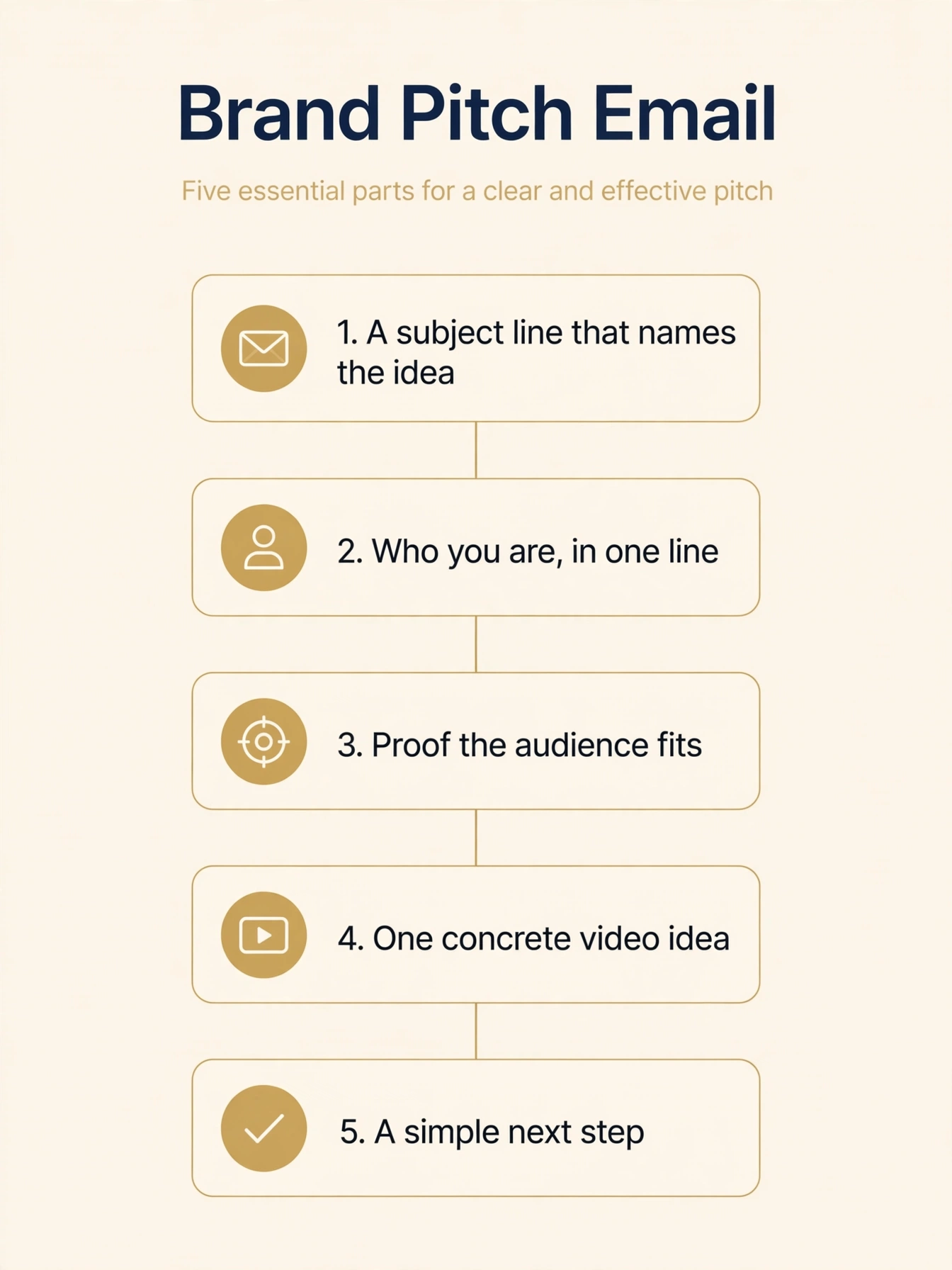
Most pitches fail because they ask the brand to do the thinking. A vague “I would love to collaborate” forces a busy manager to invent the campaign and guess your value. Flip the work onto yourself. Five parts, in this order:
- A subject line that names the idea. “Video idea: your mini tripod on a four-day city vlog series” gets opened. “Collaboration inquiry” gets archived.
- Who you are, in one line. Channel, niche, and the two numbers that matter: average views and audience. Not your biography.
- Proof the audience fits. You use the product, or your viewers are exactly who buys it, with one concrete detail to back it up.
- One concrete video idea. A real video already on your filming plan, with a rough date and a natural place for their product.
- A simple next step. One question that is easy to answer: “Worth a look? I can send my media kit.”
Keep the email near 150 words, attach the kit, and replace the bracketed parts with your own real details, numbers and names, never borrowed ones.
Example pitch: a camera accessory brand
Subject: Video idea: your mini tripod on a four-day city vlog series
Hi [Name], I run [Channel], weekly travel vlogs for first-time creators. My last 12 videos average [X] views, and the most common question in my comments is what kit I carry.
I am filming a four-day city series with carry-on luggage only. Your mini tripod is the piece of kit viewers keep asking me to recommend, and I would build one full segment around shooting low-light street scenes with it.
My media kit is attached with audience details. Would this fit any campaign you are running?
[Your name]
[Channel link]
Notice what it leaves out: no flattery marathon, no subscriber count, no rate. The proof is a behavior, viewers asking about kit, not a claim. A software brand needs the same skeleton, different fit:
Example pitch: an editing software brand
Subject: Integration idea: your caption tool inside my editing workflow vlog
Hi [Name], I make editing workflow vlogs for new creators on [Channel], averaging [X] views per video.
Next month I am filming one complete edit, from raw clips to upload. Captions are the step my viewers say they dread most, so your tool would sit in the middle of that video, used on real footage rather than shown as a demo.
My media kit is attached, with two recent videos. Is this the kind of placement your team is buying this quarter?
[Your name]
[Channel link]
Then work the pipeline like a grown-up: one polite follow-up after about a week, a shorter one later, then stop. Most pitches go unanswered at every size, and single-digit reply rates are a sensible planning assumption, so a few researched pitches a week beat thirty copy-and-paste blasts. Track contacts in a spreadsheet, and re-pitch when you have a new idea or a growth milestone to report.
Setting a rate when nobody publishes the real numbers
There is no official price list, and the rate tables on big blogs describe other people’s channels, niches and years. Build your rate from your own inputs: the views you reliably deliver, the work the format takes, and the rights the brand walks away with.
Work through five inputs: your average views, because brands think in cost per view even when paying flat; your production time, because an integration folded into a planned vlog costs far less than a dedicated shoot day; the format weight, because a dedicated video is a bigger product than a 60 second segment; the rights included, covered next; and the deadline, because a brand that needs you filming this week is buying flexibility too.
From those inputs, set two numbers: a walk-away floor you will not go below, and a target you open with. If a budget sits under your target, trade scope rather than price: a shorter segment, fewer revisions, no usage rights, a later slot. Discounting the same package teaches the market your rate was fiction. Three ready shapes, an integration, a dedicated video, and a bundle adding a Short from the same shoot, make a yes easier than one take-it-or-leave-it figure.
Two habits protect you. First, ask what budget range is allocated before you quote; a serious brand knows its range. Second, treat gifted deals as a short apprenticeship, not a rate: take them only while building proof, only for things you would genuinely film with, and only with tiny deliverables. A gifted deal never includes the right to run your footage as advertising, and anything that requires you to buy the product first is not a deal at all.
How to price brand deals: formula, ladder, and rate card
Price every deal from three parts: what the work costs you, what your audience is worth, and what each extra right costs on top. Add the three parts, and you have a quote you can explain line by line.

The rate section before this one gives you five inputs and two numbers, a floor and a target. This section builds on that one and turns those inputs into one quote. The five inputs land here: views in distribution value, production time in the production floor, format in the size of that floor, since a dedicated shoot day costs more than an integration folded into a planned vlog, rights in the add-on ladder, and deadline in the rush rung.
The pricing formula, with a worked vlog example
Quote equals production floor plus distribution value plus add-ons. The production floor is your time at your own day value plus direct costs such as travel, props, and extra editing hours. Distribution value is your reliable average views multiplied by a per-view value you choose yourself. Add-ons are every extra right from the ladder below, each priced as its own line.
The figures below are example maths only, not rates to copy. Say a dedicated video reliably reaches 8,000 views. Say you value a shoot and edit day at 400 in your own currency, and direct costs run 50, so the production floor is 450. Say you set your per-view value at 5 cents purely to show the maths, so distribution value is 400. The base is 850. Then add each extra right from the ladder below as its own line. If the brand wants paid advertising on top, that is not part of the 850. It is a separate line.
Change any input and the quote changes honestly. That is the point. The brand sees what it pays for, and you never have to defend a number you cannot explain.
Thirteen questions before you quote
Ask all thirteen before you name a figure. The answers decide the price more than your subscriber count does.
- What budget range is set aside for this deal?
- What exactly do you want delivered: format, length, and where it posts?
- Where may the brand reuse the video or clips, and for how long?
- Which competing categories are blocked, and for how many days?
- Will the brand run your content as paid advertising, and on which platforms?
- How many revisions are included, and what does an extra round cost?
- When must it film and publish, and is there a rush fee if the date moves closer?
- Do you want the raw footage, and what is that worth as a separate line?
- Who approves the video, and how many approval rounds are there?
- When and how do you pay: on posting, on approval, or split?
- What claims must the video make or avoid, and how is disclosure worded?
- Are any competing deals already running that clash with this one?
- Who owns the finished video once it is posted, and what may each side do with it afterwards?
If a brand cannot answer several of these, the deal is not ready to price. Say so, and quote once the answers arrive.
The add-on ladder: price every extra as its own line
The base fee covers one organic post on your channel. Everything beyond that is a separate line on the quote, priced by scope, never given away.
| Add-on | What the brand gets | How to price it |
|---|---|---|
| Usage rights | Reuse of the video or clips beyond your channel, for a set period, in set places, on set media | By period, territory, and media: longer, wider, and more media each raise the line |
| Whitelisting | Running your content as paid ads from your handle or theirs | As its own line, priced by ad run length and spend tier, never folded into the base |
| Exclusivity | A window where you feature no competing brand | By window length and category width: a wide category for a long window costs the most |
| Rush | Filming or publishing sooner than your normal turnaround | As a rush supplement for the squeezed schedule |
| Extra revisions | Rounds beyond the included number | Per round, agreed before filming starts |
| Raw footage | Unedited clips from the shoot | As a separate line, since it hands the brand material it can cut its own ads from |
Treat every rung as a starting point for your own card, not a published rate. Your numbers move with your audience and your costs. The ladder itself does not change: each extra is priced, none is free, and a brand that wants more pays for more. Paid advertising is whitelisting, not usage: if the brand runs your content as ads, that is the whitelisting line, and the usage line covers organic reuse only.
Beyond the one-off: packages, retainers, ambassador deals, and UGC
One video is only one shape. Four longer shapes pay differently, and each suits a different brand.
Packages are several videos over a set period at an agreed per-video rate. They suit a brand with a launch calendar. Price per video, with the same add-on ladder on top of each one.
Retainers are a monthly fee for a set output, for example two integrations a month. They suit a brand that wants you regularly. Price the month, not the video, and cap the deliverables in writing, or a retainer quietly becomes an open-ended obligation.
Ambassador deals run longer, usually three to twelve months, with regular posts and often first refusal on new products. Price by term and deliverables, not by hope. This is paid, contracted work, and it is not the pay-to-join scheme flagged in the red flags section.
UGC means you make the video, the brand posts it, and it never appears on your channel. Price it on production plus usage, since there is no audience value to charge for. That is the whole difference: no distribution value, because nothing is distributed to your viewers.
Every longer shape needs an end date and a review point. Without both, a good arrangement drifts into one you cannot leave cleanly.
The low-ball playbook
A low offer is not an insult to answer with anger, and it is not a price to match. It is a smaller deal waiting to be shaped.
First, thank them and name your base quote plainly: the base from the formula plus the add-ons that deal’s scope includes, not a discount. Second, offer the smaller scope at the same per-item rates, with lines removed so the total falls: a shorter segment, no usage rights, a later slot. Third, if the budget truly cannot move, say no cleanly and leave the door open for a later deal. Never answer with a halved quote. Answer with the smaller scope.
Keep a short reply ready for this, so a low offer on a busy day does not get a rushed yes.
Keep your rate card dated and fresh
Your rate card is the numbers behind the rates line in your media kit. A card without a date is a guess with formatting.
Date-stamp every version. Refresh it whenever your reliable views jump or you add a format, and check it on the same monthly rhythm as your kit numbers. Retire old versions, so a brand never quotes last year’s card back at you. Keep one current card, not five versions floating around in old email threads.
Agree the deal in writing, then deliver like a professional
A friendly email thread is not an agreement. Before you film, pin down the deliverable, the timeline, the revision limit, the usage rights, the exclusivity window and the payment terms in one document you both confirm.
None of this needs a lawyer at your size, just one clear page or complete email that both sides have confirmed. Work through this checklist for every paid deal:
| Term | What to pin down |
|---|---|
| Deliverables | Format, length and placement in the video, plus any link, code or pinned comment duties |
| Draft and revisions | Whether the brand sees a draft, how many revision rounds are included (cap it at two), and what counts as a revision rather than a reshoot |
| Timeline | Filming date, draft date and the publish window, with slack for product shipping |
| Usage rights | Where the brand may reuse your video or clips, and for how long. Running your content as paid advertising is a separate permission and a separate price |
| Exclusivity | Which competing categories are blocked, and for how many days. A window that stops other income belongs in the price or gets shortened |
| Payment | Amount, when it lands, the method, and a deposit for a first-time brand. Payment on results alone, with no base fee, is not a term, it is a gamble |
| Disclosure | Confirm in writing that you will label the video as a paid promotion. A brand that resists this ends the negotiation |
Delivery is where small channels quietly win. Send the draft when you said you would, publish inside the agreed window, then report back with screenshots of views and, where the deal includes a link or code, link clicks at the agreed interval, typically after the first week and again at a month, since vlog views keep arriving. Close with one natural next idea while the results are fresh. Brands rebook creators who make their internal reporting easy.

Red flags in inbound offers
The fastest way to lose money as a small creator is a bad deal, not a missed one. Walk away from any offer that asks you to pay, hides its terms, or wants your audience misled.

- The ambassador scheme that charges you. You are invited to join, then asked to buy the product at a “creator discount” or pay shipping on your free item. Legitimate brands ship at the brand’s expense; money flowing from creator to brand is the tell.
- Exposure carrying a paid workload. A dedicated video, three Shorts and advertising usage, all for “exposure” and a discount code. A list that long means the brand knows the work has value.
- Perpetual usage in the small print. Your face and footage in a brand’s ads forever is the most expensive thing you can sign away. Price broad usage as its own line item, shorten it, or refuse it.
- Any request to hide the sponsorship. “Our other creators just make it look natural.” That sentence ends the deal. See the next section.
- Vague money. No written terms, payment only after results, or payment via gift cards and unusual channels. Real budgets move through boring, traceable methods.
- Impersonators. Brand names spelled slightly wrong, free email addresses instead of the company domain, links to click urgently. Verify the sender through the brand’s real website before you reply to anything.
- Too-good offers with strange payment steps. A fee far above anything your channel size justifies, followed by an overpayment and a request to refund the difference, is a known fraud pattern, not generosity.
One verification habit defuses most of this list: ask for the campaign brief and budget range in writing, from an address on the brand’s real domain, before agreeing to anything. And never hand over channel login details; partner access is granted inside the platform’s own tools, never by password.
The one rule with no exceptions: disclose
If a brand pays you, gifts you a product, or gives you anything of value in exchange for coverage, your audience gets told, clearly and early, every time.
Say it in the video, put it in the description, and use YouTube’s paid promotion setting when you upload. Do not accept “our other creators do not mention it” as an argument, and do not bury the label. The detailed wording and platform rules deserve their own guide; the principle itself has no gray area. The trust that makes a brand want your channel is the same trust disclosure protects.
Brand deal questions, answered
Short answers to the questions small vloggers ask most about sponsorships, from subscriber minimums to what to do after the video goes live.
How many subscribers do you need to get brand deals?
There is no fixed minimum, because brands buy average views, engagement and audience fit rather than the subscriber number. Channels in the low thousands regularly land gifted and small paid deals when their viewers are specific and active. Below that, build proof first: videos where products you own appear naturally.
What should a small channel put in a media kit?
Six things on one page: channel and niche in one line, honest average views and engagement, who watches (ages, countries, interests), the formats you offer, proof from past work or organic product features, and rates or a packages note with a business email. Update monthly.
How do I find the right person to pitch at a brand?
Look for partnerships, creator marketing or PR roles on the brand’s own website, press pages or creator program pages. Avoid the support inbox, which has no budget and no reason to forward you. If the brand already sponsors channels like yours, finding who runs that process is half the pitch.
How long should a pitch email be?
Around 150 words: one concrete video idea, one piece of audience proof and one closing question, short enough to read on a phone. The attached media kit carries the detail; the email only has to earn the click that opens it.
How much should a small YouTuber charge for a sponsorship?
There is no honest universal figure: it depends on your average views, the format, production time and the rights included. Build a floor and a target from those inputs, ask the brand’s budget range, and trade scope rather than discounting when it sits below your target. Copied rate tables price somebody else’s audience.
Should I accept free product instead of payment?
Early on, sparingly, and on your terms: a product you would genuinely use on camera, tiny deliverables, and no advertising usage rights. Cap how many you take; each one is portfolio building, not income. Never pay shipping and never buy the product first; that is a sale, not a deal.
What are usage rights, and should I charge for them?
Usage rights are the brand’s permission to reuse your content. Reposting a clip on their channels is a small grant; running your video as paid advertising is a much bigger one. Both sit outside the fee for making and posting the video, and both belong in the price as their own line item, defined by where and for how long.
What is exclusivity, and why does it cost extra?
Exclusivity means agreeing not to feature competing brands for a set period. In a narrow niche, a long window can block a real share of your possible deals, so price it into the deal or negotiate a shorter window and a tighter category definition.
Do I need a contract for a small brand deal?
You need written terms, which at this size can be one complete email both sides confirm: deliverables, timeline, revision limit, usage, exclusivity, payment and disclosure. The bigger the fee and the broader the usage, the more formal the document should be. A chat thread and a promise are not enough.
How do I turn one brand deal into repeat work?
Deliver on time, then report back without being chased: screenshots of views and link clicks after the first week and again at a month. Add one natural next video idea while the results are in front of them. Repeat deals are where sponsorship income actually stabilizes.
Keep exploring
Brand deals pay best on a channel that is set up to grow. These guides cover the foundations your pitches will point to.