
Last updated: October 13, 2026
Every vlogger hits the same wall: the camera is charged, the light is good, and you have absolutely nothing to film. This list exists for that exact moment. Below are 60 concrete vlog ideas in 10 categories (daily life, travel, challenges, food, tech, fitness, money, learning, faceless formats and seasonal). Each one is specific enough to film this week. No vague filler.
They are written for 2026: formats that survive short attention spans, ideas that need no crew and no real budget, and plenty that work if you would rather not show your face. Pick one from the top 10 below and film it today. Or jump straight to the category that fits your channel.
10 ideas to film this week
- The $50 city challenge: 24 hours in your own city on a fixed budget (travel).
- Cook the same dish three ways: budget, mid-range, and “money is no object” (food).
- A 30-day skill challenge: pick one skill, film the progress weekly (challenges).
- “What my side hustle actually makes”: real numbers, no guru talk (money).
- Old phone vs. new phone for a week: film what breaks first (tech).
- Sunrise hike vlog: start at 4 a.m., film the climb and the breakfast after (travel).
- No-spend weekend: 48 hours, zero money, filmed start to finish (challenges).
- Learn to draw in 30 days: day 1 vs. day 30, side by side (learning).
- Honest fridge tour: then cook a full meal from only what’s inside (food).
- Seven outfits from ten items: a one-week capsule wardrobe challenge (daily life).
On this page
- 10 ideas to film this week
- Daily life & routines (ideas 1 to 6)
- Travel & adventure (ideas 7 to 12)
- Challenges & trends (ideas 13 to 18)
- Food & cooking (ideas 19 to 24)
- Tech & gear (ideas 25 to 30)
- Fitness & health (ideas 31 to 36)
- Money & business (ideas 37 to 42)
- Learning & skills (ideas 43 to 48)
- Faceless formats (ideas 49 to 54)
- Seasonal & holidays (ideas 55 to 60)
- Pick ideas for your channel, not someone else’s
- Batch a month of ideas in one sitting
- Stretch one idea into a five-part series
- Shrink any idea into a 60-second short
- Vlog ideas FAQ
- Keep the ideas coming
Daily life & routines
The easiest videos to make are about the life you’re already living. The trick is filming it with a plan, not hoping something interesting happens.
- 1. A “day in my life” cut into one-minute segments. Put on-screen timestamps on each block (7:00, 7:01, 7:02) and cut anything that doesn’t earn its minute. The constraint forces honest pacing and zero filler.
- 2. Your real morning routine vs. the routine you wish you had. Film both days back to back, then compare on camera. The gap between aspiration and reality is where the humor and the honesty live.
- 3. “What I spent today.” Track every expense for 24 hours (coffee, transport, the random snack) with receipts shown on camera. People are nosy about money; give them the real numbers.
- 4. Seven outfits from ten clothing items. Pick ten pieces from your closet and build a full week of outfits from nothing else. Film a quick fit-check each morning and rate the repeats at the end.
- 5. A night routine for people who work late. Wind-down habits, a screen-time audit from your phone’s own stats, and prepping tomorrow’s clothes and bag: practical, relatable, easy to film.
- 6. Room tour, 2026 edition. Show what’s changed in your space this year and tell the story behind each change: the desk upgrade, the plant that survived, the corner that finally got organized.
Travel & adventure
Travel vlogs don’t need a plane ticket. The best ones make familiar places feel new by adding a constraint, a budget or a mission.
- 7. The $50 city challenge. Spend 24 hours in your own city on a fixed budget for food, transport and one activity, and film every expense. The budget is the plot; the city is the set.
- 8. A local spot tourists never find. Take viewers somewhere within 30 minutes of home that no guidebook lists: the viewpoint, the food stall, the quiet street. Then explain why locals love it.
- 9. A weekend trip from a single carry-on. Pack it on camera, weigh it, then survive two full days from one small bag. Show what you packed that you never touched and what you wished you’d brought.
- 10. Recreate a viral travel photo in your hometown. Find the angle, match the shot. Then pull back and show the unglamorous behind-the-scenes: the crowd, the parking lot, the waiting. Reality-check videos always perform.
- 11. Public transport only for a full day. No car and no rideshare. Get around by bus, train or tuk-tuk to run your normal errands, then rate the experience honestly once the day is done.
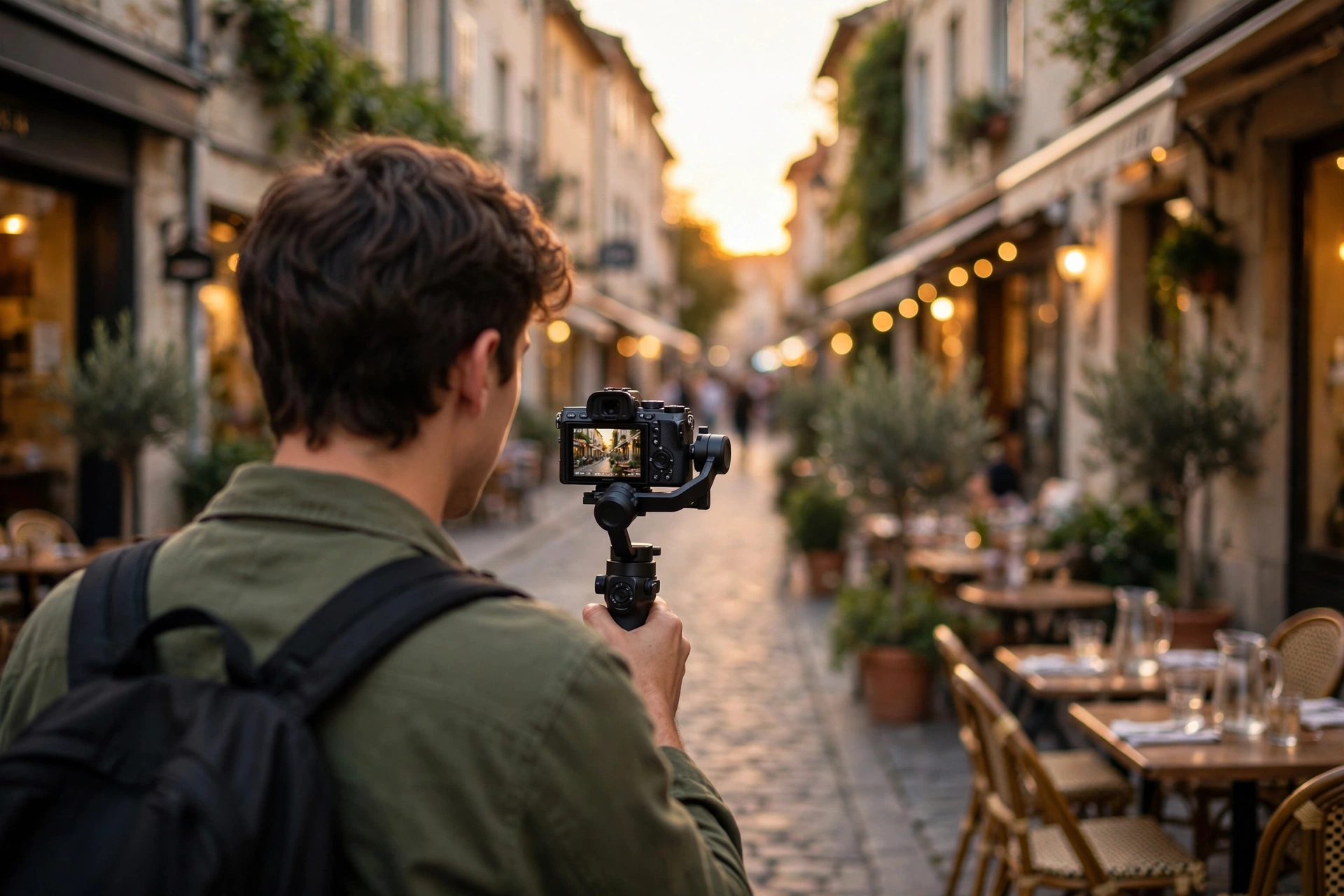
- 12. Sunrise hike vlog. Start at 4 a.m., film the climb in the dark, the summit at first light, and the well-earned breakfast after. The early start is the hook; the sunrise is the payoff. For aerial shots of the route, see our drone guide.
Challenges & trends
Challenges give your video a built-in structure (a start, a middle and a payoff), which is exactly what keeps viewers watching to the end.
- 13. A 30-day skill challenge. Pick one skill (juggling, drawing, a language or an instrument) and film a short progress check every week. Day 1 vs. day 30 is the thumbnail; the middle weeks are the story.
- 14. No-spend weekend. 48 hours, zero money spent, filmed start to finish. Show the temptations, the workarounds, and the final tally of what you would normally have spent.
- 15. Let your viewers plan your day. Run a poll the night before, then follow the winning schedule exactly: meals, activities, everything. The loss of control is the entertainment.
- 16. 24 hours speaking only the language you’re learning. Subtitles on, fails included. Order food, ask directions, make small talk. The struggle is the content, and learners will relate hard.
- 17. Try the week’s biggest viral trend for a full day. Not a 30-second clip. Commit to it for an entire day and film what it’s actually like. Trends die fast; the “I actually did it” angle outlives them.
- 18. Digital detox weekend. Phone in a drawer from Friday night to Monday morning. Film the boredom, the phantom-vibration urges, and what ends up filling the time instead.
Food & cooking
Food is the most forgiving vlog category: everyone eats, the visuals are naturally good, and a clear format beats fancy production every time.
- 19. Cook the same dish three ways. Budget version, mid-range version, and “money is no object” version, then do a blind taste test on camera to see if the expensive one actually wins.
- 20. Recreate a restaurant dish at home for under $10. Film the attempt, the cost breakdown on screen as you go, and the side-by-side verdict against the real thing.
- 21. Honest fridge tour, then cook from only what’s inside. Open the fridge, show everything without tidying first, then make a full meal from those ingredients. No shopping allowed.
- 22. The one-ingredient challenge. Pick eggs, potatoes, or rice and turn it into three completely different meals. The constraint forces creativity viewers can steal for their own kitchens.
- 23. Street-food crawl in your own city. Five stalls, one afternoon, small portions at each, then rank them at the end with a clear winner. Keep the camera rolling between stops for the walk-and-talk.
- 24. Meal-prep Sunday in real time. A full week of lunches cooked in under two hours, costs shown per meal. Speed up the boring parts, keep the tips. You can repeat this format every month.
Tech & gear
Tech vlogs work best as honest tests, not spec readings. Use the thing, film what happens, give the verdict.
- 25. “What’s on my phone,” 2026 edition. Every app, every home-screen decision, every notification setting, all explained. Viewers love this format because it’s nosy in the best way and full of app discoveries.
- 26. Build a creator desk setup for under $200. Buy it piece by piece on camera (light, mic arm, background) and show the before-and-after of your filming corner. See our lighting guide for the light pick.
- 27. Old phone vs. new phone for a week. Shoot your whole week on a 4 to 5 year old phone and film what actually breaks first: the camera, the battery or the storage. The results usually surprise people.
- 28. Buy one hyped gadget, use it daily for 30 days. Unbox it, then come back with the honest verdict after a month of real use, not the day-one excitement. Long-term reviews are rare and they get watched.
- 29. Free apps that replaced my paid subscriptions. The full list, what each one does, and what you gave up switching. Practical, searchable, and easy to update next year.
- 30. Film an entire vlog on the cheapest gear you own. Old phone, no mic, window light. Then ask viewers to guess what you shot it on. It proves the point that gear isn’t the bottleneck, and it’s fun to make.
Fitness & health
The fitness videos people actually finish are experiments and honest journeys, not lectures. Film the process, skip the preaching.
- 31. A 30-day walking challenge. 10,000 steps a day for a month. Film the routine, the bad-weather excuses, the days you almost quit, and whatever changed by the end. Simple, relatable, repeatable format.
- 32. “I tried the 5 a.m. club for a week.” Real sleep notes, real energy levels, and an honest answer on whether it stuck. Don’t fake the enthusiasm if it was miserable. That’s the video.
- 33. A zero-equipment home workout in real time. Film a genuine 20-minute session viewers can follow along with. Keep a timer on screen and share form tips as you go. Follow-along videos get saved and rewatched.
- 34. What I eat in a day, realistic version. Honest meals, normal kitchen lighting, real portions, with no styling and no “perfect” day. The anti-glamour angle is exactly why people trust it.
- 35. Learn one physical skill in 30 days. Handstand, skating, swimming: weekly progress clips, wobbles included. The visible improvement arc is the whole reason this format never gets old.
- 36. A two-week sleep experiment. Fix exactly one habit (no phone in bed, or a fixed bedtime) and track how you actually feel each morning. One variable, honest log, clear conclusion.
Money & business
Money content gets watched when it’s specific and honest. Real numbers beat vague advice every time.
- 37. “What my side hustle actually makes.” Real revenue, real expenses, real hours. The full picture, with no guru talk. Even small numbers are interesting when they’re honest.
- 38. A freelance month on a whiteboard. Income, costs, savings, taxes set aside. All of it, drawn out and explained. Freelancers and aspiring ones will watch this twice.
- 39. Sell everything you don’t use for 30 days. List it all, film what sells, what doesn’t, the weird buyer messages, and the final profit total. Decluttering meets money: two audiences in one video.
- 40. “What I’d do with $1,000 to start over.” Build a realistic plan on camera: what you’d buy, what you’d skip, where the first dollar goes. Constraints make business content concrete.
- 41. Audit every subscription for a month. List them all, check what you actually used, then cancel the ones you forgot existed, right on camera. Everyone has zombie subscriptions; show them yours.
- 42. The true monthly cost of your lifestyle. Rent, food, transport, fun, the small stuff. Add it all up and react to the total. Simple concept, endlessly watchable, different for everyone.
Learning & skills
Learning vlogs have a natural arc viewers love: day one is rough, day thirty is different, and the progress is the whole point.
- 43. Learn a language for 30 days using only free apps. Weekly speaking tests on camera. The stumbles are the content. Show the app, the routine, and how far free tools actually get you.
- 44. One book a week for a month. Four books, and what each one actually taught you in under five minutes per book. Pick a theme (productivity, money or biographies) so the month has a spine.
- 45. Take a free online course and show the result. The certificate or the honest dropout review. Either ending is a video. Review the course itself: what was worth it, what was filler.
- 46. Teach your best skill in 10 minutes. Compressed and no fluff: the fastest useful lesson you can give. If you can teach it clearly in ten minutes, you understand it; viewers can tell.
- 47. Learn to draw in 30 days. Day 1 vs. day 30, side by side, with the ugly middle days included. “No talent required” is the promise that gets beginners to click.
- 48. Interview someone 20 years older about their career. A parent, a mentor or a neighbor. Ask what they’d do differently. The advice episode: simple to film, genuinely valuable, and it honors the guest.
Faceless formats
You don’t need to appear on camera to vlog. These formats put the subject, the process, or the story in front of the lens instead of you.
- 49. Narrated screen recording. Walk through a real process (budgeting a month, editing a video, planning a trip) with voiceover. Record the screen, talk over it, cut the dead air. Some of the biggest education channels are exactly this.
- 50. Hands-only cook or build. Camera points straight down; your hands do everything. No face, no talking head, just the process, well lit and tightly edited. Works for recipes, crafts, repairs, and desk setups.
- 51. Photo-story with text on screen. Stills and short clips sequenced with captions carrying the narrative: a trip, a transformation, a story from your life. The editing does the talking.
- 52. Whiteboard explainer of something you know well. Simple tools, clear teaching, your voice over the drawing. If you can explain a concept on a whiteboard, you have a repeatable format for anything you learn next.
- 53. Chest-mounted POV day. Strap the camera to your chest and narrate the whole day: commute, work, errands, cooking. Your face never appears, but viewers still feel like they’re with you.
- 54. Timelapse project with voiceover. Room makeover, garden bed or furniture build. Film the whole thing as a timelapse, then narrate each step over it. Hours of work become five satisfying minutes.
Seasonal & holidays
Seasonal videos have a built-in deadline and a built-in audience. Publish while people are searching, not after.
- 55. Holiday prep on a budget. Decorations, food and gifts. Film the whole prep and put the total cost at the end. Budget holiday content gets searched every single year.
- 56. A seasonal bucket list. Ten things to do this season, filmed as you check them off. The list is the structure and the completions are the episodes. Works for summer, winter, monsoon, whatever your climate gives you.
- 57. Gift ideas from things you actually own. Not a generic list: your real recommendations, the things you use daily and would buy again. Honesty is the whole differentiator.
- 58. New Year reset. This year’s systems and goals, plus an honest review of last year’s: what worked and what quietly died by March. The accountability angle makes it more than a resolution video.
- 59. One dish that defines the season where you live. Film it start to finish, and explain why it’s tied to this time of year. Seasonal food carries nostalgia, and nostalgia gets shared.
- 60. “What the holidays really cost.” Track every holiday expense (gifts, travel, food and decorations) for full transparency. The final number is the thumbnail; the breakdown is the video.
Pick ideas for your channel, not someone else’s
The best idea on this list is the one that fits your niche, your life, and the gear you own. Run every candidate through those three filters before you film.
Sixty ideas are only useful if you can pick the right five. Use the three-filter test: does it fit your niche? A tech channel filming a street-food crawl confuses the audience you are building. Adapt the format to your topic instead: a “street-food crawl” becomes a “gadget crawl through the electronics market”. Does it fit your life? A sunrise hike vlog is a bad pick if you work nights; the no-spend weekend might be perfect. Does it fit your gear? Most ideas here need nothing but a phone, but the drone shots and chest-mounted POV need the actual hardware, so check before you commit.
Then apply the 50-video test from our how to start vlogging guide: could this idea become a format you’d happily repeat? One-off videos are fine, but channels grow on formats. The audience subscribes to the series, not the single video. If an idea can’t survive being repeated with a twist, it’s a filler episode, not a foundation.
Finally, steal structure, never content. When a video in your niche holds you to the end, note how it was built (the hook, where the payoff landed, how the middle stayed moving) and rebuild that skeleton with your own material. That’s not copying; it’s how every working creator learns.
Batch a month of ideas in one sitting
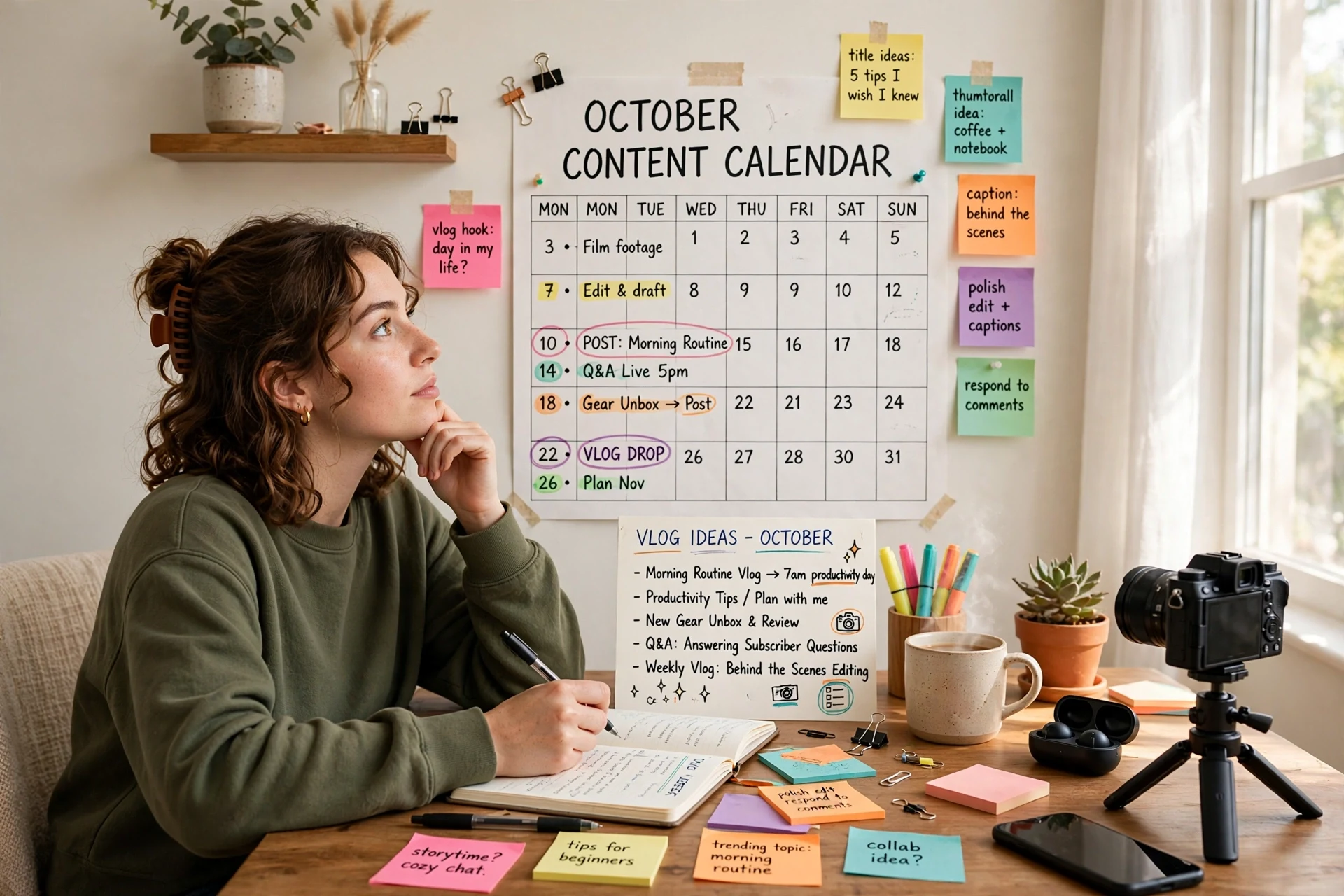
One focused hour of planning beats thirty daily “what should I film?” panics. Bank 8 to 12 ideas at once, then film them in batches.
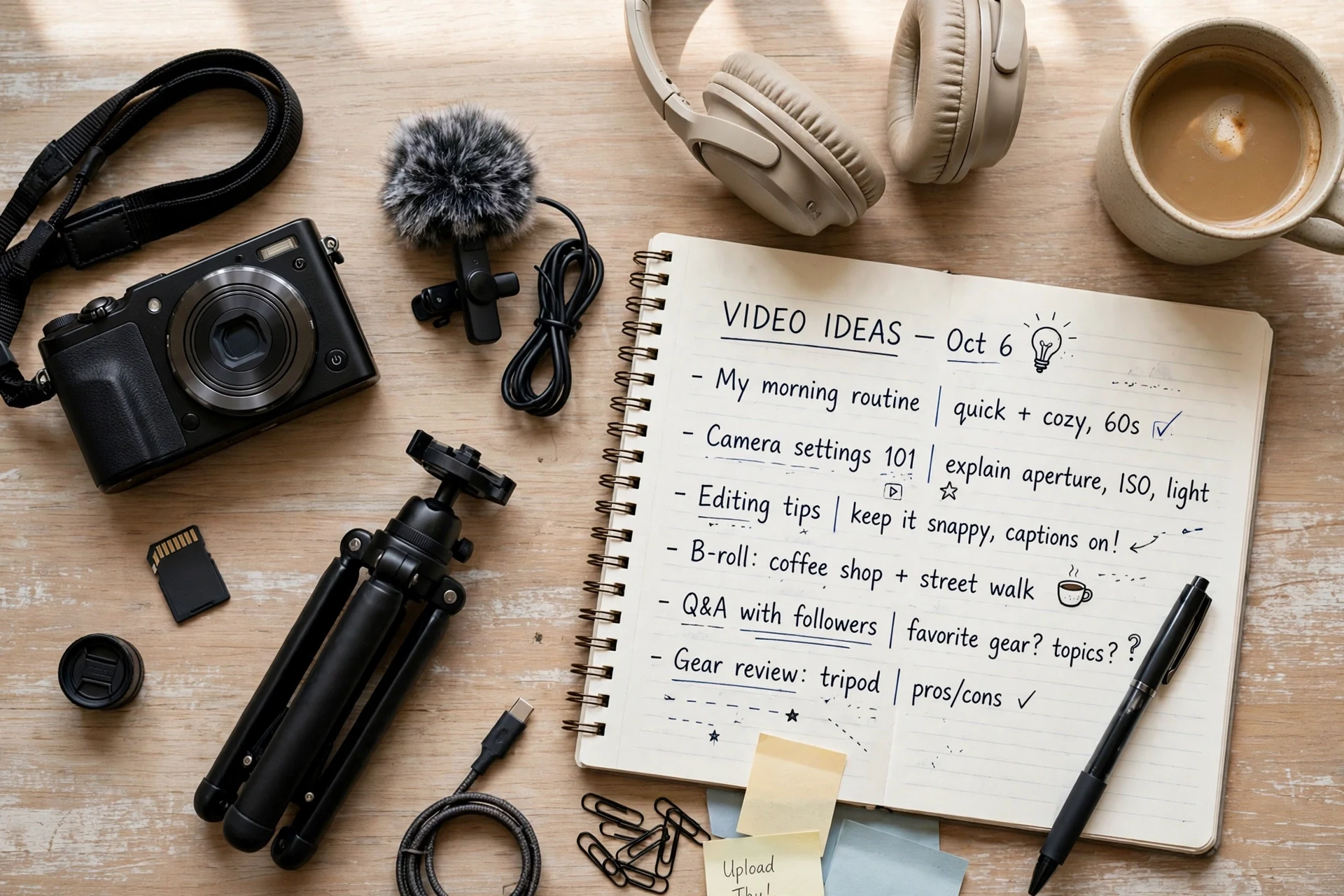
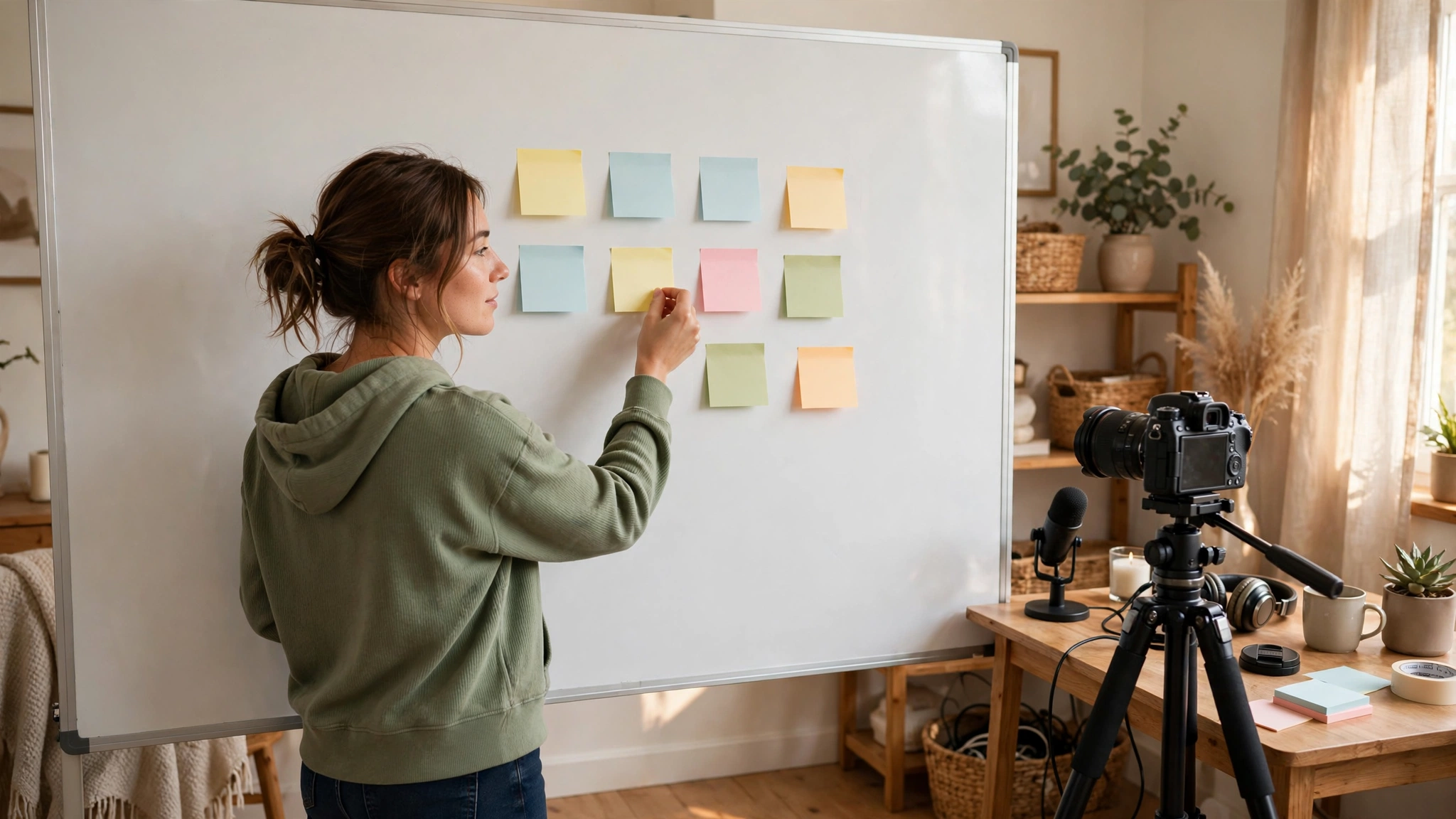
Here’s the monthly session: open your notes app, pick 8 to 12 ideas from this list that pass the three-filter test, and write one sentence for each: what the viewer gets by the end. That sentence is your filming brief; if you can’t write it, the idea isn’t ready. Sort them into filming batches: the three that need daylight, the two that need a location, the ones you can film at home in one afternoon.
Then film in batches, not in sequence. Three sit-down videos in one day with the tripod already set up and the light already dialed in beats three separate setup-and-teardown sessions across the week. The tripod and lighting guides cover the setup worth standardizing. Batching removes the daily “should I film today?” negotiation, which is quietly where most channels die.
Keep a rolling idea bank in your phone and feed it constantly: every comment asking “can you make a video about…”, every video that holds your attention, every interesting thing that happens to you. One line each, captured immediately. An idea bank with 30 rough lines in it means you never start a planning session from zero again.
Stretch one idea into a five-part series
A single good idea is worth five videos. Series keep viewers coming back and take the pressure off finding something new every week.
Almost every idea on this list is a series in disguise. The 30-day skill challenge becomes five weekly progress episodes. “What I spent today” becomes a monthly series. The seasonal bucket list becomes ten check-off episodes. The trick is naming the series clearly (“30 Days of Drawing,” “The No-Spend Diaries”) so viewers recognize each new part and new viewers can start at part one.
Structure each part the same way: 15 seconds recapping where the series stands, the new progress or attempt, and a 10-second tease of the next part. End every episode pointing at the next one: a pinned comment, an end screen, a “part 3 drops Thursday.” Series are how small channels manufacture binge-watching: one click becomes five views.
And when a series ends, don’t let it die. Make the finale a compilation (“everything I learned in 30 days”) and a bridge (“next month I’m doing X, so vote in the poll”). The finale usually outperforms the middle episodes, and the poll hands you your next series on a plate.
Shrink any idea into a 60-second short
Most ideas on this list also work as Shorts, Reels or TikToks. Keep one idea per short, open on the payoff, and film vertically so the frame works for you instead of against you.
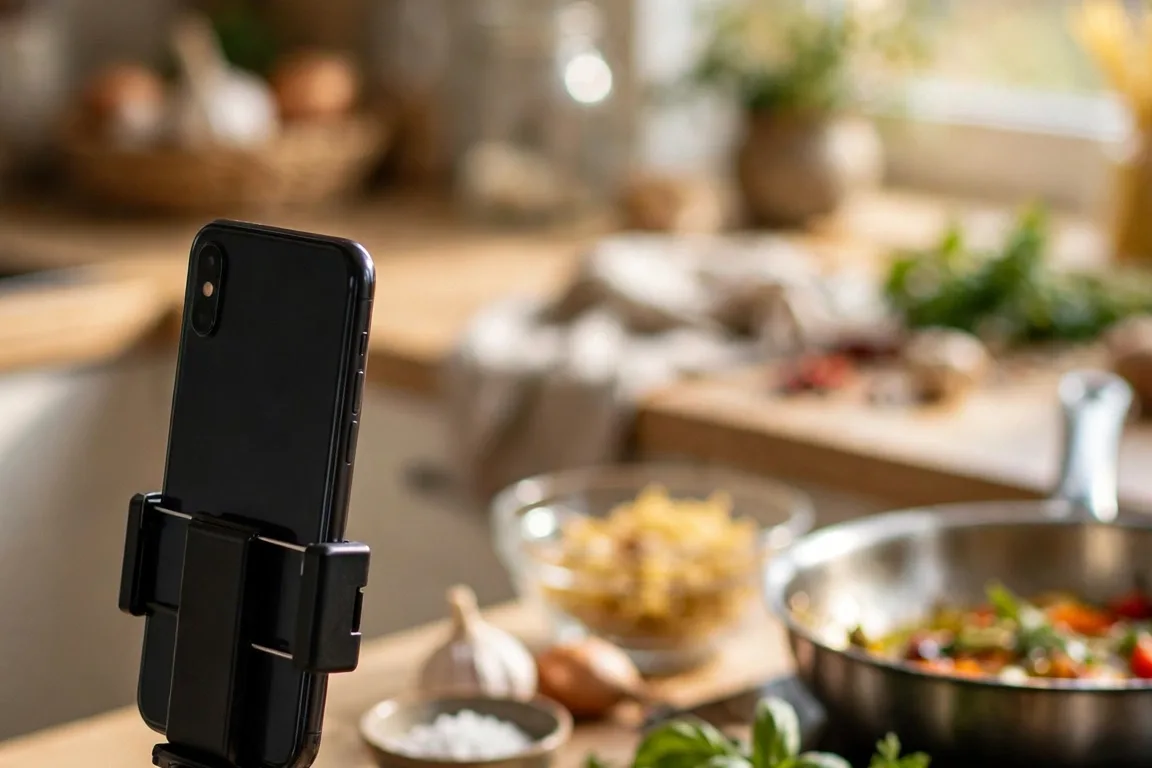
Short-form is not a separate content plan. It is the same ideas cut down to their sharpest minute. The formats that compress best are the ones with a visible result: the before-and-after of a room tour or a 30-day skill, one step of a recipe instead of the whole dish, a single outfit from the capsule wardrobe, or the final tally of a spending video. If the long version ends with a reveal, the short is basically the reveal with ten seconds of setup in front of it.
Film for the small screen from the start: vertical 9:16 framing, your subject close to the lens, and the most interesting moment inside the first two seconds, because a short has no warm-up time. Put captions on everything, since a large share of viewers watch on mute. Our vertical video guide covers the framing and export settings step by step.
Use shorts as cheap tests, too. Post the 60-second version of an idea before committing a weekend to the long one. If the short travels, the full video has a proven hook. If it stalls, you spent an evening finding out instead of a week. And when a long video is already filmed, its best minute is usually hiding in the middle of it: cut that minute out and the long video gets a trailer that sends new viewers back to your channel.
Vlog ideas FAQ
What creators actually ask before picking their next video idea.
How many vlog ideas do I need before I start?
Ten to fifteen, written down with a one-sentence promise for each. That’s enough to film your first month without panicking, and the habit of banking ideas matters more than the size of the list. You’ll add to it constantly once you’re publishing.
What if my niche doesn’t fit these categories?
Then adapt the format, not the topic. Every category here is really a structure: a challenge, a comparison, a day-in-the-life, a test. A gaming channel can do a “no-spend weekend” in a game economy; a tech channel can do a “day in my life” of a developer. Keep the skeleton, change the subject.
How can I tell if an idea is good before I film it?
Write one sentence: what does the viewer get by the end? “I ranked five street-food stalls” is filmable; “I walked around downtown” is a hope, not a plan. If you can’t write the sentence, the idea needs a constraint, a budget, or a verdict added to it.
Should I chase trends or stay in my niche?
Both, roughly 80/20. Eighty percent niche content builds your library, and twenty percent trends bring in new viewers. The trick with trends is adding your angle fast: “I tried the viral trend for a full day” outlives the trend itself because the commitment is the content.
What are the best vlog ideas for a brand-new channel?
Specific, searchable ones. “I built a desk setup for under $200” beats “my first vlog” because strangers can find it. New channels grow on search and suggested videos long before the algorithm knows they exist, so pick ideas with clear titles people would actually type. Our start vlogging guide covers the full launch playbook.
How do I make “day in my life” vlogs actually interesting?
Add structure: timestamps, a mission for the day, or a constraint. Pure chronological filming is boring because real days have dead time, and the one-minute-segment format from idea #1 exists precisely to cut it. And open with the most interesting 10 seconds of your footage, not your alarm clock.
What can I vlog about when my life feels boring?
Add a twist to an ordinary day: a constraint, a question or a deadline. Cook only what is already in the fridge, reset the messiest corner of your home in 30 minutes, get through the day on the smallest budget you can manage, or film the errands you were running anyway with the receipts on camera. Most of the 60 ideas above are ordinary days with one of those twists added. And if your week really is work, home and sleep on repeat, the progress formats (a skill challenge, a sleep experiment, a savings goal) manufacture a story out of the repetition itself.
Can I repeat the same video format every week?
Yes. That’s how channels grow. “What I spent today” monthly, a weekly progress series, a recurring challenge format: repetition builds an audience that shows up for the next installment. Vary the subject inside the format so it never feels copy-pasted.
What vlog ideas work if I don’t want to show my face?
The whole faceless section above: narrated screen recordings, hands-only builds, photo-stories, whiteboard explainers, POV days, and timelapse projects. Faceless isn’t a limitation; it’s a genre with its own huge audience, and it removes the biggest reason most people never start.
How far ahead should I plan my videos?
Keep 2 to 4 weeks of ideas banked and one week of videos filmed ahead. That buffer absorbs sick days, busy weeks, and the occasional filming disaster without breaking your schedule. Plan monthly, film weekly, publish on rhythm.
How often should a beginner post vlogs?
Once a week is the honest starting point for most people: frequent enough to build a filming habit and a returning audience, light enough to sustain next to a job or studies. Twice a week works if you batch film. Daily posting burns out new creators and buries their better ideas under rushed uploads. Whatever cadence you choose, hold it for at least two months before judging it. The schedule you actually keep beats the ambitious one you planned.
I used all 60 ideas, now what?
You haven’t. You’ve used 60 formats. Turn each one into a series, adapt them to your niche, and combine them: a faceless, no-spend, 30-day skill challenge is three ideas in one. And by the time you’ve filmed 60 videos, your comments section will be handing you the next 60 for free.
Keep the ideas coming
Picked your idea? Here’s the gear and know-how to film it well.