
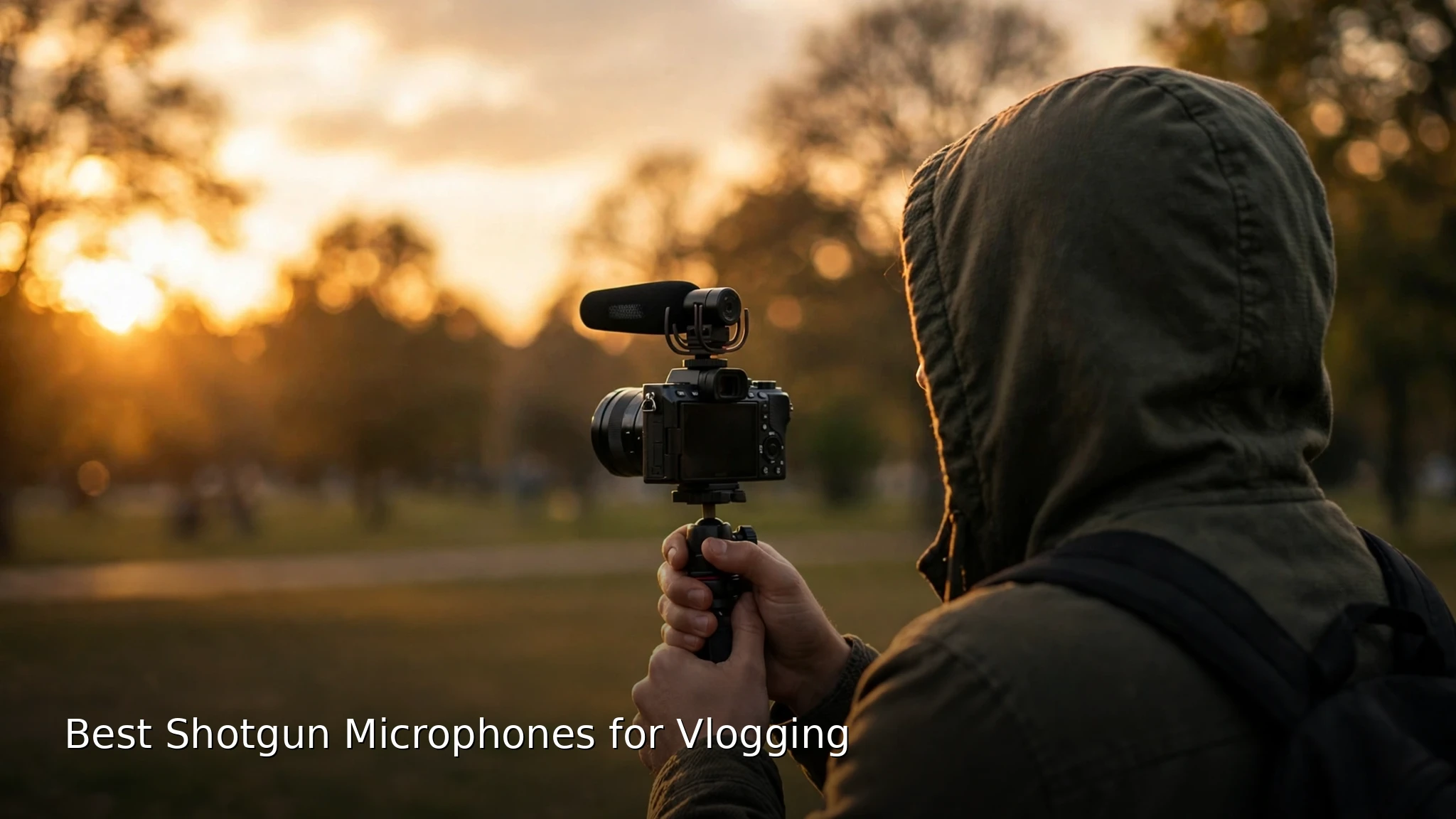
Last updated: November 2026
The Rode VideoMic NTG is the best shotgun microphone for vlogging in 2026: it works on a camera, a phone and a computer, its rechargeable battery runs for over 30 hours, and its gain knob lets you keep a noisy camera preamp out of your audio. If money is tight, buy the Rode VideoMicro II. If you film yourself talking to the camera, the Deity V-Mic D4 Duo is the only mic here that records your voice and your subject at the same time on its own, with no extra mic. And if you shoot on a Sony camera, the Sony ECM-G1 gets clean sound with no cables and no battery to charge.
A shotgun microphone is the fastest audio upgrade a vlogger can make. It sits on the camera hot shoe, points at what the lens points at, and lifts your voice clear of the room. But it is not a zoom lens for sound. A shotgun mic cannot rescue a voice recorded from across a room, and no model here changes that. The honest limit is about two meters: inside arm’s length your voice sounds close and full, past that the room starts to win. Every pick in this guide is judged against that limit, and against the three things that decide whether a mic works on a small vlogging camera: how much it weighs, how it gets its power, and what wind protection comes in the box.
This guide covers on-camera shotgun mics only. That is a deliberate line. Cinema shotguns need phantom power, an XLR input and a boom pole, and they make no sense on a ZV-E10 or an R50 V. The ten mics below all mount on a hot shoe, all plug into a camera or a phone, and all suit a vlogger filming themselves at arm’s length, plus b-roll, travel and run-and-gun shooting. If you need a mic for interviews at a distance or two people talking, a wireless lavalier is the better tool, and the section on when a lav beats a shotgun says so plainly.
As an Amazon Associate I earn from qualifying purchases. When you buy through links on this page, we may earn a commission at no extra cost to you.
⚡ Quick Picks
- 🏆 Rode VideoMic NTG: best all-rounder
- 💰 Rode VideoMicro II: best budget pick
- 🎙️ Deity V-Mic D4 Duo: best for solo vloggers
- 📱 Rode VideoMic GO II: best for phone and computer too
- 📷 Sony ECM-G1: best for Sony cameras
The other five picks, the D4 Mini, the MKE 400, the ECM-B10, the VideoMic Pro+ and the MKE 600, are in the comparison table and the cards below.
On this page
The 10 shotgun mics compared
Short answer: the VideoMic NTG wins overall, the VideoMicro II wins on price, the D4 Duo wins for solo vloggers who talk to camera, and the GO II wins for anyone who also records to a phone or computer. The table puts the differences that matter side by side: weight on a small body, power source, connection, and what wind protection comes in the box.
| Microphone | Weight | Power | Connection | Wind protection in the box | Best for |
|---|---|---|---|---|---|
| Rode VideoMicro II | 39g | Plug-in power, no battery | 3.5mm | Foam and furry | First mic, tight budget |
| Deity V-Mic D4 Mini | 28g | Plug-in power, no battery | 3.5mm | Furry, rated to 20 mph wind | Tiny rig, second audio source |
| Rode VideoMic GO II | 33g mic, 89g rigged | Plug-in or USB power, no battery | 3.5mm and USB-C | Foam | Camera, phone and computer |
| Deity V-Mic D4 Duo | 40g | Plug-in power, no battery | 3.5mm | Two furry | Solo vlogger, front and rear sound |
| Rode VideoMic NTG | 94g | Rechargeable, 30+ hours | 3.5mm and USB-C | Foam | One mic for everything |
| Sony ECM-G1 | 34g | MI Shoe or plug-in, no battery | MI Shoe and 3.5mm | Windscreen | Sony cameras, no cables |
| Sennheiser MKE 400 | 93.5g | 2x AAA, 100+ hours | 3.5mm | Built-in plus furry | Compact rig with real controls |
| Sony ECM-B10 | 72g | MI Shoe, no battery | MI Shoe only | Windscreen | Sony cameras, switchable pickup |
| Rode VideoMic Pro+ | 122g | Rechargeable LB-1, 100+ hours | 3.5mm | Foam | Loud rooms, full control |
| Sennheiser MKE 600 | 128g | Phantom power or 1x AA | XLR | Foam | Step-up to XLR and boom |
Our picks in detail
Short answer: buy the VideoMicro II if money is tight, the D4 Mini if you want the lightest mic with a second input, the GO II if you also record to a phone or computer, the D4 Duo if you talk to the camera, the NTG if you want one mic that does everything, the ECM-G1 or ECM-B10 if you shoot Sony, the MKE 400 if you want real controls in a compact mic, the Pro+ if you shoot in loud places, and the MKE 600 if you are ready for XLR.
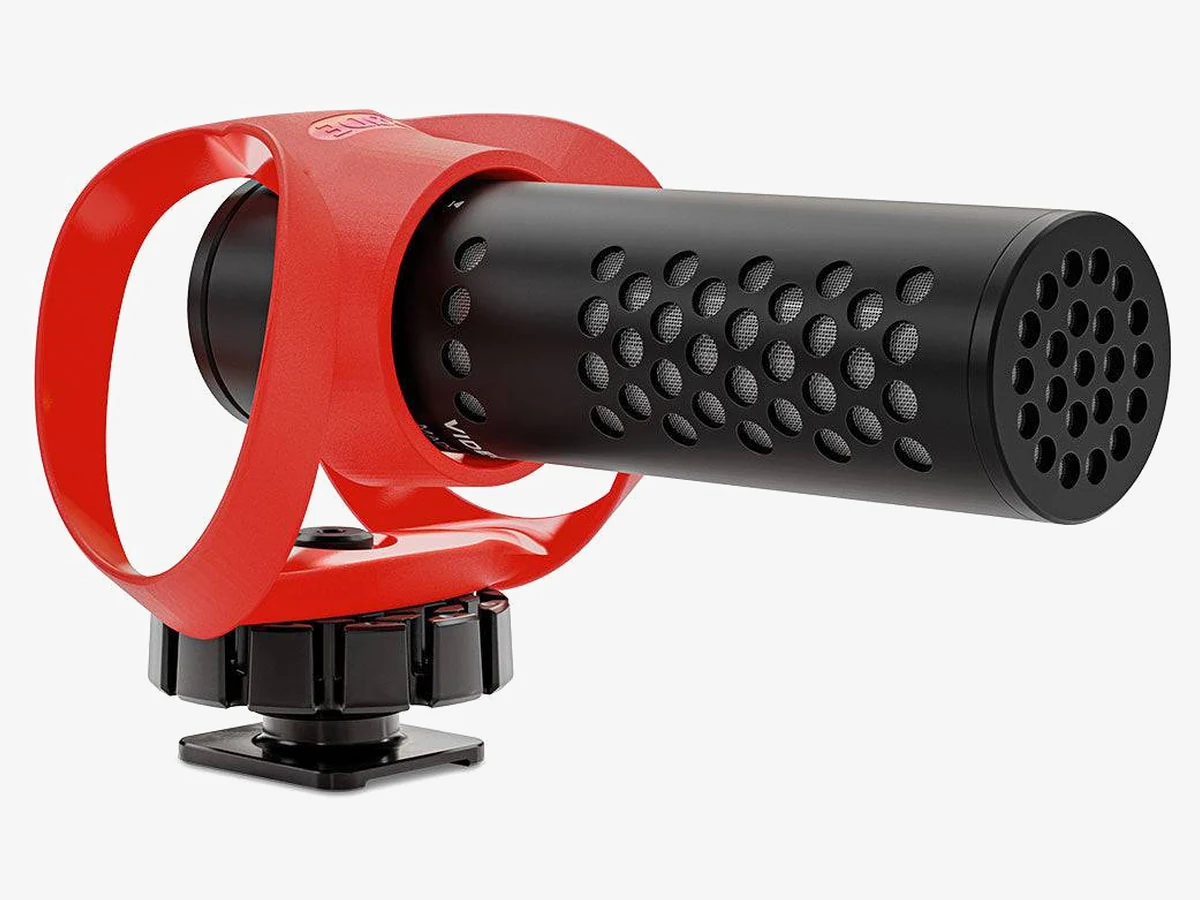
Photo: Rode
Key specs
💰 Best budget pick
1. Rode VideoMicro II
The VideoMicro II is the cheapest honest way into clean vlog audio: 39 grams, no battery, no switches, and both a foam and a furry windshield in the box. Plug it in and record.
This is the mic to buy when you want better sound than the camera gives you and nothing else to think about. It draws its power from the camera mic jack, so there is nothing to charge and nothing to forget. The HELIX isolation mount sits between the mic and the camera and soaks up knocks, footsteps and handling noise. The supercardioid pattern focuses on what is in front of the lens and pushes the sides and rear down, which is what makes a voice stand out from a noisy street or a busy room. At 80mm long it never creeps into a wide shot, and at 39 grams it adds about a tenth of the weight of a ZV-E10 on top of the camera.
The limits. There are no controls at all, so you set your level on the camera and live with it. The mic is mono, and it has no headphone jack, so you check your audio after the take, not during it. It is also a short mic with a short reach: it does its best work at arm’s length, and past about two meters the room takes over, same as every mic here. None of that is a fault at this size and weight. For a first external mic, this is the one to buy.
Technical features
- Supercardioid polar pattern with annular line tube technology
- 39g with mount, 80mm long, all-metal body
- Plug-in power from the camera or phone, no battery required
- No controls or switches, true plug-and-go operation
- HELIX isolation mount with cable management slots
- Foam and furry windshields included in the box
- 3.5mm TRS to TRS cable for cameras and TRS to TRRS cable for phones included
- Frequency range 20Hz to 20kHz, maximum SPL 110dB
- Works on cameras, smartphones and action cameras with a mic input
What we like
- Only 39g, barely felt on a small camera
- Nothing to charge, nothing to switch on
- Both windshields included, rare at this size
- HELIX mount cuts handling noise properly
- Too short to creep into a wide shot
Watch out for
- No gain control, no headphone jack
- Mono only, no stereo mode
- Needs a camera that supplies plug-in power
- Short reach, arm’s length is its home
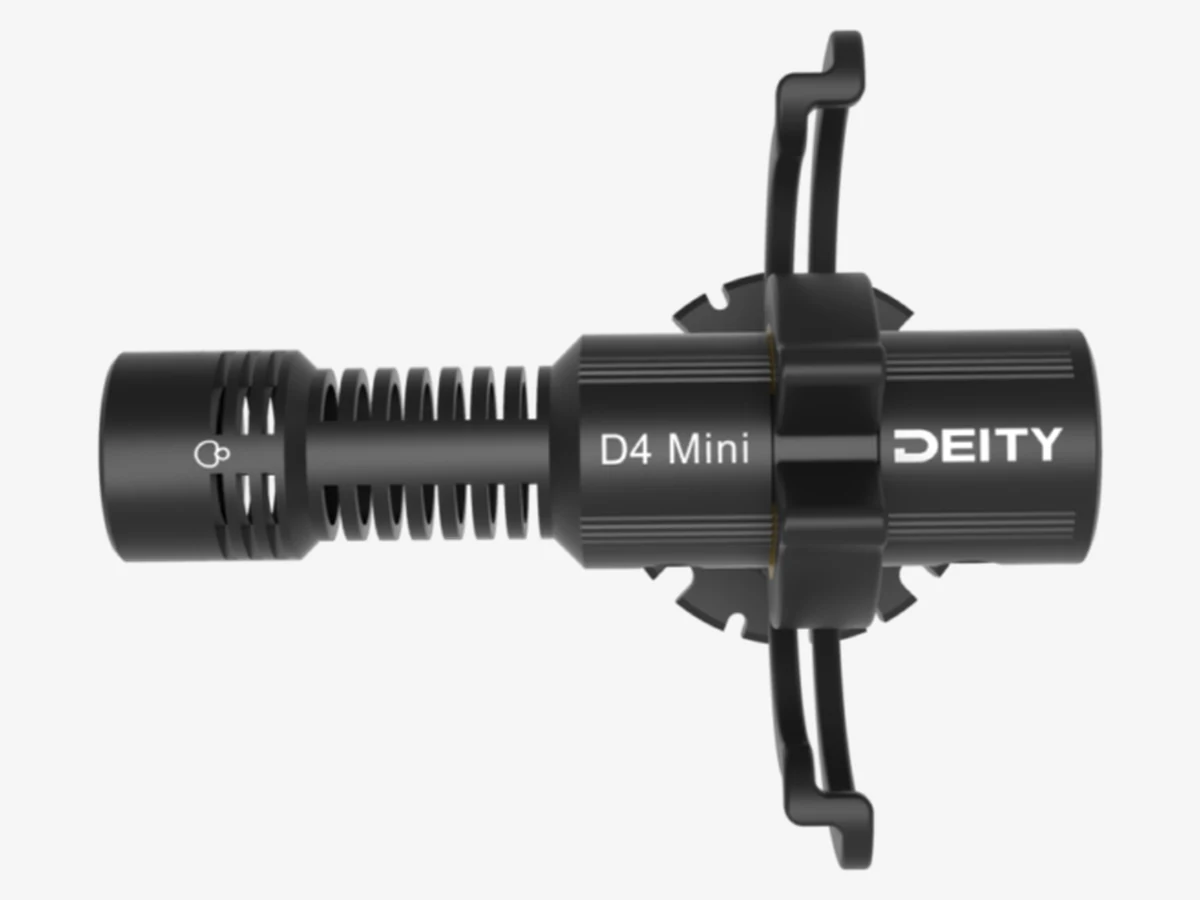
Photo: Deity
Key specs
🎧 Best budget mic with a lav input
2. Deity V-Mic D4 Mini
The D4 Mini is the lightest mic in this guide at 28 grams, and the only budget mic here with a second input: plug a lavalier into its side and you record two sources at once.
Deity built this mic around a 14mm capsule, larger than the tiny capsules most micro shotguns use, and that shows in a fuller voice with less thin edge. It runs on plug-in power from the camera, so like the VideoMicro II there is no battery to manage. The offset shockmount is the clever part: it pushes the mic to one side so a wide-angle lens never catches the mic in the frame, a real problem on vlogging cameras at 16mm and wider. The faux fur windshield in the box is rated for wind up to 20 mph, which is the strongest wind claim of any mic here at this size.
The second input is what sets it apart. Plug a passive lavalier or a wireless receiver into the 3.5mm input on the side and it lands on the right channel while the shotgun stays on the left, no splitter cable needed. That turns a one-mic rig into a two-source rig for interviews: the shotgun catches the room, the lav catches the person. The limit is the same as the VideoMicro II: no gain control, no headphone jack, and arm’s length is where it sounds best.
Technical features
- Supercardioid polar pattern, 14mm medium-diaphragm capsule
- 28g mic, 61.5g fully rigged with mount and windshield
- Plug-in power 1 to 5V from camera, phone or recorder, no battery
- 3.5mm AUX input for a second source, routed to the right channel
- Offset Rycote Lyre shockmount keeps the mic out of wide shots
- Faux fur windshield rated for wind up to 20 mph included
- TRS to TRS and TRS to TRRS cables included for camera and phone
- Frequency range 20Hz to 20kHz, maximum SPL 134dB
- Aluminum body, cold shoe mount with 1/4 inch and 3/8 inch threads
What we like
- Lightest mic here at 28g
- Second input records a lav at the same time
- Offset mount keeps wide shots clean
- Furry windshield rated to 20 mph in the box
- Fuller voice than most micro shotguns
Watch out for
- No gain control, no headphone jack
- AUX input does not work on mono recorders or phones
- No USB mode for computers
- Short reach, arm’s length is its home
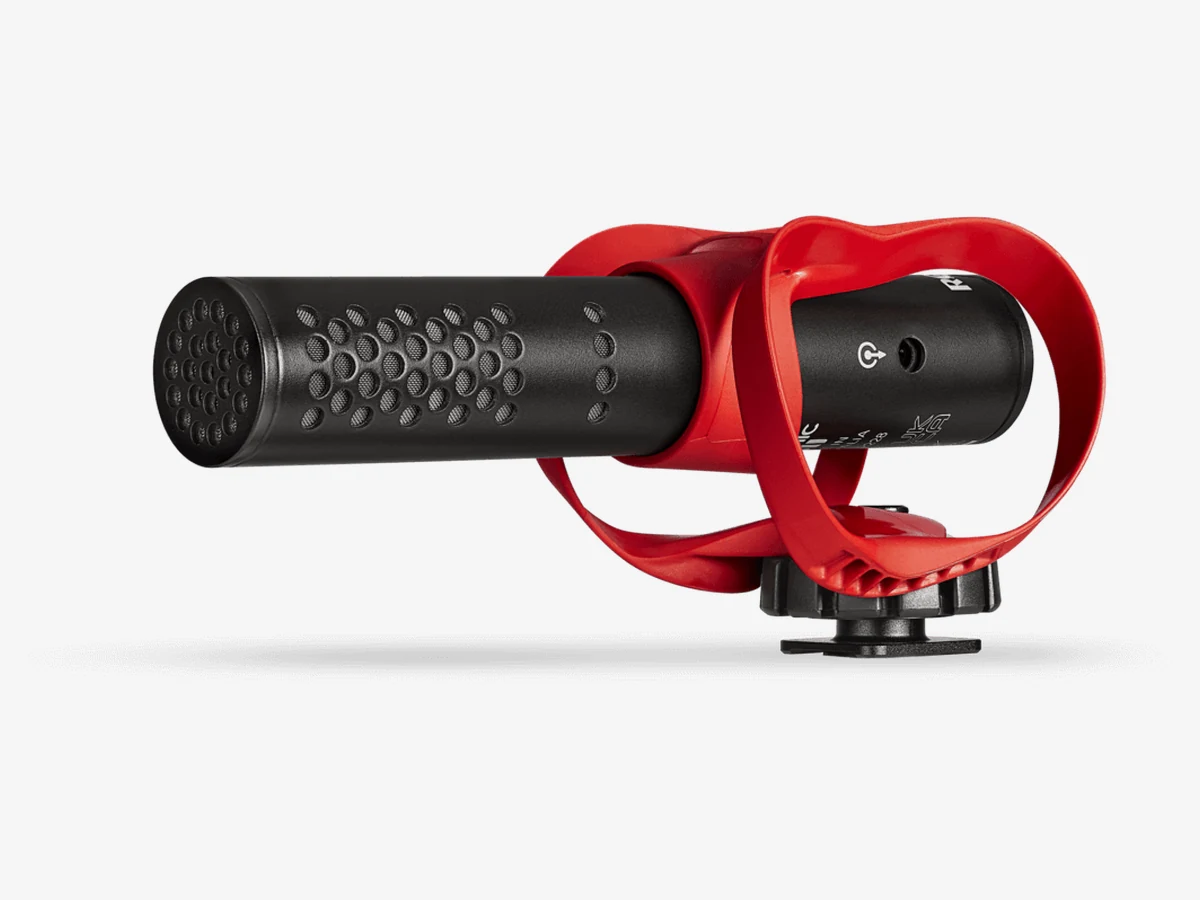
Photo: Rode
Key specs
📱 Best for phone and computer too
3. Rode VideoMic GO II
The GO II is one of two mics here that is a camera mic, a phone mic and a computer mic in one body: 3.5mm for the camera, USB-C for a phone or laptop, and no battery anywhere in the chain.
On a camera it behaves like a simple shotgun: plug-in power, no switches, HELIX mount, foam windshield. Plug it into a computer over USB and it turns into a proper USB microphone for voiceovers, calls and livestreams, with the 3.5mm jack switching over to headphone monitoring. Plug it into a phone the same way and you get the same USB mic for mobile recording. The RODE Central app opens the extras in USB mode: a high-pass filter, a pad, a high-frequency boost and input gain. The mic itself is 33 grams; with the HELIX mount and windshield it is 89 grams on the camera, still light enough for a small body.
The catch is the cables. The USB cables for phones and computers are sold separately, and you need the right one: a USB-C to USB-C cable for Android and modern iPads, or a Lightning cable for older iPhones. The furry WS12 windshield for real wind is also sold separately. Buy the mic with the cable your device needs, or the USB half of the trick stays in the box.
Technical features
- Supercardioid polar pattern with annular line tube technology
- 33g mic body, 89g with HELIX mount and windshield
- 3.5mm TRS output for cameras, USB-C output for phones and computers
- Plug-in power on 3.5mm, USB power on USB-C, no battery
- HELIX isolation mount with sliding rail for wide lenses
- RODE Central unlocks high-pass filter, pad, high-frequency boost, input gain and direct monitoring
- 3.5mm jack becomes a headphone output in USB mode
- Foam windshield included, WS12 furry windshield sold separately
- USB cables for phone and computer sold separately
What we like
- One mic for camera, phone and computer
- No battery to charge, ever
- Headphone monitoring in USB mode
- App controls for filter, pad and gain
- Sliding mount keeps wide shots clean
Watch out for
- USB cables sold separately
- Furry windshield sold separately
- No controls on the mic itself in camera mode
- Pad and filter only work in USB mode
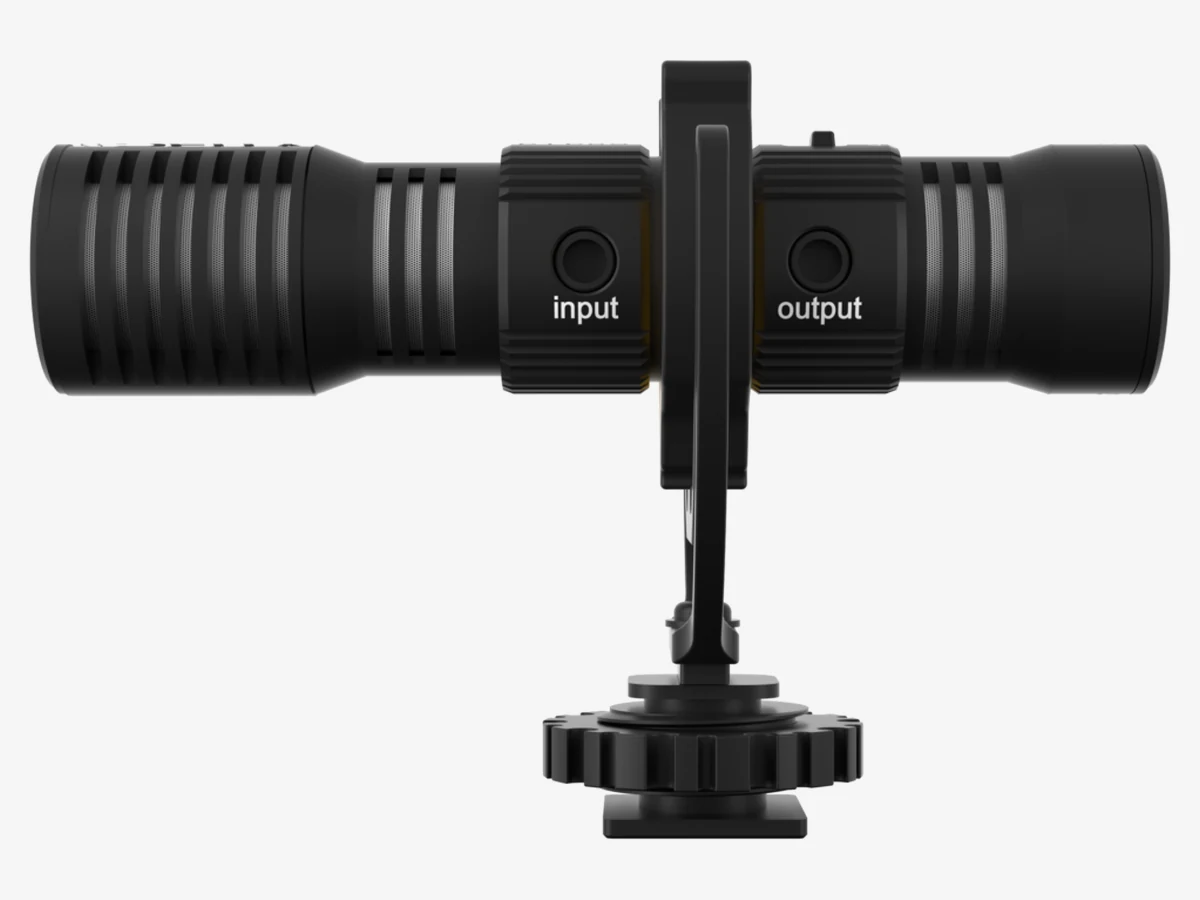
Photo: Deity
Key specs
🎙️ Best for solo vloggers
4. Deity V-Mic D4 Duo
The D4 Duo is the only mic here with two capsules: one faces your subject, one faces you. For a solo vlogger talking to the camera, that is the difference between usable narration and a muffled voice from behind the mic.
Every other shotgun in this guide points forward and treats the person behind the camera as off-axis noise. That is fine when you film other people, but a vlogger filming themselves is behind the camera, and a forward-only mic hears them at their worst. The D4 Duo fixes it with a second cardioid capsule aimed back at you. A switch on top chooses the mode: front capsule only, for a normal stereo track, or dual mono, where the front capsule goes to the left channel and the rear capsule to the right, so you can balance or cut either voice in the edit. The rear capsule is 9dB less sensitive than the front, because your mouth is much closer to it than your subject is to the front. A 3.5mm AUX input on the side can replace the rear capsule with a lavalier or a wireless receiver, which lands on the right channel.
The trade is stereo. In dual mono mode the track is two separate mono sources, not a stereo image, and listening back on headphones can sound odd until you mix it. The mic is also a little wider than a single-capsule mic, and it has no USB mode. But for the exact job most vloggers do, talking to the camera while showing what is in front of it, no other mic here records both sides of the conversation.
Technical features
- Two 14mm cardioid capsules, one front and one rear
- 40g aluminum body, Rycote Lyre shockmount included
- Front capsule minus 42dB, rear capsule minus 51dB sensitivity
- Switchable front-only stereo or dual mono, front left and rear right
- 3.5mm AUX input bypasses the rear capsule for a lav or receiver
- Plug-in power from the camera, no battery required
- Two faux fur windshields included, one per capsule
- Frequency range 50Hz to 20kHz, maximum SPL 120dB
- 3.5mm TRS cable included, cold shoe mount with 1/4 inch thread
What we like
- Only mic here that records you and your subject
- Dual mono gives two editable tracks from one mic
- AUX input takes a lav instead of the rear capsule
- Nothing to charge
- Two furry windshields in the box
Watch out for
- Dual mono sounds odd on headphones before mixing
- Rear channel is quieter and needs a level lift in the edit
- No USB mode for computers
- Wider than a single-capsule mic
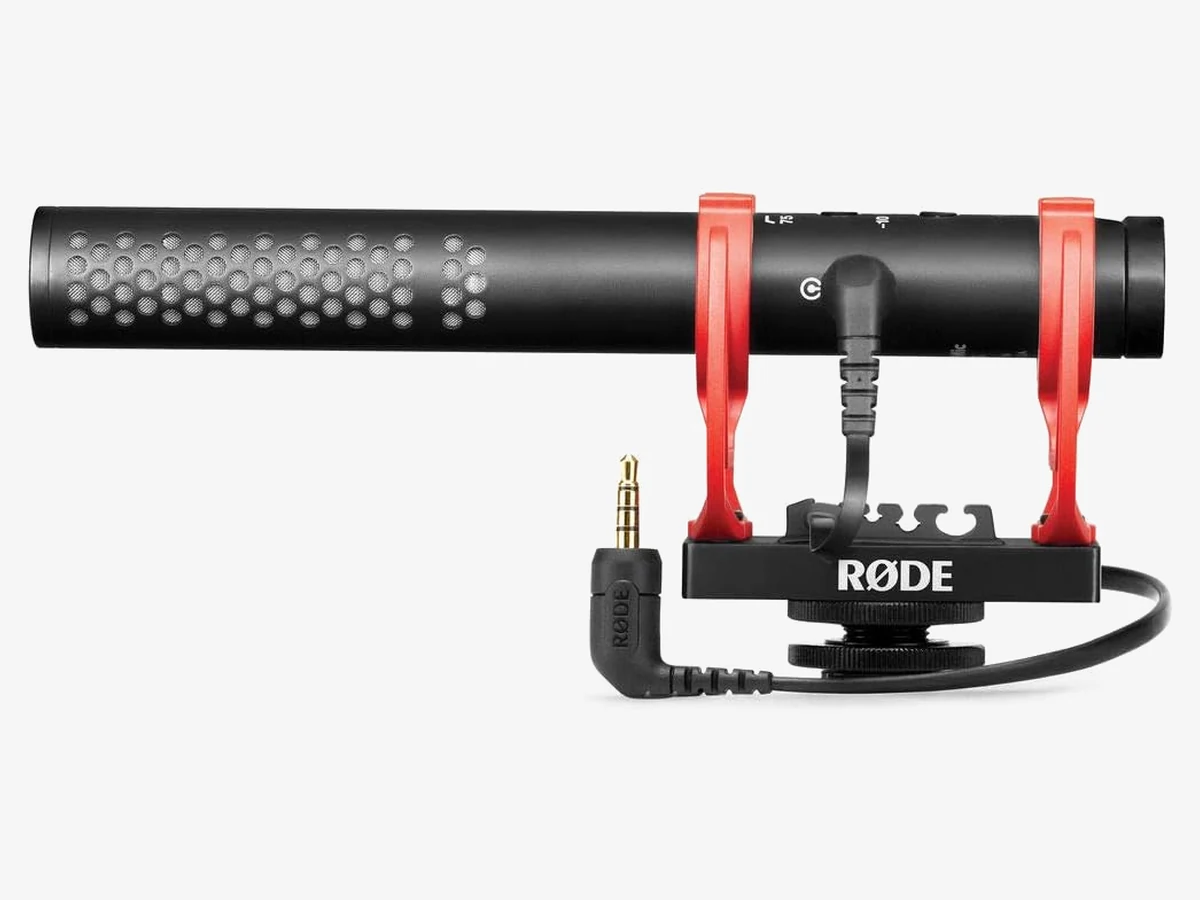
Photo: Rode
Key specs
🏆 Best all-rounder
5. Rode VideoMic NTG
The VideoMic NTG is the one mic in this guide that does every job: camera shotgun, phone mic, USB mic for voiceovers and streams, with a gain knob that keeps noisy camera preamps out of your audio.
The gain knob is the reason it wins. Most mirrorless cameras have weak preamps, and when the camera adds most of the gain, it adds hiss with it. The NTG lets you turn the camera gain down to its lowest setting and drive the level from the mic instead, with a numbered dial from 1 to 15, so the track stays clean. The auto-sensing 3.5mm output works with cameras and phones without adapter cables. Over USB-C it becomes a 24-bit, 48kHz digital mic for a computer, and the 3.5mm jack turns into a headphone output for monitoring. It is the same USB mic you would use for voiceovers, and if you also stream, our guide to the best cameras for streaming covers the camera side. A safety channel records a second track 20dB quieter on the right channel, so a sudden shout or a door slam does not clip your only take. The internal battery runs for over 30 hours and recharges over USB-C in about two hours, and it can run from a power bank while you record.
The limits. The battery is built in and cannot be swapped, so a dead battery ends the shoot unless you have USB power. The mic is 171mm long, which can creep into a very wide shot, and the furry WS10 windshield for real wind is sold separately. At 94 grams it is also heavier than the budget mics, about a quarter of a ZV-E10 on top of the camera. None of that changes the verdict: if you buy one shotgun mic and want it to cover every vlogging job, buy this one.
Technical features
- Supercardioid polar pattern with annular line tube technology
- 94g, 171mm long, aerospace-grade aluminum body
- Internal rechargeable battery, 30+ hours, USB-C recharge in about 2 hours
- Auto-sensing 3.5mm output for cameras and mobile devices
- USB-C digital output, 24-bit and 48kHz, class-compliant, no drivers
- Infinitely variable gain control, numbered 1 to 15
- High-pass filter 75Hz and 150Hz, high-frequency boost, minus 20dB pad
- Safety channel records a backup 20dB quieter on the right channel
- Peak warning light, auto power on and off, Rycote Lyre mount, foam windshield
What we like
- Gain knob keeps camera preamp hiss out
- One mic for camera, phone and computer
- Safety channel saves clipped takes
- 30+ hour battery, charges while recording
- Headphone monitoring in USB mode
Watch out for
- Battery is built in and cannot be swapped
- 171mm can creep into very wide shots
- Furry windshield sold separately
- Heavier than the budget mics at 94g
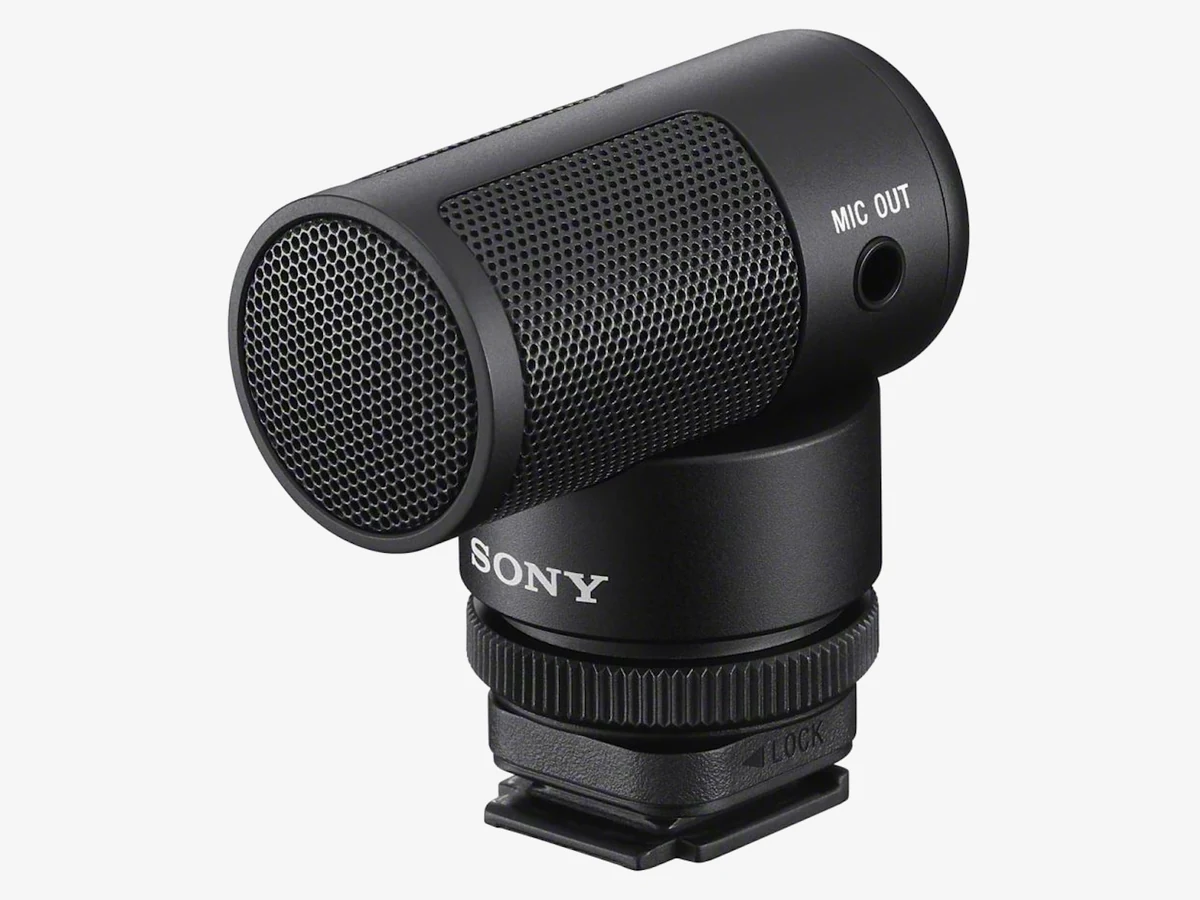
Photo: Sony
Key specs
📷 Best for Sony cameras
6. Sony ECM-G1
The ECM-G1 is the smallest mic here that still sounds like a real shotgun: 34 grams, under 50mm long, and on a Sony camera it needs no cable and no battery at all.
Slide it into the Multi Interface Shoe of a Sony camera and the shoe does everything: it powers the mic, carries the audio as a digital signal, and leaves no cable to pick up handling noise or get in the way of a flip screen. The 14.6mm capsule is large for a mic this size, which is why Sony compares its sound to a dedicated recorder: a full voice with the room pushed down. Anti-vibration dampers inside the body cut the rumble that travels up from the camera. It also has a 3.5mm jack and cable in the box, so it works on non-Sony cameras and recorders that supply plug-in power. At 34 grams it adds about a tenth of a ZV-E10 on top of the camera, and it is short enough to stay out of every shot.
The limits. The cable-free digital trick only works on Sony cameras with an MI Shoe, and the digital audio path needs a camera with a digital MI Shoe interface. On other cameras it is a normal 3.5mm mic, and then it is just a good small shotgun with no controls and no headphone jack. There is also no gain control, so levels are set on the camera. For a Sony shooter who wants the smallest possible rig, nothing here beats it.
Technical features
- Supercardioid polar pattern, large-diameter 14.6mm capsule
- 34g, 48.5mm long, compact enough to leave on the camera
- MI Shoe connection: cable-free, battery-free, digital audio on Sony cameras
- 3.5mm microphone out jack and recording cable included for other devices
- Plug-in power on 3.5mm, no battery in either mode
- Anti-vibration dampers suppress handling and camera noise
- Furry windscreen included for outdoor recording
- Frequency range 50Hz to 20kHz, maximum SPL 125dB
- Works with the vari-angle screen open, no cable in the way
What we like
- Second lightest mic here at 34g
- No cable, no battery on Sony cameras
- Digital audio path, no analog hiss
- Large capsule for a full, clear voice
- Too short to enter any shot
Watch out for
- Digital MI Shoe trick is Sony only
- No gain control, no headphone jack
- On other cameras it is a plain 3.5mm mic
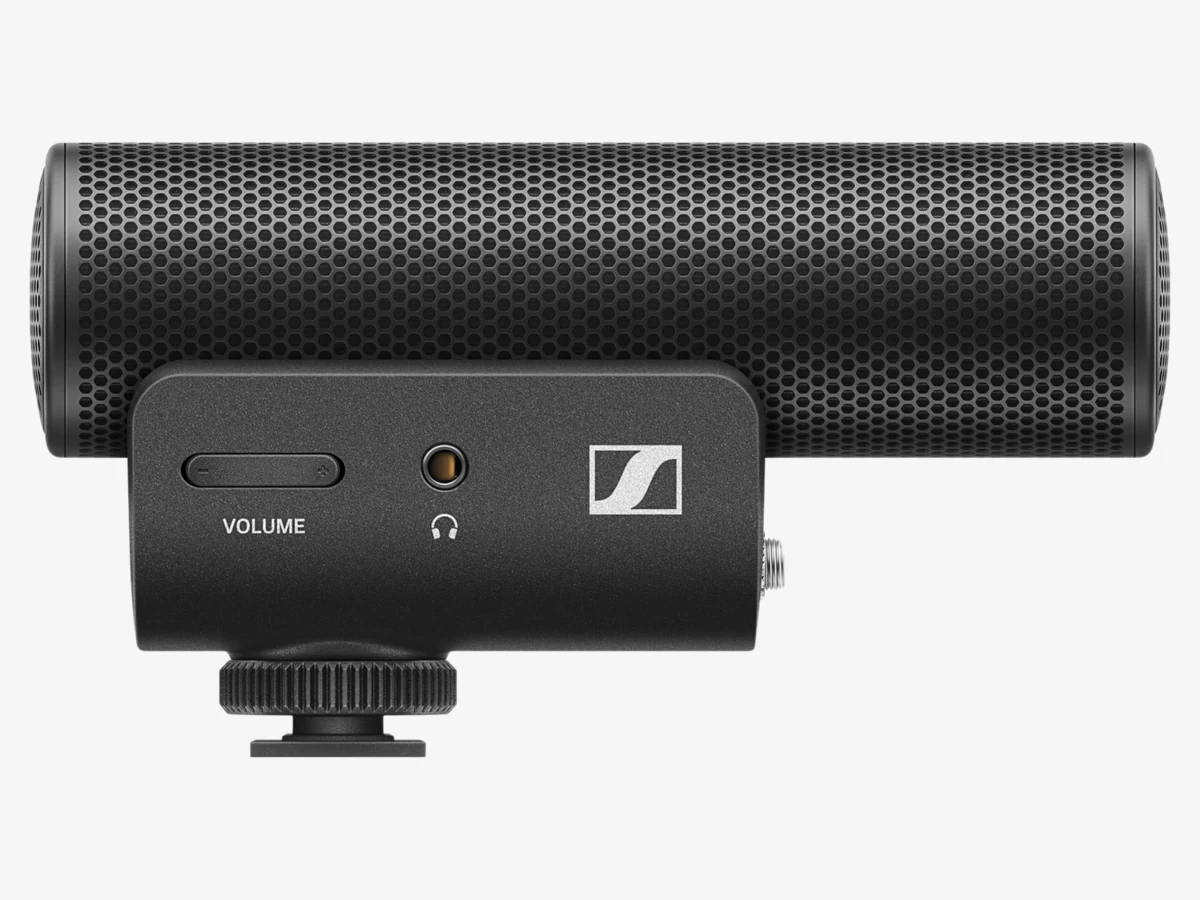
Photo: Sennheiser
Key specs
🎛️ Best compact mic with controls
7. Sennheiser MKE 400
The MKE 400 is the mic to buy when you want real controls in a compact body: a three-step sensitivity switch, a low-cut filter, and a headphone jack with its own volume control.
Sennheiser built this mic around an acoustic design that needs less help from the camera: its high sensitivity keeps the camera preamp low, and its built-in wind protection cuts light wind before you even add the furry. The three-step sensitivity switch covers the range a vlogger actually meets: high for a quiet room, medium for normal speech, low for a loud street or a concert. The headphone output with volume control is the feature no other compact mic here offers: you hear exactly what the camera is recording, while you record, and you catch a dead cable or a rustling shirt before it ruins a take. Two AAA batteries run for over 100 hours, and the mic shuts off when the camera stops, so they last.
The limits. At 93.5 grams it is heavier than the budget mics, and its blocky shape is wider than a tube mic, so it sits higher on a small camera. It has no USB mode, and the Sennheiser US store has shown it out of stock at times, while one US retailer lists the standalone mic as no longer available, so check availability before you plan a rig around it. If you want to hear your audio while you film and never touch a phone app to do it, this is the mic.
Technical features
- Supercardioid polar pattern, compact 126 x 67 x 37mm body
- 93.5g, integrated suspension mount reduces handling noise
- 2x AAA batteries, 100+ hours of operation
- Three-step sensitivity switch, minus 23, minus 42 and minus 63 dBV per Pa
- Low-cut filter reduces low-frequency rumble
- Headphone output with volume control for live monitoring
- Built-in wind protection plus MZH 400 furry windshield in the box
- Locking 3.5mm TRS and TRRS cables included for camera and phone
- Frequency range 50Hz to 20kHz, maximum SPL 132dB
What we like
- Only compact mic here with a headphone jack
- Three-step sensitivity covers quiet to loud
- 100+ hour battery life on two AAA
- Built-in wind protection plus furry in the box
- Locking cables never pull loose mid-take
Watch out for
- Blocky shape sits high on a small camera
- No USB mode for computers
- US availability has been patchy, check before buying
- Heavier than the budget mics at 93.5g
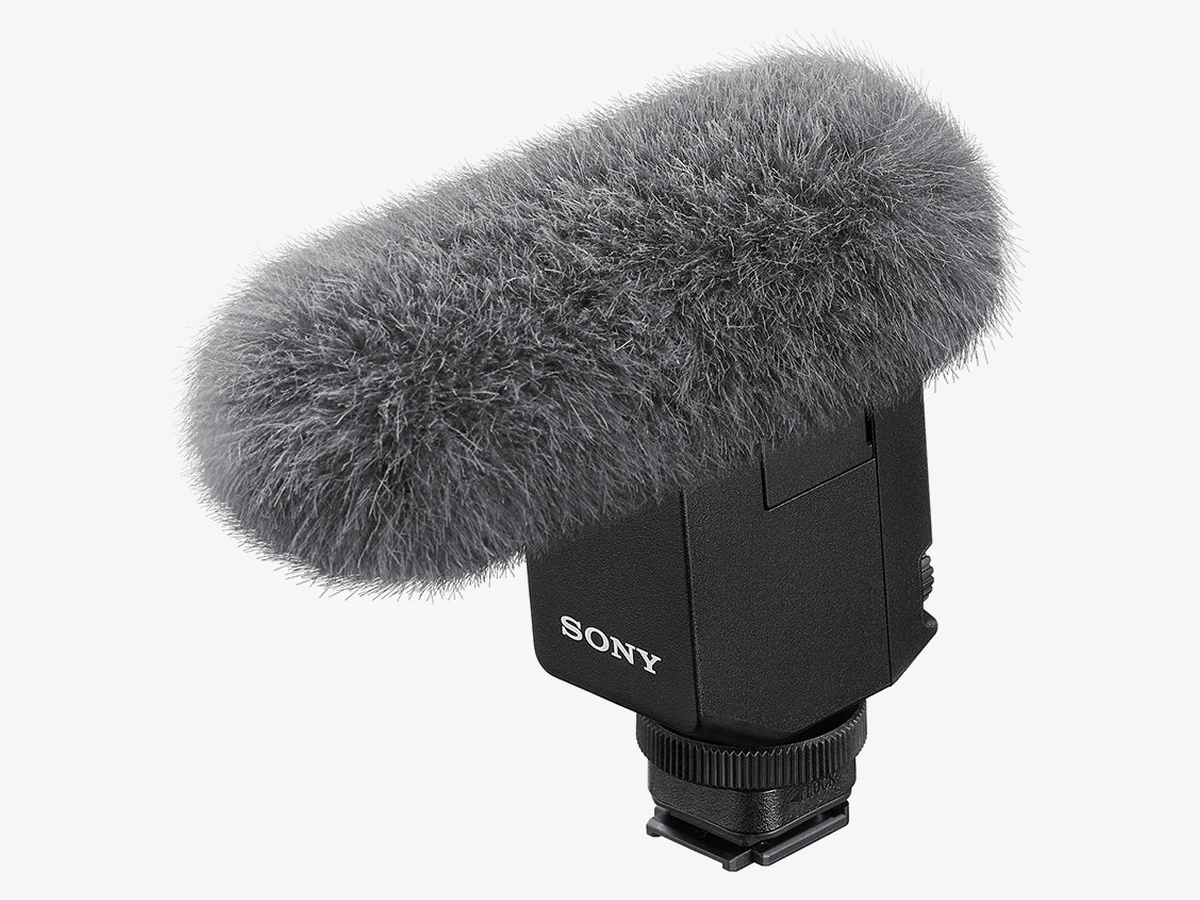
Photo: Sony
Key specs
📷 Best digital Sony mic
8. Sony ECM-B10
The ECM-B10 is the only mic here that changes its pickup pattern with a switch: super-directional for one voice, unidirectional for a normal vlog, omnidirectional for a group or a room.
Eight tiny microphones inside the body work together to form a beam, and a switch on the mic chooses which beam shape you get. Super-directional picks up a narrow cone in front of the camera and cuts the most room sound, which suits a single speaker at arm’s length. Unidirectional opens the beam for a normal talking-to-camera vlog. Omnidirectional takes in the whole scene for group shots, ambient sound or a music performance. Like the ECM-G1 it mounts on the MI Shoe, so on a Sony camera there is no cable, no battery and no analog path to add hiss. A noise filter switch and a three-step attenuator handle rumble and loud scenes, and an audio level wheel sits on the mic itself. The furry windscreen in the box is made for this shape, and the body is sealed against dust and moisture.
The limits. The MI Shoe is the only connection, so this mic works on Sony cameras and nothing else. It is also the most complex mic here: three patterns, three filter settings, three attenuator steps and a level wheel, and the wrong combination can sound worse than the right one. At 72 grams it is heavier than the ECM-G1. If you shoot Sony and your vlog mixes solo talking, interviews and room sound, one mic that changes pattern is worth more than three fixed ones.
Technical features
- Eight-microphone beamforming, three selectable directivity patterns
- 72g, 79.3mm long, dust and moisture resistant body
- MI Shoe connection: cable-free, battery-free, digital audio on Sony cameras
- Super-directional, unidirectional and omnidirectional patterns on one switch
- Noise reduction switch and low-cut filter for rumble and wind
- Three-step attenuator, 0, 10 and 20dB, plus audio level wheel
- Furry windscreen included, audio level can be set from the mic
- Frequency range 40Hz to 20kHz, dynamic range 105dB
- Noise filter switch: off, low cut, noise cut
What we like
- Three patterns in one mic, no swapping
- No cable, no battery on Sony cameras
- Digital audio path, no analog hiss
- Attenuator and level wheel on the mic
- Sealed against dust and moisture
Watch out for
- Sony MI Shoe only, no 3.5mm output
- More settings to get wrong than any mic here
- Heavier than the ECM-G1 at 72g
- Beamforming can sound odd if the subject moves off axis
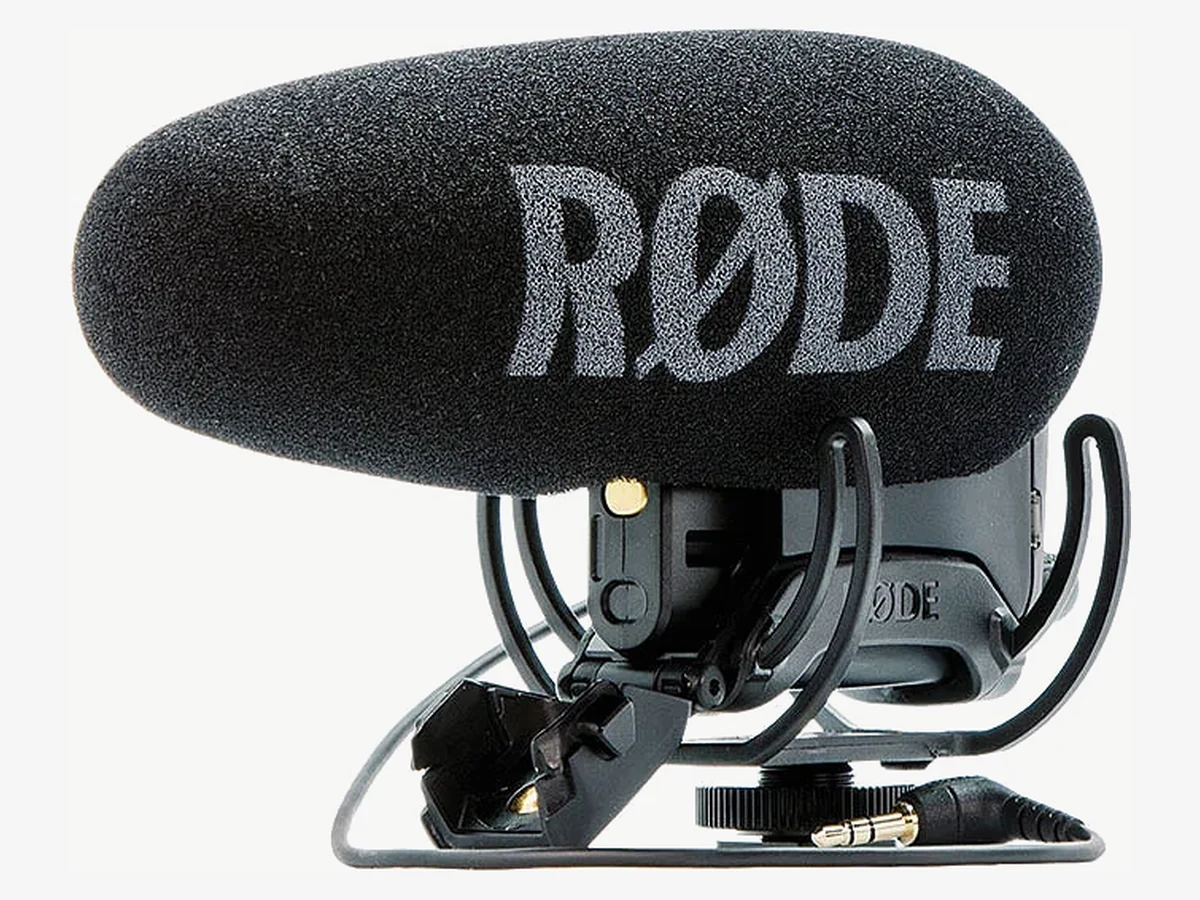
Photo: Rode
Key specs
🎚️ Best for loud rooms
9. Rode VideoMic Pro+
The VideoMic Pro+ is the mic to buy when your shoots get loud: a 100-hour battery, a three-stage gain switch, a safety channel and a high-pass filter that tames rumble before it reaches the camera.
This is the most controlled mic here. The LB-1 rechargeable battery runs for over 100 hours and can be swapped for two AA batteries or powered over micro-USB, so a dead battery never ends a shoot. A three-stage gain switch sets the level at minus 10, 0 or plus 20dB, which keeps the camera preamp low and the hiss down. A safety channel records a second track 10dB quieter on the right channel for loud moments. The high-pass filter cuts rumble at 75 or 150Hz, and a high-frequency boost lifts detail at 7kHz. It powers itself on and off with the camera, so there is no switch to forget. The Rycote Lyre mount is the best shockmount in this guide, and it handles knocks, footsteps and wind gusts that shake cheaper mounts.
The limits. At 122 grams it is the second heaviest mic here, about a third of a ZV-E10 on top of the camera, and at 170mm it can creep into a very wide shot. The furry DeadCat for real wind is sold separately. It also has no USB mode, so it stays a camera mic. If your vlog takes you into loud streets, markets, concerts or events, the battery life and the safety channel are worth the weight.
Technical features
- Supercardioid polar pattern, Rycote Lyre suspension mount
- 122g, 170mm long, all-metal body
- LB-1 rechargeable battery, 100+ hours, removable and swappable
- Also runs on 2x AA batteries or micro-USB power
- Three-stage gain control, minus 10, 0 and plus 20dB
- Safety channel records a backup 10dB quieter on the right channel
- High-pass filter 75Hz and 150Hz, high-frequency boost plus 5dB at 7kHz
- Auto power on and off with the camera, detachable 3.5mm cable
- Foam windscreen included, DeadCat VMPR+ furry sold separately
What we like
- 100+ hour battery, swappable mid-shoot
- Safety channel saves loud takes
- Three-stage gain keeps camera hiss down
- Best shockmount in this guide
- Auto power on and off with the camera
Watch out for
- Second heaviest mic here at 122g
- 170mm can creep into very wide shots
- Furry DeadCat sold separately
- No USB mode for computers
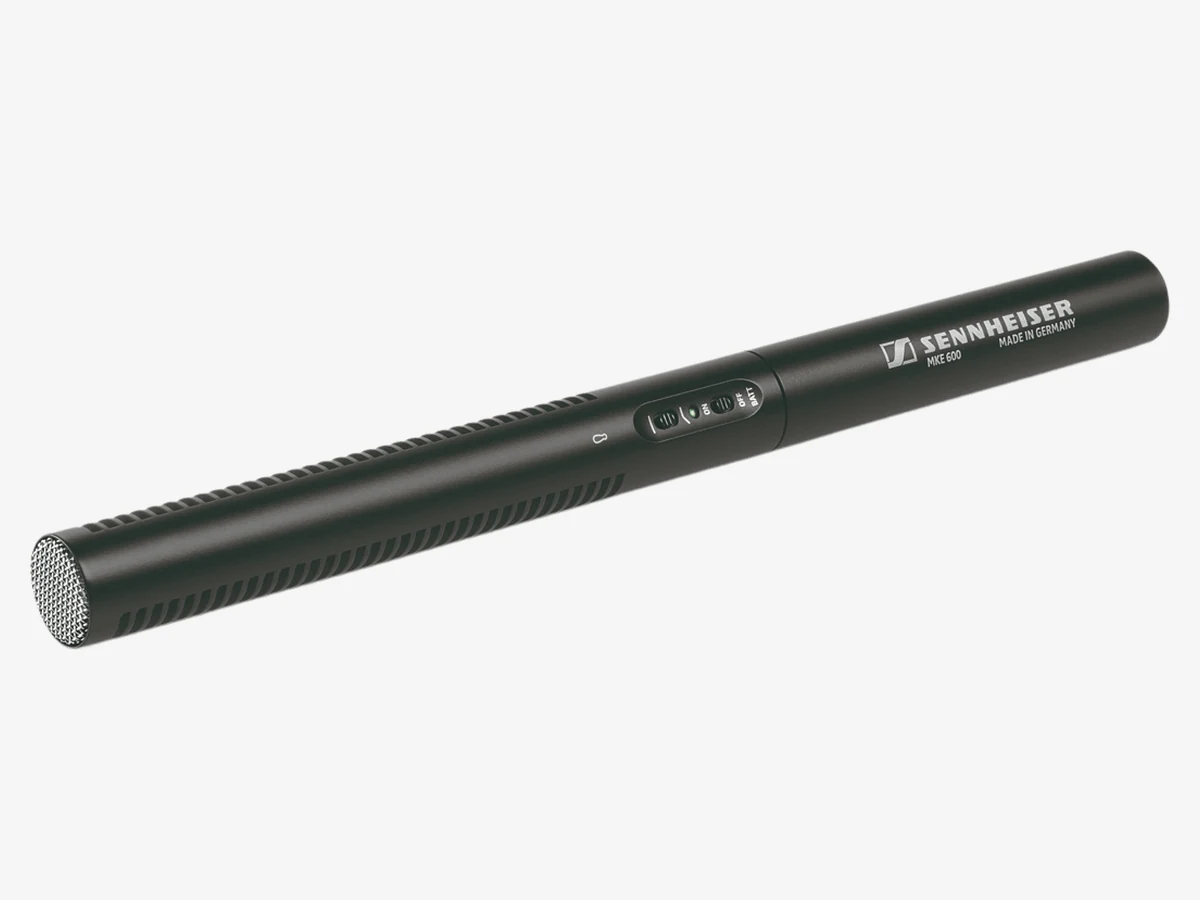
Photo: Sennheiser
Key specs
🎬 Best step-up to XLR
10. Sennheiser MKE 600
The MKE 600 is the step-up pick: a proper XLR shotgun that can live on a camera today and on a boom pole tomorrow, and the only mic here that runs on phantom power or a single AA battery.
This is a broadcast mic in a camera-mic body. Its long interference tube gives it the tightest pickup in this guide, which is why it rejects room echo and side noise better than any short mic can. The XLR output means it plugs into recorders, mixers and camera rigs with XLR inputs, and it comes with the shockmount, the foam windscreen and the XLR-to-3.5mm cable in the box, so it is not a bare mic. If you record to a separate recorder, you need to sync external audio with video in the edit. On a camera with no XLR input, one AA battery powers it for about 150 hours, with a low-battery warning that leaves roughly eight hours of runtime, so you are not stranded. A low-cut filter trims rumble, and the body is built to survive daily use.
The limits are the reason it is last, not first. A 256mm mic on a small camera is a big mic: it will enter wide shots, it shifts the balance forward, and at 128 grams it is the heaviest mic here. The 3.5mm cable in the box only carries the signal; the camera still cannot power the mic, so you always need the AA battery or phantom power from a recorder. And the tight pickup is a double-edged sword: a subject who drifts off axis sounds thin. Buy this one when you are ready to add a recorder or a boom, not as a first mic.
Technical features
- Supercardioid and lobar polar pattern, long interference tube
- 128g, 256mm long, metal body built for daily use
- XLR output, 48V phantom power or 1x AA battery, about 150 hours
- Low-battery indicator leaves about 8 hours of runtime
- Low-cut filter switch reduces low-frequency rumble
- MZS 600 shockmount, MZW 600 foam windscreen and KA 600 XLR to 3.5mm cable included
- On and off switch, no auto power with the camera
- Frequency range 40Hz to 20kHz, maximum SPL 132dB on phantom power
- Works on camera, on a rig, or on a boom pole with a recorder
What we like
- Tightest pickup in this guide
- XLR ready for recorders and boom work
- AA battery gives about 150 hours
- Shockmount, foam and cable in the box
- Built for daily professional use
Watch out for
- Heaviest mic here at 128g
- 256mm enters wide shots on small cameras
- Camera 3.5mm jack cannot power it, battery or phantom required
- Tight pickup punishes a subject who moves off axis
The distance limit: how close is close enough
Short answer: a shotgun mic sounds good to about two meters. At arm’s length, about 60cm, your voice is close and full. Past two meters the room wins, and no shotgun mic, at any price, changes that.
A shotgun microphone works by rejecting sound from the sides and the rear, not by pulling in sound from far away. Think of it as a flashlight, not a telescope: it lights up what is in front of it, but it does not reach further. Most mics here use a supercardioid pattern; the D4 Duo uses two cardioid capsules and the ECM-B10 forms its pattern with beamforming. Our guide to polar patterns explains what that means for your recordings. Every decibel of distance costs you voice level while the room noise stays the same, so the voice-to-room ratio drops fast. Double the distance and your voice drops by about 6dB while the echo, the fan and the street stay where they are. That is why a two-meter shot sounds thin and echoey even on a broadcast mic, and why a one-meter shot on a budget mic can sound better than a three-meter shot on a flagship.
The practical rule for vlogging is simple. Hold the camera at arm’s length and talk to it, and any mic in this guide will sound good. Film yourself from a tripod two meters away and the same mic will sound distant. Film a person across a room and you need a different tool: a wireless lavalier on the person, or a boom mic held close to them. That is not a flaw in the mic. It is physics.
Distance also changes how much of the room you hear. Indoors, hard walls and floors bounce your voice back to the mic a fraction of a second late, and that echo is what makes a vlog sound like it was recorded in a bathroom. The closer the mic is to your mouth, the louder your voice is relative to those reflections. That is why the same mic sounds great in a furnished room and poor in an empty one, and why a rug, a curtain or a soft chair can improve your audio more than a new mic.
Weight on a small body: why it matters
Short answer: a mic that weighs a third of your camera changes how the camera handles. Keep the mic under about 100 grams on a ZV-E10 or an R50 V, and check the balance before you buy.
A Sony ZV-E10 weighs about 343 grams with battery and card. A Canon R50 V weighs about 370 grams the same way. Against those numbers, the mics in this guide split into three groups. The light group, the D4 Mini at 28g, the VideoMicro II at 39g, the D4 Duo at 40g and the ECM-G1 at 34g, adds roughly a tenth of the camera’s weight. You barely notice it. The middle group, the ECM-B10 at 72g, the GO II at 89g rigged, the MKE 400 at 93.5g and the NTG at 94g, adds about a fifth to a quarter. You feel it after an hour, but the camera still balances. The heavy group, the Pro+ at 122g and the MKE 600 at 128g, adds a third or more, and the camera tips forward in the hand.
Weight is not just a number. A heavy mic on a small camera makes the rig front-heavy, which tires your wrist on a long walk and makes handheld shots shake more. It also matters on a gimbal: a 128g mic on top of a small camera can push a compact gimbal past its balance range, and a 256mm mic on a gimbal is a lever that fights the motors. If you shoot handheld for hours, buy light. If you shoot on a tripod, weight barely matters, and the Pro+ or the MKE 600 becomes a fair choice.
Length matters too. A mic longer than about 170mm can creep into a wide shot at 16mm and wider, which is where vloggers live. The VideoMicro II at 80mm and the ECM-G1 at 48.5mm never enter the frame. The NTG and the Pro+ at about 170mm sit right on the edge. The MKE 600 at 256mm will enter a wide shot, so you either frame tighter or mount it further back.
Power: plug-in, battery, rechargeable or phantom
Short answer: most mics here run on plug-in power from the camera and never need charging. The exceptions are the NTG and the Pro+, which recharge, the MKE 400, which runs on two AAA batteries, and the MKE 600, which needs phantom power or one AA battery. A mirrorless camera cannot supply phantom power.
Plug-in power is the simplest system. The camera sends a small voltage down the mic cable, the mic uses it, and there is nothing to charge, nothing to switch on and nothing to forget. The VideoMicro II, the D4 Mini, the D4 Duo and the ECM-G1 on its 3.5mm cable all work this way, and the GO II does too on its 3.5mm output. The only catch is that the camera must supply it, and almost every mirrorless camera and phone does. If a mic sounds dead on a camera, check that plug-in power is on in the camera menu before you blame the mic.
Rechargeable mics trade simplicity for control. The NTG runs over 30 hours on a charge and recharges over USB-C in about two hours, and it can run from a power bank while you record. The Pro+ runs over 100 hours on its LB-1 battery, and the battery pops out so you can swap in two AA batteries or power it over micro-USB. The battery is built into the NTG, so a dead battery ends the shoot unless you have USB power. That is the one real risk of the rechargeable route, and it is why the Pro+ is the safer choice for long days.
Replaceable batteries are the oldest system and still the most forgiving. The MKE 400 runs over 100 hours on two AAA batteries, and the MKE 600 runs about 150 hours on one AA. Carry a spare set in your bag and a dead mic is a ten-second fix. The MKE 600 also takes 48V phantom power from a recorder or mixer, but a mirrorless camera cannot supply phantom power, so on a camera the AA battery is not optional. If you buy the MKE 600 for camera use, put a spare AA in your bag on day one.
The MI Shoe mics are a special case. On a Sony camera with a Multi Interface Shoe, the ECM-G1 and the ECM-B10 take their power from the shoe and send digital audio straight to the camera, so there is no battery, no cable and no analog path to add hiss. The ECM-G1 also works on other cameras through its 3.5mm cable, where it runs on plug-in power like any other mic.
Wind: foam, deadcat or blimp
Short answer: a foam windscreen handles indoor air and a light breeze. Real wind outdoors needs a furry deadcat. A blimp is for storms and film sets, not vlogging.
Wind noise is not a recording problem, it is a physics problem. Moving air hits the mic capsule and the capsule hears it as a low rumble that swallows your voice. No filter fixes it cleanly after the fact, because the rumble sits in the same frequencies as your voice. If a take is already noisy, our guide on how to fix bad audio in the edit shows what can and cannot be saved. The fix is mechanical: put something between the wind and the capsule that breaks the air up before it arrives.
Foam is the first line. It is the small black cover that comes on most mics, and it handles indoor air movement, a fan, and a light breeze. Five mics here include foam in the box: the VideoMicro II, the GO II, the NTG, the Pro+ and the MKE 600. The VideoMicro II goes further and includes a furry cover too, which is the best wind protection of any mic here at its size.
A deadcat is the furry cover that looks like a small animal. The fur breaks up the wind before it reaches the capsule, and it is the only thing that works in a real breeze. The D4 Duo includes two furry covers, one per capsule, and the D4 Mini includes one rated for wind up to 20 mph. The MKE 400 includes its furry MZH 400 cover on top of built-in wind protection. The ECM-G1 and the ECM-B10 include a furry windscreen too. For the GO II, the NTG and the Pro+, the furry cover is sold separately: the WS12 for the GO II, the WS10 for the NTG, and the DeadCat VMPR+ for the Pro+. If you shoot outdoors more than indoors, buy the furry cover with the mic, not after your first ruined take.
A blimp is the big cage with a furry cover that film crews use on boom poles. It works in strong wind, but it is big, heavy and expensive, and it makes no sense on a vlogging camera. If the wind is strong enough to need a blimp, move indoors, put your back to the wind, or use a lavalier under a jacket.
When a lavalier beats a shotgun
Short answer: a lavalier wins when the mic cannot stay close to the voice. Interviews, two people talking, windy streets and moving subjects all belong to the lav. A shotgun wins when you film yourself at arm’s length and want the simplest rig.
The rule is the distance rule again. A shotgun mic sounds good because it sits close to the voice. A lavalier sounds good because it sits on the voice. When the camera cannot get close, the lav wins every time. An interview across a table, a subject walking away from the camera, a presenter moving through a market: the shotgun is two meters away and fighting the room, while the lav is ten centimeters from the mouth and hearing almost nothing else.
Two people is the other clear case. One shotgun cannot favor two mouths at once, and if one person is closer to the mic than the other, one voice is loud and the other is buried. Two lavalier mics, one per person, give two clean tracks at the same level. That is why every interview setup uses lavs, not shotguns. Our guide to the best wireless microphones covers the lav side in full, including the two-person setups.
Wind is the third case. A lavalier hides under a jacket, behind a collar or under a furry cover the size of a coin, and the body blocks the wind. A shotgun sits on top of the camera in the open air, and in a strong wind even a deadcat struggles. If you shoot outdoors in wind most days, a lav is the safer buy, and a shotgun is the second mic, not the first.
That said, the D4 Duo and the D4 Mini blur the line. Both have a 3.5mm AUX input that takes a lavalier or a wireless receiver and records it alongside the shotgun, so you get the room and the person in one take. That is the smartest single purchase if you know you will need both: buy the D4 Duo, add a lav later, and you have both tools on one mount. To record clear audio outdoors, a lav under clothing plus a shotgun for ambience is a combination that covers most vlogging days.
What about the cinema mics
Short answer: the cinema shotguns, like the Rode NTG5 and the Sennheiser MKH 416, are boom microphones, not camera microphones. They need phantom power, an XLR input and a boom pole, and they are not for this article.
The NTG5 and the MKH 416 are superb microphones, and they are the right tools for film sets, documentaries and interviews on a boom pole. But they do not fit a vlogging camera. They take XLR only, they need 48V phantom power that no mirrorless camera supplies, they are long, and they are priced for a film budget. A vlogger who buys one needs a recorder and a boom pole, and usually a second person to hold it, which is three purchases and a crew for a job a 39g mic does alone.
The MKE 600 is the closest thing in this guide to that world, and it is here because it can run on one AA battery and a 3.5mm cable, so it works on a camera today and on a boom pole with a recorder tomorrow. That is the line: if a mic cannot work on a camera with nothing but its own battery or plug-in power, it is not a vlogging mic. The cinema mics fail that test, so they are not picks in this guide.
FAQs
Short answers to the questions vloggers ask most about shotgun microphones, from whether you need one at all to how close you have to get.
Do I really need a shotgun mic, or is the camera mic enough?
A shotgun mic is the single biggest audio upgrade for a talking-to-camera vlog. A camera mic hears everything in the room at the same level: your voice, the fan, the street, the echo. A shotgun mic focuses on what is in front of the lens and pushes the rest down, so your voice stands clear. If your vlog is mostly you talking to the camera, the difference is night and day.
What is the best shotgun mic for the Sony ZV-E10?
The Sony ECM-G1 is the natural match: 34 grams, no cable and no battery on a Sony camera, and digital audio straight from the shoe. If you also record to a phone or a computer, the Rode VideoMic NTG is the better all-rounder, with a gain knob and a USB mode. Both are light enough for the ZV-E10.
Can I use a shotgun mic on my phone?
Yes. The Rode VideoMic GO II and the VideoMic NTG plug into a phone over USB-C and work as USB microphones. The VideoMicro II and the D4 Mini connect over 3.5mm with the TRRS cable in the box. The D4 Duo ships with a TRS cable only, so for a phone you need a TRRS cable or adapter bought separately. You need the right cable for your phone: USB-C to USB-C for Android and modern iPads, or a Lightning cable for older iPhones.
How far away can a shotgun mic pick up my voice?
Cleanly to about two meters. At arm’s length, about 60cm, your voice is close and full. Past two meters the room noise and echo catch up with your voice and the recording sounds distant and thin. A shotgun mic rejects sound from the sides, it does not reach further, so distance is set by physics, not by price.
Do shotgun mics need a battery?
Most mics here do not. The VideoMicro II, the D4 Mini, the D4 Duo, the GO II and the ECM-G1 on 3.5mm run on plug-in power from the camera, and the Sony MI Shoe mics take power from the shoe. The NTG and the Pro+ have rechargeable batteries, the MKE 400 runs on two AAA batteries, and the MKE 600 runs on one AA battery or phantom power from a recorder.
What is a deadcat, and do I need one?
A deadcat is the furry cover that slips over a microphone. The fur breaks up moving air before it reaches the capsule, so wind noise drops sharply. A foam cover handles a light breeze, but real wind outdoors needs the furry cover. If you shoot outside more than inside, buy the furry cover with the mic. The VideoMicro II, the D4 Duo, the D4 Mini, the MKE 400, the ECM-G1 and the ECM-B10 include one in the box.
Should I buy a shotgun mic or a wireless lavalier first?
Buy a shotgun mic first if you film yourself at arm’s length, which is most vlogging. Buy a wireless lavalier first if you interview people, film two people talking, or shoot in wind most days. The lav sits on the voice and wins when the camera cannot get close. The D4 Duo is the middle ground: it has a second input that takes a lavalier alongside the shotgun.
Why does my shotgun mic sound worse indoors?
Hard walls and floors bounce your voice back to the mic a fraction of a second late, and that echo is what makes a vlog sound like it was recorded in a bathroom. The fix is distance and softness: get the mic closer to your mouth, and add soft things to the room, a rug, a curtain, a sofa, to soak up the reflections. A shotgun mic cannot fix an echoey room from three meters away.
Can the Rode VideoMic NTG work as a USB mic?
Yes. Plug it into a computer over USB-C and it becomes a 24-bit, 48kHz digital microphone for voiceovers, calls and livestreams, with no drivers needed. The 3.5mm jack switches over to headphone monitoring, so you hear yourself while you record. The GO II works the same way, with fewer controls.
Can the Sennheiser MKE 600 work without phantom power?
Yes. One AA battery powers it for about 150 hours, with a low-battery warning that leaves roughly eight hours of runtime. A mirrorless camera cannot supply phantom power, so on a camera the AA battery is not optional. Phantom power only comes from a recorder, a mixer or a camera with an XLR input.
What is the difference between the VideoMic GO II and the VideoMicro II?
The GO II adds a USB-C output, so it works as a phone and computer mic, plus app controls like a pad, a high-pass filter and input gain. The VideoMicro II is simpler and lighter at 39 grams, with no app and no USB mode, but it includes both a foam and a furry windshield in the box. Buy the GO II if you record to a phone or computer; buy the VideoMicro II if you want the cheapest, simplest camera-only mic.
Does the Deity V-Mic D4 Duo really record two mics at once?
Yes. It has two capsules: one faces your subject, one faces you. In dual mono mode the front capsule goes to the left channel and the rear capsule to the right, so you can balance or cut either voice in the edit. The rear capsule is 9dB less sensitive than the front, because your mouth is much closer to it. A 3.5mm AUX input can replace the rear capsule with a lavalier or a wireless receiver.
How do I stop wind noise in my vlogs?
Use a furry deadcat on the mic, stand with your back to the wind, and get the mic closer to your mouth. Those three things fix most wind noise. If the wind is strong, hide a lavalier under a jacket and use the shotgun only for room sound. No filter in the edit fixes wind noise cleanly, because the rumble sits in the same frequencies as your voice.
The bottom line
Short answer: most vloggers should buy the Rode VideoMic NTG. If money is tight, buy the VideoMicro II. If you talk to the camera, buy the D4 Duo. If you shoot Sony, buy the ECM-G1.
A shotgun mic is the fastest audio upgrade a vlogger can make, and the choice is simpler than it looks. The NTG does every job, the VideoMicro II does the core job for the least money, the D4 Duo solves the solo-vlogger problem in a single mic, and the ECM-G1 is the simplest way to get clean sound on a Sony camera, with no cable and no battery. The other six mics are for specific jobs: the D4 Mini for the lightest rig with a second input, the GO II for phone and computer recording, the MKE 400 for live monitoring, the ECM-B10 for switchable patterns, the Pro+ for loud rooms, and the MKE 600 for the step up to XLR.
Whatever you buy, remember the two rules that matter more than the mic. Stay close, about arm’s length, because past two meters the room wins. And put a furry cover on the mic before you go outside, because wind noise is the one mistake no edit can fix.
This guide is research-based curation: we compared manufacturer specifications, published reviews, and current prices. Read how we choose.
Keep exploring
Good shotgun audio is only half the vlog. Here is the rest of the kit, from the camera to the edit.