
Last updated: November 2026
A client does not hire you for your camera. A client hires you because you can turn a shoot day into a finished video that holds attention, on a date you promised, without drama. If you already vlog, you practice those three skills every week. Freelance videography is the job of selling them to creators and small brands who need video but cannot make it themselves. This guide shows how to pick services, build a portfolio from skills you already practice, find first clients, price packages, and write a contract that protects both sides.
In this guide
- Can vlogging skills really become paid freelance work?
- What creator services should you offer first?
- What gear do you actually need to start?
- How do you build a portfolio that wins creator clients?
- How do you find your first paying clients?
- How should you price freelance video work?
- What should your contract cover?
- What about insurance and tax?
- How do you handle difficult clients and scope creep?
- Your first 30 days as a freelance videographer
- Frequently asked questions
Can vlogging skills really become paid freelance work?
Most beginner guides describe freelance videography as a generic craft: build a portfolio, pick a niche, find clients. That advice is true but it misses why a vlogger starts ahead. A working vlogger has already solved the problems that sink new freelancers. You know how to light a face in a small room, get usable audio without a crew, hold a shot steady while walking, and cut a rambling take into something a stranger watches to the end. Those are not beginner skills. They are the service.
The transfer is direct. The table below maps what you already do to what a client buys.
| Vlogging skill you already practice | Client service it becomes | What the client sees |
|---|---|---|
| Hooking viewers in the first seconds | Channel trailers and video openings | A video that keeps viewers past the first ten seconds |
| Cutting for retention | Editing retainers for creators | Weekly videos delivered on time, in the channel’s style |
| Talking to camera with clean audio | Founder and testimonial shoots | A confident speaker who sounds professional |
| Short-form pacing | Shorts and Reels packages | One shoot turned into a week of vertical clips |
| Lighting and framing a small room | Small brand and product shoots | A product that looks expensive on a small budget |
Two honest limits belong here. First, client work is not your channel. The client sets the message, the deadline, and the revision process, and your taste serves their brief. Second, your own vlogs do not prove you can serve a client. A portfolio of personal videos shows style; a portfolio of client-shaped work shows reliability. the portfolio section closes that gap.
For the craft itself, the site’s technique guides stay useful as reference: shot types and composition, smooth handheld movement, and the wider ways vlogging earns, of which freelance client work is one.
What creator services should you offer first?
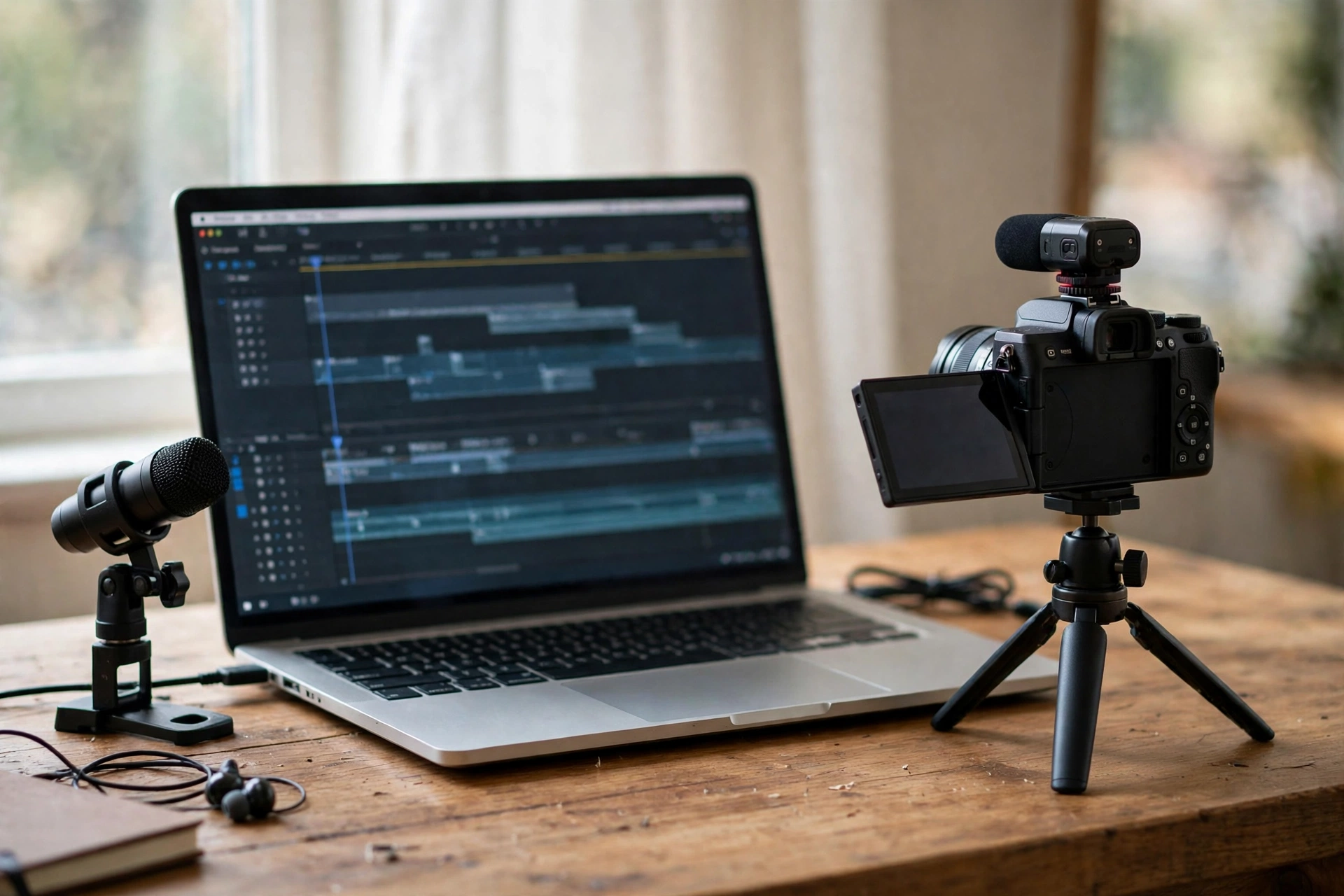
New freelancers fail by offering everything. A services page that lists corporate films, documentaries, music videos, and real estate tells a buyer nothing about what you are good at. A creator client wants to know one thing: have you made videos like mine, for people like me? Pick services where your own channel is the proof.
| Service | What you deliver | Who buys it |
|---|---|---|
| Shooting for other creators | Half day or full day on location, plus a first edit | Creators who hate filming themselves or need a second angle |
| Editing retainer | Two to four finished videos a month, in the channel’s style | Creators publishing weekly who are drowning in edits |
| Shorts and Reels package | One shoot cut into five to ten vertical clips with captions | Creators and small brands building a short-form presence |
| Channel trailer | One 60 to 90 second trailer from existing footage plus one shoot day | Creators relaunching or rebranding a channel |
| Testimonial and founder shoot | One interview setup, clean audio, one finished edit plus cutdowns (short versions cut from the main edit) | Small brands and startups that need trust on camera |
The first three rows of the table are the starting set. The last two rows are services to add once the first three are selling.
Two boundaries keep this guide focused. Wedding filming is its own specialty with its own booking season and client expectations, and it sits outside this guide. Video work made for brands to run as advertising, where usage rights are priced separately from the making of the video, is a different job model from freelance client work, where a creator or small business hires you for videos they use themselves.
The retainer deserves special attention because it is the service that turns freelancing from gig hunting into income. A creator who publishes weekly needs an editor every week. One retainer client paying monthly beats four one-off jobs that each need fresh pitching, fresh briefing, and fresh trust. Price retainers by the month, cap the number of videos and revision rounds, and review the scope every three months as the channel grows. A retainer also changes how you plan your week: with two retainer clients, you know which days are edit days before the month starts, and you can say yes to a shoot day without guessing whether an edit will collide with it. That predictability is worth a small discount against one-off pricing, because a booked month is worth more than a hopeful one.
Freelance client work also differs from a brand deal, where a brand pays you for access to your own audience. Brand deals for small YouTubers explains that side. As a freelancer, the client pays for your labor and your finished files, and your follower count is irrelevant to the price.
What gear do you actually need to start?
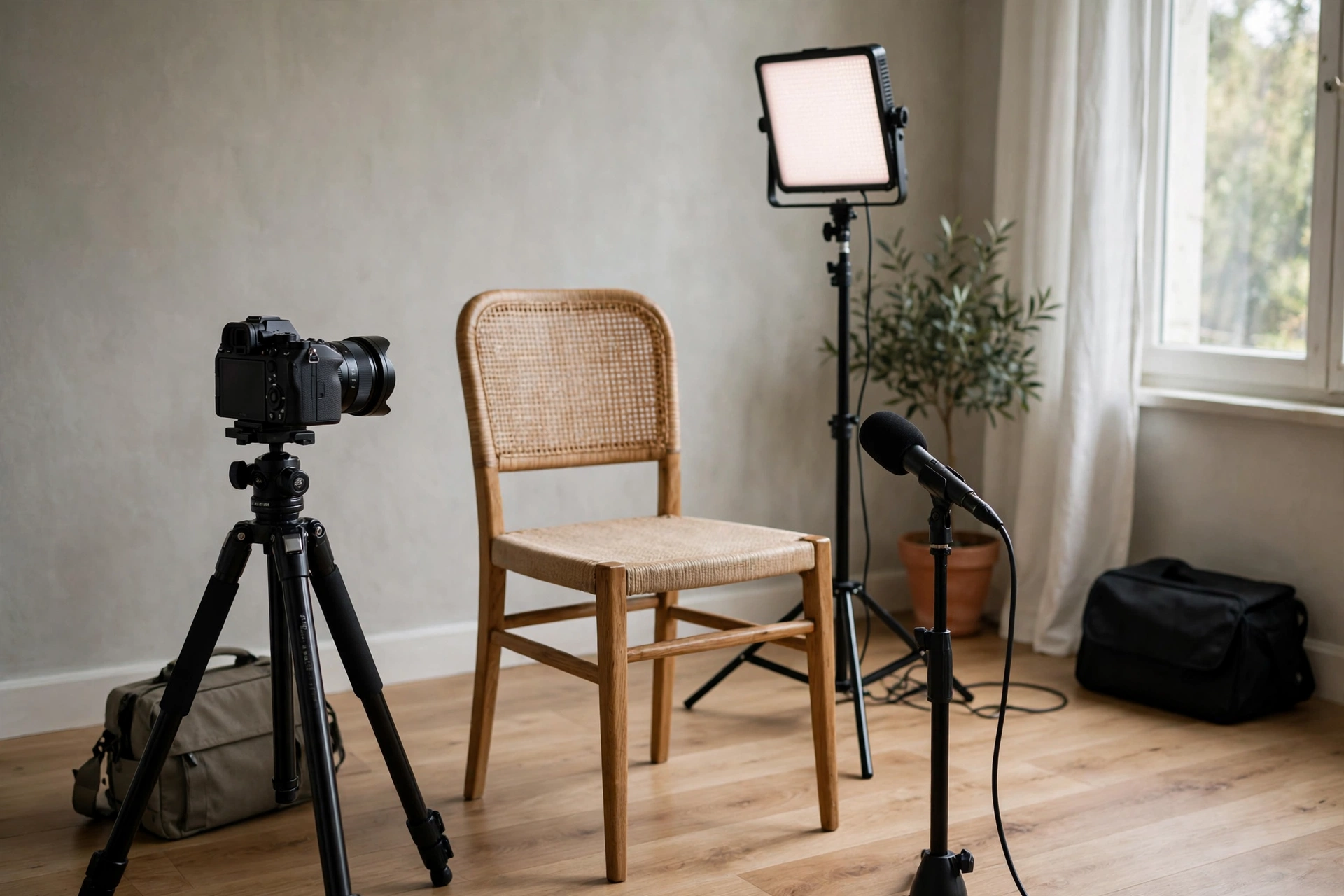
Gear lists are where beginners burn money. The honest starter kit is the kit you already shoot your own videos with, checked and packed as a professional would pack it. A client never sees your wishlist. A client sees clean audio, steady shots, a face that is lit well, and files delivered on time.
| Own now | Rent per job until it pays | Skip for now |
|---|---|---|
| Your vlogging camera and one versatile lens | A second camera body for multi-angle shoots | Cinema lenses and full lighting rigs |
| A wireless or shotgun microphone you trust | Extra microphones for panels and groups | A dedicated audio recorder you have not learned yet |
| One LED panel and a small tripod | Stands, softboxes, and backdrops for larger rooms | A gimbal you cannot balance under time pressure |
| Editing software you know well | Specialist tools for one job (motion graphics, for example) | Every plugin on sale |
| Two memory cards, charged batteries, a hard drive | Backup camera for a shoot that cannot be repeated | A second of everything “just in case” (a rented backup for an unrepeatable shoot is the exception, not the rule) |
Storage and backup belong in the kit, not after it. A freelancer’s reputation dies with one lost card. Shoot on two cards when the camera allows it, copy footage to a hard drive on the day, and keep a second copy somewhere other than your editing machine until delivery is accepted. Tell the client your backup routine in the first call. It sounds boring and it wins trust faster than any showreel.
For the craft behind each item: camera settings for vlogging, lighting a face well, and recording clean audio. The settings that make your own videos look good are the settings that make a client’s video look good. Nothing exotic is required.
How do you build a portfolio that wins creator clients?
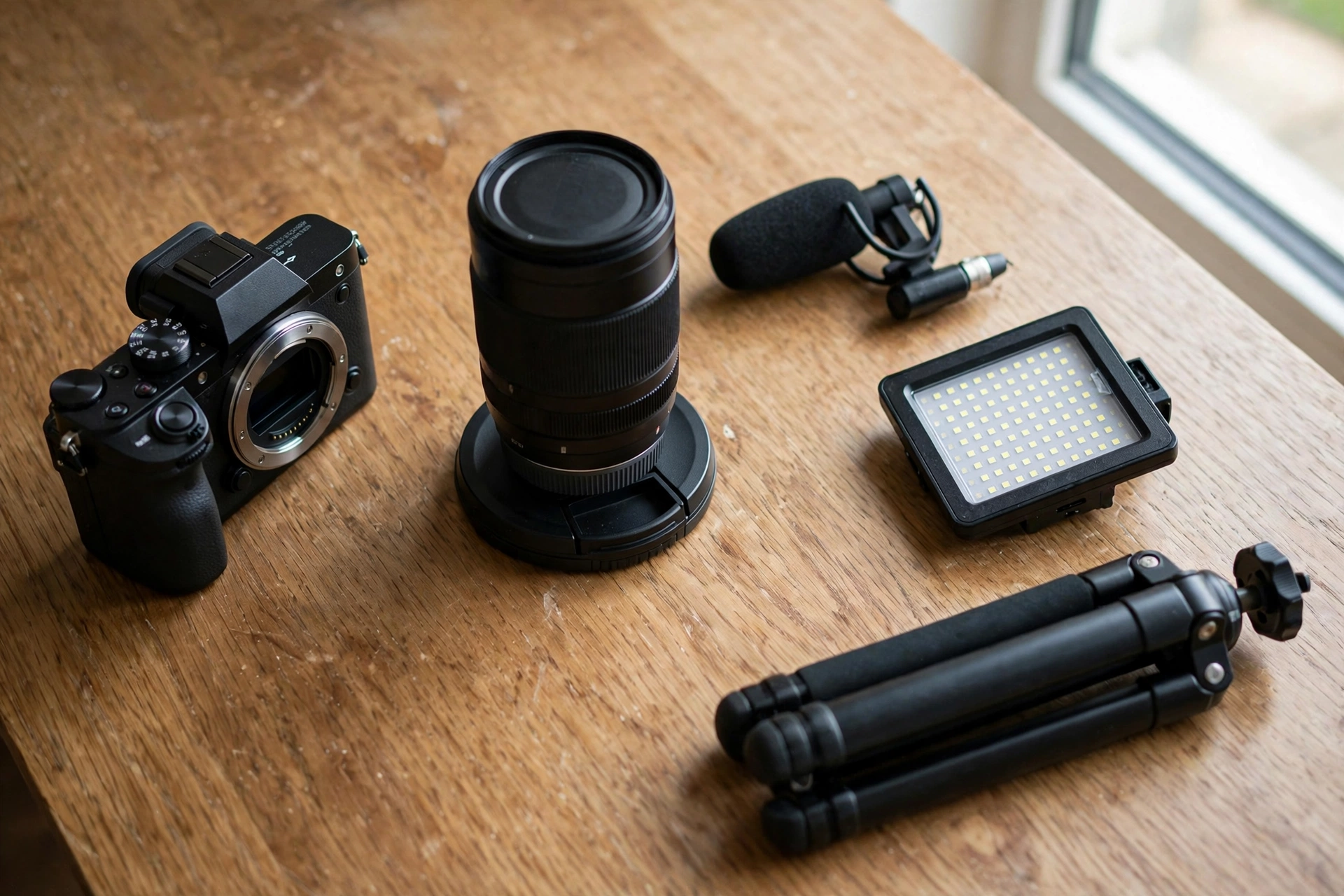
Every guide says “build a portfolio” and stops there. The useful question is what a busy creator actually does with your portfolio page. They watch the first twenty seconds of the first video. If it looks like their channel, they keep watching. If it looks like a film school showreel, they close the tab. Your portfolio must answer, in the first minute, whether you can make videos like theirs.
Build it in this order:
- Pick one niche. If you want fitness creators, every sample should look like fitness content. One mixed reel that jumps from travel to tech to cooking proves range and wins nobody.
- Cut six pieces, each under 90 seconds. Three edits in the niche, two shoots that show lighting and audio, and one before-and-after that shows raw footage becoming a finished edit. Label each piece with what you did: shot, edited, or both.
- Make spec work honestly. Re-editing a public clip or filming a fake brand spot is legitimate portfolio material, but label it as spec work. Presenting practice pieces as paid client work destroys trust the moment a client asks for a reference.
- Get permission for real client work. Ask every client, in the contract, whether you may show the finished video in your portfolio. Most say yes. A portfolio that never includes real client work stays thin forever, which is why the permission clause matters.
- Put it on one page. A single page with embedded videos, one line of context under each, and a contact button beats a sprawling site. Creators hire from phones, between shoots. Make the page load fast and play instantly.
The before-and-after piece earns its place. Clients cannot judge editing from a finished video alone, because they cannot see what you started with. Thirty seconds of shaky, echoing raw footage followed by the same thirty seconds clean, paced, and captioned shows the value of the edit more honestly than any claim about your skills.
Do not wait for a paid client to start. Film a local shop, re-edit a willing small creator’s video with permission, or shoot a spec spot for a product you own. The portfolio comes first. Paid work follows proof, not the other way round.

How do you find your first paying clients?
Client finding has three routes that matter at the start: direct outreach, marketplaces, and referrals. Direct outreach converts best for creator services, because you can show the creator exactly what you would change in their videos. In direct outreach you contact creators, local small brands, and agencies yourself. Marketplaces bring volume but also bidding wars. Referrals arrive later, once you have happy clients. Local small brands are the most overlooked target inside direct outreach: the cafe, gym, or shop in your town probably has a phone-shot social feed and no video help at all.
Direct outreach works only when it is specific. A message that says “I love your content, hire me” gets deleted. A message that names one video, names one fix, and offers one next step gets answered. Three scripts, each under 120 words, cover the first month:
To a small creator: “Hi [name], I watched your video on [topic]. The story is strong, but the middle section loses pace around the three-minute mark, and the captions drop out in the second half. I edit for [niche] creators, and I would be glad to re-cut the opening 60 seconds in your style, with your permission, so you can judge the difference. If it helps, I offer a one-video paid test before any monthly arrangement.”
To a local small brand: “Hi [name], I visited [business] last week and noticed your social videos are shot on a phone in mixed light. I film short product and testimonial videos for local businesses, and I can shoot a one-minute testimonial with clean audio and lighting in a single morning visit. Would a short call this week be useful to talk through one video?”
To a small agency: “Hi [name], I shoot and edit short-form video for creators and small brands in [niche]. I am looking for one agency partner for overflow editing and small shoots. My portfolio page is [link], and I can take a paid test edit this week if you have a project that needs hands.”
Follow up twice, then stop. A short note on day three and another on day ten is professional. A fourth message is pestering, and a creator who feels pestered will never hire you later. Track every pitch in a simple list: who, when, what you offered, and what they answered. Twenty well-aimed pitches in a month is a real campaign. Five pitches and silence is not rejection. It is not a campaign yet.
Test edits need guardrails. A paid test is always better: a small fee for one finished video, agreed in advance, with a clear brief. If you offer one free test, cap it hard: one video, one revision round, a fixed delivery date, and a testimonial agreed in advance if the client is happy. Open-ended free work teaches clients that your time costs nothing, and that lesson is hard to unteach.

How should you price freelance video work?
Hourly pricing punishes speed. The faster and better you get, the less you earn per job, while the client sees a meter running and argues about every hour. Package pricing fixes the fee, defines the deliverable, and lets both sides know exactly what is included. Pricing guides for video professionals put the logic as a simple formula, and it is worth adopting: base cost plus creative margin plus a risk buffer equals the client price. Base cost covers your time, travel, software, and subcontractors. Creative margin pays for skill and keeps the business growing. The risk buffer covers the revision round that runs long and the shoot that moves dates.
Reported market ranges help you sanity-check a package, but they are ranges, not promises. Rates vary by city, niche, and experience, and any guide that states one number for all video work is selling certainty it does not have. Published 2026 pricing guides report these broad bands for solo freelancers: a simple local promo at the lowest band, a testimonial video at roughly twice that, and a social content day between the two. For editing-only work aimed at creators, reported hourly ranges run from a low rate to about four times that, with monthly retainers for a regular creator starting modest and running to about five times that or more per month per client. Use those bands to check your own maths, then price from your costs, not from someone else’s table.
A creator package makes the maths concrete. Take an editing retainer: four videos a month, each up to ten minutes, with captions, one revision round each, delivered on set weekdays. Price it as one monthly fee. The client gets predictable cost and a guaranteed slot in your week. You get predictable income and no weekly renegotiation. Add clear extras with prices: extra revision rounds, rush turnaround, and vertical cutdowns. Extras with prices prevent the awkward conversation where extra work appears and nobody knows what it costs.
Deposits are not optional. Ask for 30 to 50 percent before the shoot, with the balance due on delivery or within an agreed number of days. The deposit covers your booked date, which you cannot sell twice, and it filters out clients who were never serious. If a client refuses any deposit, treat that as information about how the rest of the job will go.

What should your contract cover?
Contracts scare beginners because they sound legal. Think of a contract as a brief with consequences: it writes down what both sides already agreed, so memory cannot rewrite it later. Every guide agrees on the same core clauses, and the disputes they prevent are always the same ones: scope creep, revision sprawl, raw footage arguments, and cancellations. Write each clause in plain language. A clause nobody understands protects nobody.
| Clause | What to write down | The dispute it prevents |
|---|---|---|
| Project description | Exactly what the video is for, in one specific paragraph | “That is not the video I meant” after delivery |
| Deliverables | Number of videos, lengths, formats, cutdowns, and delivery dates | Extra versions expected for free |
| Revisions | How many rounds are included, what counts as a revision, and the price of extra rounds | Endless changes that erase the margin |
| Payment terms | Total fee, deposit, milestones, due dates, and late payment terms | Work delivered, payment drifting for months |
| Raw footage | Who owns the raw files, and whether the client may have them, at what price | The most common ownership argument in video work |
| Rights and usage | Where the client may publish, for how long, and in what form | A local video turning up in paid ads you never priced |
| Cancellation | Notice period, what happens to the deposit, and short-notice fees | A canceled date you cannot refill |
| Music and releases | Licensed music only, and signed releases from people on camera | Copyright and likeness claims after publication |
| Portfolio use | Whether you may show the finished video in your portfolio | A portfolio that stays empty for legal reasons |
Raw footage deserves its own paragraph because it causes more arguments than any other clause. Many clients assume raw footage is included in the fee. Many videographers assume they are keeping it. The finished edit and the underlying footage are different assets with different value, and the contract should address them separately. If the client wants the raw files, price them: storage, transfer time, and the loss of future edit work all cost something.
Two related points belong in every creator contract. First, music: use only music you are licensed to use, and say in writing who supplies or pays for the license. A client who hands you a chart song they do not own is handing you their copyright problem. Second, people on camera: get signed releases where the video will be published, and read the site’s guide to filming people, places, and property legally before promising a client that a location shoot is simple. If a video promotes a brand, disclosure rules apply to the creator who publishes it, so point creator clients to sponsorship disclosure rather than guessing at the rules yourself.
Whoever writes the contract sets the starting position. A client’s template will lean toward broad usage rights and tight delivery terms. Your own template will lean toward capped revisions and protected payment. Read a client’s template clause by clause before signing, and negotiate the three that matter most: revision cap, payment schedule, and raw footage. Everything in this section is general information, not legal advice. For a contract you will reuse across many clients, a short review by a lawyer in your area costs far less than one bad dispute.

What about insurance and tax?
Insurance sounds like a big-business topic until the first shoot in a hired room. A light stand falls, a guest trips over a cable, a card fails and a shoot cannot be repeated. General liability covers claims for accidental injury or property damage to other people during a shoot. Equipment cover repairs or replaces gear that is stolen or damaged. Professional liability covers claims that a professional failure, such as lost footage, caused a client a loss. Venues, rental houses, and larger clients often ask for proof of cover before they let you work, in the form of a certificate of insurance. Short-term event cover exists for one-off shoots, which makes a first job insurable without a year-long policy.
Start by listing what you own and what could go wrong with it, then get quotes from two or three providers who understand video work. Compare what is covered, not only the price: a cheap policy that excludes equipment in transit or work at heights is no policy at all for a working videographer. Keep the certificate where you can send it within minutes. A client who waits three days for proof of insurance starts doubting the booking.
Tax is simpler than it feels when handled from day one, and harder than it looks when ignored. Keep a separate account for business money, record every payment in and every cost out from day one, and set aside a share of every payment for tax before you spend it. Invoice promptly, with the contract’s payment terms on the invoice itself. Keep receipts for gear, travel, software, and phone costs in one folder, physical or digital, so the year-end tally takes an evening instead of a week. If you drive to shoots, log the miles on the day, not from memory months later. Small habits like these are what make an accountant’s job cheap and your tax return boring, which is exactly what you want.
How you register (as a sole trader, a company, or another local business form) depends on your country and your income, and the right choice changes as income grows. Talk to an accountant before the first tax year ends, not after. An hour of advice at the start costs far less than untangling a year of mixed personal and business money.
How do you handle difficult clients and scope creep?
Scope creep rarely arrives as a demand. It arrives as a small favor: one more version, a slightly different edit, a quick extra shoot, a caption change that becomes a re-edit. Each favor is small. Together they eat the margin and push the next client’s deadline. The fix is a sentence, used every time: “Happy to do that. That adds one revision round and moves delivery to Thursday. Shall I confirm the updated fee?” Most clients accept at once. The ones who push back are telling you the job was underpriced, and that is useful information too.
Watch for red flags before they become disputes. No deposit offered. Unlimited revisions requested. Payment promised in “exposure” or future work. A brief that changes every call. A rush deadline with no rush fee. Music or footage supplied without any right to use it. Any one flag is a conversation. Three together are a reason to walk away, politely, before the shoot. Turning down a bad job is not lost income. It is a week saved for a good one.
Late payment needs a calm, fixed process. Send a polite reminder on the due date. Follow up once, in writing, a week later. Pause further deliveries until the account is current, if the contract allows it. Charge a late fee only if the contract says so, which is one more reason the contract matters. Never threaten, never argue on the phone, and never deliver the next video to a client who has not paid for the last one. Quiet firmness collects more money than anger ever does.
If a working relationship is truly broken, end it cleanly. Deliver what has been paid for, hand over the files the contract requires, and write a short closing note. Burning a bridge in a small industry costs more than one bad job ever did. Creators talk to each other, and the story of how you ended a job travels further than the story of how you started it.
Your first 30 days as a freelance videographer
A plan beats a wish list. The first month has one goal: proof that someone will pay you, and a system that can repeat it. Everything else, including a logo, a business name, and a fancy website, can wait.
Week 1: proof. Pick one niche you already understand from your own channel. Cut the six-piece portfolio from the portfolio section. Write the contract template from the contract section and the pricing sheet from the pricing section. Put the portfolio on one page with a contact button.
Week 2: outreach. List 20 creators and small brands in the niche. Watch one video from each and note one specific improvement. Send the pitches from the finding-clients section, five a day over four days, working through the list of 20, and log every reply. List on one freelance marketplace with the same niche portfolio.
Week 3: delivery. Take the first paid test, even a small one, and treat it like a flagship job. Confirm the brief in writing, shoot clean, deliver on the promised date, and ask for a testimonial the day the client is happy. One testimonial from a real client beats ten spec pieces.
Week 4: repeat. Offer the happy client a monthly retainer for the next three months. Ask for one introduction to another creator in the same niche. Review what the first job actually cost you in hours, and adjust the pricing sheet before the next quote.
Good looks like this at day 30: one paid test delivered. If no test has landed yet, three warm conversations with creators in your niche is the honest fallback, and month two starts with following those three up. Set one monthly habit now that most beginners skip: on the last day of each month, review what you earned, what each job cost in hours, and which channel brought the work. That single review tells you which service to push, which price to raise, and which pitch to stop sending.
Frequently asked questions
Do I need a degree to become a freelance videographer?
No. Clients hire from portfolios, not certificates. Training courses help, and practice helps more, but published guides for freelance videographers report that clients judge the portfolio, not the degree. Show six strong pieces in their niche and the question never comes up.
How much should a beginner charge for freelance video work?
Charge a package fee built from your base cost plus a margin and a revision buffer, and check it against reported market ranges for your niche. A simple local promo is reported at the lowest band and a testimonial video at roughly twice that, but those are broad bands that vary by market, not prices to copy blindly.
Do I need followers to get freelance video work?
No. Freelance clients pay for your labor and your finished files, not for your audience. That is the core difference from a brand deal, where the brand pays for access to your followers. A small channel with a strong portfolio wins freelance work.
Should I work for free to build a portfolio?
At most, one capped test: one video, one revision round, a fixed delivery date, and a testimonial agreed in advance. A paid test is always better. Open-ended free work teaches clients that your time costs nothing, and it rarely turns into paid work.
What should I put in my first portfolio?
Six short pieces in one niche: three edits, two shoots, and one before-and-after that shows raw footage becoming a finished edit. Label each piece with what you did, and label spec work as spec work. One page, fast loading, contact button visible.
Do I need insurance before my first paid job?
Yes, at least general liability cover, equipment cover for the gear you shoot with, and professional liability cover before the first paid job. Venues, rental houses, and larger clients often ask for proof of cover before work starts. Short-term event cover exists for a single shoot if a yearly policy feels too early.
Who owns the raw footage after a shoot?
Whatever the contract says. That is why the contract must address raw footage separately from the finished edit. If the client wants the raw files, price them for storage, transfer time, and lost future edit work, and write the agreement down before the shoot.
How many revision rounds should I include in a fee?
One or two, stated in the contract, with a price for extra rounds. State what counts as a revision and what counts as a new deliverable. The retainer example in this guide uses one round per video. Unlimited revisions are the fastest way to turn a profitable job into a loss.
Is freelance videography different from UGC work?
Yes. Freelance client work sells your labor and finished files to a creator or small business for videos they use themselves. Work made for brands to run as advertising sells a video asset to the brand, with usage rights priced separately from the making of the video. The pricing and contract logic differ, so treat them as different services.
How long until freelance videography pays regularly?
Honestly, months of steady outreach, not days. The turning point is usually the first monthly retainer, because repeat income replaces constant pitching. Expect the first month to produce one paying client or a handful of warm conversations, and build from there.
This guide is research-based: we compared published guidance and creator resources.
Keep exploring
Ready to turn your skills into paid work? These guides cover clients, pricing, contracts, and the business side of video.
- UGC Creation for Vloggers: How to Become a UGC Creator
- How to Make Money Vlogging in 2026: 7 Income Streams, Beyond AdSense Alone
- How to Get Brand Deals as a Small Vlogger in 2026
- Selling Presets, LUTs and Courses as a Creator
- Taxes for Creators: What Vloggers Need to Track
- Camera Gear Insurance for Vloggers in 2026
- Sponsorship and Disclosure Done Right: FTC and ASA Rules for Vloggers
- How to Collaborate with Other Creators on YouTube in 2026
- Wedding Videography for Vloggers: From Vlogs to Weddings
- Real Estate Vlogging Tips: Agent-Hosted Walkthroughs That Sell the Home
- How to Film Tech Reviews: Disclosure, Screens, and Real-World Tests
- LinkedIn Video for Creators: Turn Your Vlogs Into Clients, Not Just Views